

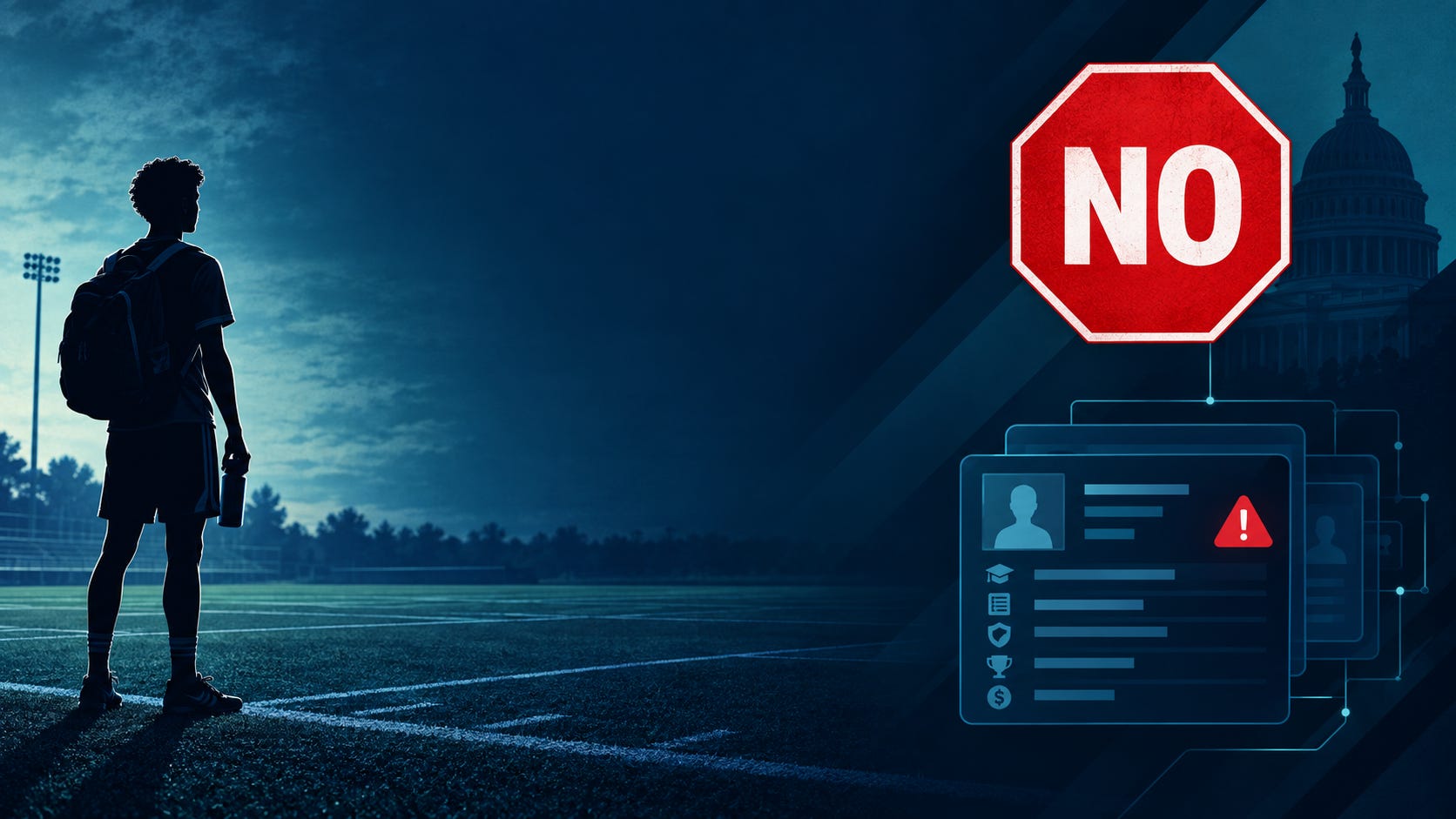
As the parent of a future college athlete, I am saying ‘NO’ to the Protect College Sports Act.
And shame on the NCAA for using a database of young people it encourages families to enter as early as sixth grade to lobby those children and their parents for legislation that primarily expands the NCAA’s own power.
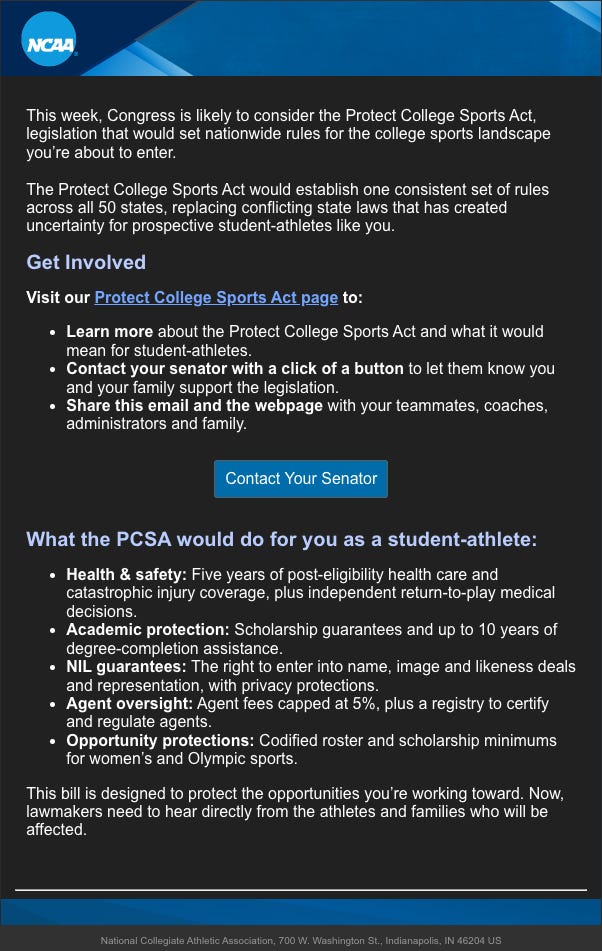
An email sent to the NCAA Eligibility Center database
the only way I know is my 17-year-old son forwarded it to me asking if he should act on it
is framed as a friendly invitation to “get involved.” It tells students and families that Congress is considering a bill that would “protect the opportunities you’re working toward,” and then directs them to contact their senators in support of the bill.
But that message carries a different weight when it comes from the organization that controls a crucial gate on the path to NCAA participation.
The NCAA Eligibility Center says that students may register at any age and specifically encourages sixth graders considering college sports to create a Profile Page. It also makes clear that students who want to compete at an NCAA school must register with the Eligibility Center. That gives the NCAA a direct line to families long before a child is old enough to understand federal legislation, antitrust law, labor rights, NIL policy, or the tradeoffs embedded in a major college-sports bill.
That should concern every parent and school administrator.
A Captive Audience Is Not Advocacy
The problem is not that the NCAA has an opinion. Every organization has the right to advocate for its preferred public policy.
The problem is the relationship between the NCAA and the people receiving the message.
A sixth grader or any child under the age of 18 exploring college athletics is not able to vote, let alone a policy insider. Most parents are not policy insiders and take what the NCAA says as fact, and will oblige because the NCAA is the gatekeeper to their student-athlete’s future. We are trying to help our children make sound decisions about education, health, academic eligibility, athletic development, recruiting, costs, and future opportunities. We reasonably assume that an eligibility registration system exists to protect and help a child navigate the path to college sports, not to turn our family into a lobbying target for the organization that may someday regulate our child.
The NCAA email asks families to:
Learn about the Act through the NCAA’s own advocacy page.
Contact their senator “with a click of a button.”
Share the message with teammates, coaches, administrators, and family.
Support a bill presented as necessary to protect health care, scholarships, NIL rights, agent regulation, and women’s and Olympic sports.
Those are legitimate subjects for public debate. But presenting the NCAA’s preferred legislation as a straightforward, child-centered protection package leaves out the central question:
Who gains new authority, and who loses leverage?
The NCAA’s own advocacy materials describe a proposal that would preempt certain state laws, establish nationwide rules on eligibility and transfers, and provide targeted antitrust protection for NCAA enforcement of rules governing eligibility, transfers, academic requirements, and revenue sharing. That is not a minor technical adjustment to the current system. It is a major shift in the legal balance among athletes, schools, conferences, and the NCAA.
Parents should not be encouraged to click a button before they have been given an honest explanation of what that button supports, and what it actually means for their child and family.
College Sports Does Not Need Immunity
College sports has real problems.
The transfer portal can be chaotic.
NIL arrangements need transparency and consumer protections.
Athletes deserve health protections, meaningful academic support, safeguards against predatory agents, fair access to representation, and stronger enforcement against bad actors.
But none of that requires Congress to give the NCAA and its member institutions broad protection from antitrust scrutiny.
The NCAA and college leaders have had decades to build a fairer and more durable system. READ THAT AGAIN! AND AGAIN!
They could have created transparent NIL rules, meaningful health care protections, enforceable scholarship commitments, athlete representation, and sensible transfer standards long before Congress became their preferred escape hatch.
They could have treated athletes as essential partners in a multibillion-dollar enterprise rather than people to be regulated from above.
Instead, the Protect College Sports Act asks Congress to create nationwide rules while providing the NCAA and its member institutions special legal protection to enforce them. The Senate’s description of the legislation includes NIL requirements and a limited antitrust exemption related to certain joint media-rights arrangements. The broader NCAA-backed policy agenda also seeks protection for institutional authority over athlete compensation, transfers, and eligibility.
That should make every parent, administrator, coach, guidance counselor, and fan stop and ask what is actually happening.
When an organization repeatedly loses in court, or faces credible legal challenges to restrictive rules, the answer should not automatically be to change the law so that the organization can no longer be challenged. The answer should be to ask whether the rules are fair in the first place.
Here is what no one is talking about:
College sports is not on the verge of disappearing if Congress rejects the NCAA’s preferred legislation.
Ratings are strong.
NIL has helped some elite athletes remain in school longer.
Women’s sports are growing.
Niche sports are finding audiences.
The commercial center of college athletics is not as fragile as the NCAA’s lobbying rhetoric suggests.
The question is not whether college sports will survive without special protection. It will.
The question is whether Congress will use this moment to build a system that gives athletes meaningful rights, or simply reinforce the authority of institutions that have governed without adequate athlete voice or accountability.
The Olympic Warning
There is one important point where the claim that college sports will be fine requires more caution: the U.S. Olympic and Paralympic pipeline may not be fine.
The United States may lead the medal table at the Los Angeles 2028 Olympic Games. That would not prove the underlying system is healthy. Olympic outcomes lag institutional decisions by years. The athletes likely to compete in Los Angeles were developed through college, club, and high-performance systems that existed before the recent acceleration of roster reductions, sport eliminations, and resource concentration.
A strong showing in 2028 could mask, rather than disprove, the erosion already underway.
For decades, college athletics has provided much more than scholarships to athletes in non-commercial sports. Colleges have supplied coaching, facilities, athletic training, medical support, regular high-level competition, teammate depth, academic structure, recruiting networks, and a bridge between youth participation and international performance.
For many Olympic and Paralympic athletes, particularly late bloomers and athletes from middle-income families without access to elite private club systems, a college roster has been the pathway.
When institutions cut teams, reduce roster sizes, eliminate walk-on opportunities, or redirect resources toward football and basketball, they do more than rebalance an athletic department budget. They reduce the developmental capacity on which swimming, track and field, rowing, wrestling, gymnastics, diving, and other Olympic sports have depended.
The immediate loss may be one team or one roster spot. The longer-term loss is a generation of athletes who never receive the coaching, competition, support, or time needed to become elite.
The decline of college-supported Olympic-sport pathways does not show up immediately on a medal stand. It first appears as fewer young athletes continuing beyond high school, fewer developmental opportunities, fewer late bloomers, fewer affordable options outside wealthy regions, and fewer athletes who can take the risk of pursuing international competition. By the time the impact is evident in medal counts, the missing generation of developing athletes will be difficult to replace.
The warning is especially relevant because college programs have historically supplied a central part of the U.S. Olympic talent infrastructure.
The Broken Pipeline: How The Collapse of College Sports Threatens U.S. Olympic Dominance

The NCAA settlement may have dismantled America’s Olympic talent infrastructure
Private markets do not reliably replace that infrastructure. Strong club systems may exist in selected sports and affluent regions, but they are expensive, unevenly distributed, and inaccessible to many families. Where college sports once offered partial scholarships, walk-on opportunities, large training groups, subsidized coaching, and institutional facilities, the replacement can become a pay-to-participate system shaped increasingly by geography and family wealth.
That is why the meaningful question is not whether the United States can win medals in 2028. It can and most likely will, and the hype and results will sweep the long-term problem further under the rug and out of the spotlight.
The question arising from the LA28 success is whether the country will retain the broad, affordable, and geographically diverse development system needed to sustain Olympic and Paralympic success in 2032, 2036, and beyond.
Farrey is right to reject the NCAA’s apocalypse narrative. College sports will not collapse if Congress refuses to give the NCAA the legal protections it wants. But “college sports is doing fine” and “the Olympic development pipeline is secure” are not the same claim.
The commercial center of college athletics may be healthy while the development system for Olympic sports becomes increasingly fragile.
Institutional Protection Is Not Athlete Protection
Families should also consider the broader warning from the U.S. Olympic and Paralympic system.
The Ted Stevens Olympic and Amateur Sports Act created a federally recognized structure intended to support American Olympic and Paralympic sport. But formal institutional status, nonprofit governance, patriotic language, and athlete-centered messaging have not guaranteed that athletes can earn a sustainable living from their sport or that they have meaningful power over the institutions governing them.
A recent account of a U.S. bobsled athlete illustrates the economic reality. Competing at a high level in the sport required him to maintain a full-time engineering job and rent out his home while competing internationally. Even a place on the top USA Bobsled team could provide no more than approximately $1,200 per month.
That is not merely a story about one athlete’s resourcefulness. It reflects a structural reality across much of Olympic sport.
Athletes in many non-commercial sports sustain their careers through outside employment, flexible employers, family resources, a spouse’s income, personal assets, fundraising, camps, coaching, appearances, and occasional sponsorships. They are expected to train and compete at an international level while also assembling the personal financial infrastructure needed to remain in the system.
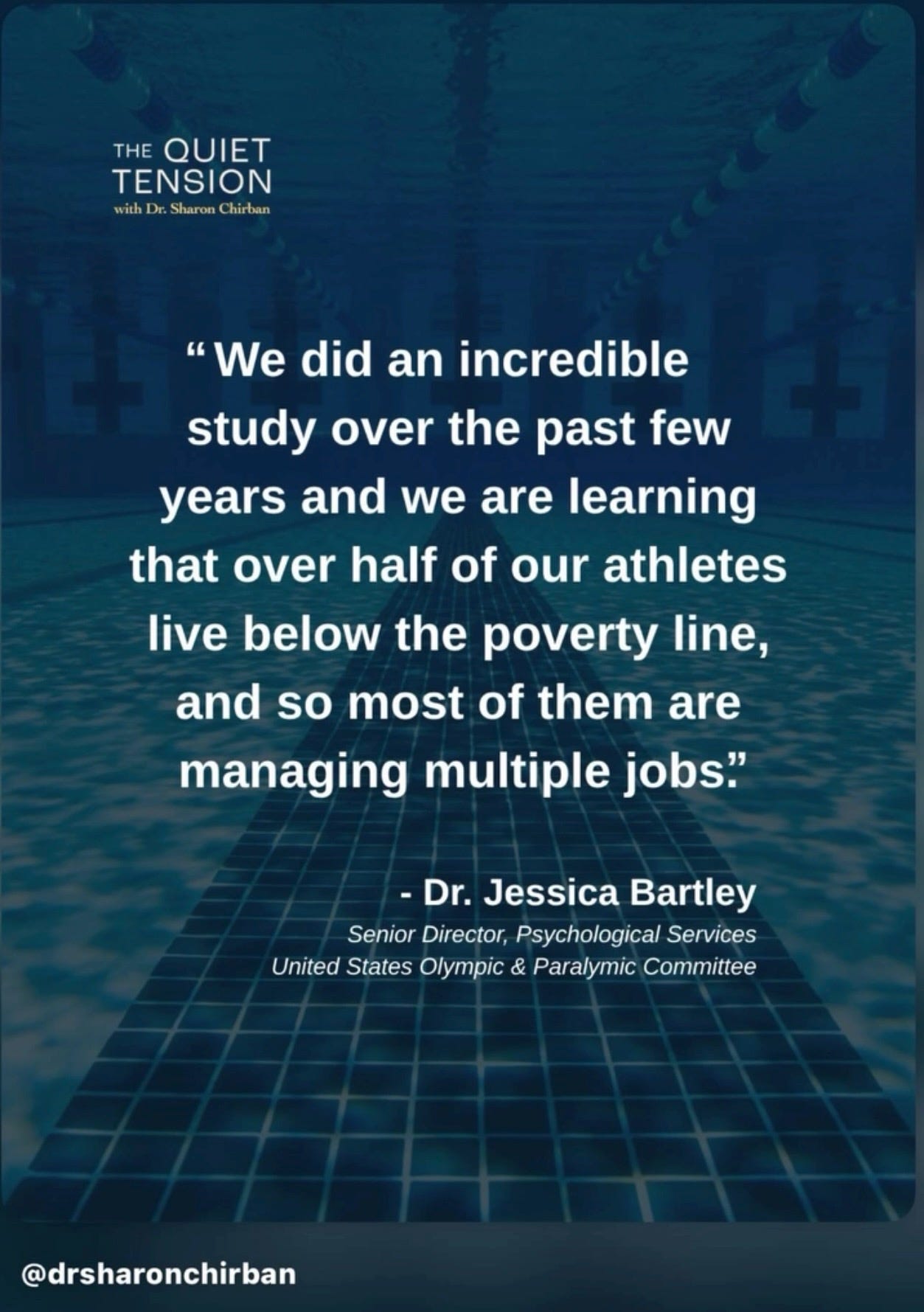
Take away the outside job, flexible employer, family support, rental income, personal assets, and side work, and the picture becomes clearer. Sport-derived income alone would leave most Olympic-pathway athletes below a meaningful threshold for self-sufficiency. For many, it would leave them below the federal poverty line.
The athlete may wear a national-team uniform, but often still personally finances the opportunity to represent the country.
That is the lesson Congress should take from the Olympic model. Institutional legal protection does not automatically produce athlete economic security. Nonprofit status does not equal accountability. A national governing structure does not guarantee meaningful athlete voice. A system can invoke education, national pride, health, and opportunity while still relying on athletes’ financial precarity, private resources, and limited bargaining power.
Congress should not repeat that mistake in college sports.
The answer is not to give the NCAA broad new legal insulation and hope its institutions preserve Olympic opportunities voluntarily. Nor is the answer to pretend that college sports has no responsibility for the youth and Olympic ecosystems from which it draws talent.
If Congress creates a federal framework, that framework should require real athlete rights, independent oversight, financial transparency, meaningful governance power, and measurable commitments to preserve participation pathways.
Stability Cannot Mean Silencing Athletes
Supporters call the Protect College Sports Act a path to “stability.” The NCAA says that the proposal would replace a patchwork of state laws, preserve a five-year eligibility framework, allow reasonable transfer limits, strengthen enforcement, and codify athlete protections. Those protections include post-eligibility health care, degree-completion support, scholarship guarantees, NIL privacy, agent-fee limits, and representation on governance boards.
Some of those provisions are constructive. They deserve a place in any eventual national solution.
But parents should not be forced to choose between chaos and NCAA control.
A better system would pair national standards with genuine athlete power:
Independent health and safety protections that athletic departments cannot weaken.
Guaranteed multiyear scholarships and meaningful degree-completion assistance.
Strong oversight of agents, collectives, and NIL intermediaries.
Transparent NIL agreements and practical protections against exploitation.
Meaningful athlete representation with actual voting authority, not simply a seat at an advisory table.
A lawful process for athletes to organize and bargain collectively where appropriate.
Rules created with athletes, rather than simply imposed on them.
Protections for non-commercial sports and Olympic development pathways that cannot be discarded solely because they are not immediately profitable.
Professional leagues do not solve every problem. But they demonstrate an important principle: when compensation, mobility, eligibility, commercial rights, and working conditions are at stake, the people whose labor creates the product should have a meaningful role in negotiating the rules.
It is also important to be accurate about the legal history. The Northwestern football unionization effort did not result in an NLRB ruling that college athletes are employees. In 2015, the National Labor Relations Board declined to assert jurisdiction rather than deciding the employee-status question on the merits.
Families deserve an honest conversation about athlete rights. They do not need rhetoric that treats employment status and collective bargaining as settled questions. Nor do they need legal uncertainty used as a reason to give institutions more control while athletes remain outside the room.
The broader point is clear: Congress should not use a college-sports bill to reduce athletes’ legal and economic leverage while granting more protection to the institutions that already dominate the system.
Youth Sports Cannot Be Ignored
The most consequential omission in this debate is what it says, or deliberately omits, about youth and school sports.
College athletics does not exist in isolation. Its incentives flow downward. Families experience them through year-round travel schedules, private training bills, club dues, showcase fees, recruiting pressure, early specialization, injury risks, and the growing assumption that every 11- or 12-year-old needs to begin building a college-sports résumé.
Youth and school sports touch the lives of roughly 30 million young people. Yet only a small percentage of high school athletes will compete in college. The college recruiting ecosystem can nevertheless make families behave as if every child’s future depends on entering the race early and never stepping out.
Parents are increasingly dissatisfied with the costs, pressure, specialization, and uneven safety protections built into this model. Yet Congress is considering a proposal that would entrench important incentives within that system without a serious public examination of its downstream effects or a requirement that college sports help improve the broader ecosystem.
Private Equity Didn’t Break Youth Sports

If you have watched the local news or scrolled the headlines and social feeds recently, you might think private equity is destroying youth sports and turning children’s games into a Wall Street product. That gets people fired up and focused on private equity as the enemy, but I believe it misses the real story:
That is why it is especially troubling that the NCAA is sending a political call to action into a pipeline that reaches children as young as sixth grade.
A young athlete’s contact information should not be treated as a political asset. A family’s decision to understand eligibility should not become implied consent to participate in institutional lobbying.
Before Congress creates a new federal college-sports framework, it should examine:
Whether the framework will make youth sports more accessible or more expensive.
Whether it will reduce or intensify pressure for early specialization.
Whether it will improve health, safety, and long-term athlete development.
Whether it will reduce the advantage held by families able to afford elite club systems.
Whether major college sports institutions will be required to invest in community, school, and youth sports access.
Whether young athletes and parents will have a meaningful voice before national rules are adopted.
Whether Olympic and Paralympic development will remain available to talented athletes who do not come from affluent families or elite private pipelines.
The Senate’s September 15 cloture vote, 74 to 24, to begin consideration of the Protect College Sports Act makes this debate immediate.
That urgency is exactly why families should not be rushed into clicking a button in an NCAA advocacy email.
What Congress Should Do
I am not asking Congress to ignore college sports. I am asking Congress to do its job more thoroughly.
Before granting special antitrust protection to the NCAA and its member institutions, lawmakers should conduct a full public examination of how this legislation would affect athletes, families, youth sports, women’s sports, Olympic and Paralympic pathways, lower-resource schools, and communities already priced out of the escalating youth-sports system.
Congress should insist on a framework that:
Protects athletes’ independent legal rights rather than insulating institutions from accountability behind nonprofit status.
Requires authentic athlete participation in decision-making, including voting power where policy directly affects athletes.
Separates health and safety oversight from athletic departments’ financial interests.
Protects education without using the term “student-athlete” to deny economic reality.
Establishes meaningful safeguards for youth-sports access, affordability, safety, and inclusion.
Requires college sports to contribute to, rather than merely extract from, the wider U.S. sport ecosystem.
Protects Olympic and Paralympic development pathways by preserving participation opportunities, roster access, scholarships, and institutional capacity in non-commercial sports.
Makes any federal preemption or antitrust protection conditional on enforceable public-interest obligations, not voluntary promises.

My child’s future, and any young person’s future in sports, should not be used to sell Congress a bill that gives the NCAA more control, more insulation, and more authority without demanding sufficient accountability in return.
So, to the NCAA:
stop treating young people in your Eligibility Center database as a ready-made lobbying list.
And to Congress:
do not confuse protecting college sports with protecting the institution that has long governed it.
Protect the athletes. Protect the families. Protect the children entering this system years before they can vote, and long before they can understand the political campaign being conducted in their name.