

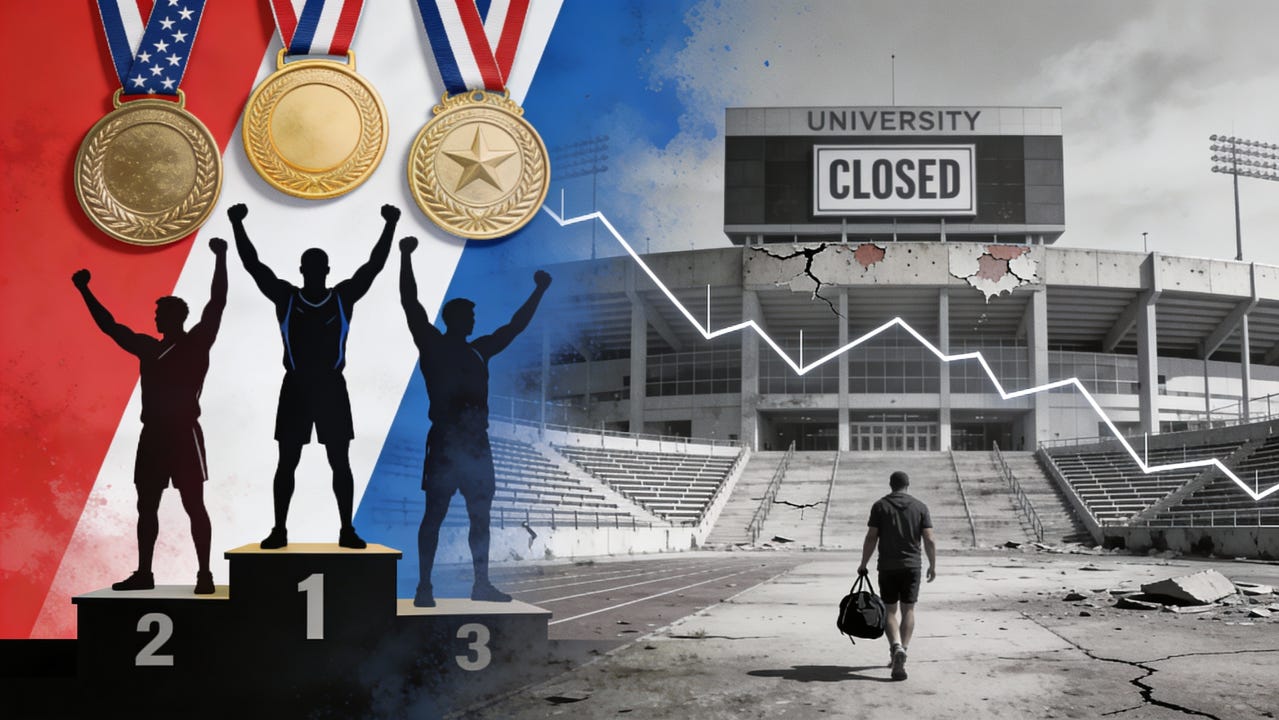
The NCAA settlement may have dismantled America’s Olympic talent infrastructure
The end of a dynasty didn’t start with a loss on the podium. It started with a 10-minute Zoom call.
In June 2025, the Track & Field athletes at Washington State University, a program that had produced four Olympians for the Paris Games just a year prior, were summoned to a virtual meeting. With two hours’ notice and their coaches barred from attending, they were told half of their team (the “Field” events) was effectively dissolved. Jumpers and throwers were out; distance runners were in. The message was brutal in its brevity: You are no longer efficient.
This scene has played out across the country since the House v. NCAA settlement was finalized in mid-2025. From the dissolution of Grand Canyon University’s men’s volleyball team (fresh off a Final Four appearance) to the gutting of swimming rosters at Cal Poly, a quiet purge is underway.
The mechanism is simple math. To remain competitive in football and basketball, the only sports that generate profit, schools must maximize that $20.5 million to pay their stars. Every dollar spent on a swimmer, a gymnast, or a wrestler is now viewed not as an investment in student development, but as "dead money" that could have gone to a starting quarterback.On the surface, Team USA looks as dominant as ever. But beneath the medal counts, the foundation of American athletic supremacy is rotting. For 70 years, the United States maintained a unique advantage over the rest of the world: a decentralized, $15 billion talent-development machine known as the NCAA. Seventy-five percent of U.S. Olympians have historically come through this college pipeline.
That system is now dismantling itself in real time, threatening to reduce the U.S. to a second-tier Olympic power within the next Olympic cycle.
The Irony at the Heart of Reform
The irony is sharp: just as the NCAA surrendered to player compensation through the House v. NCAA settlement, the very system that built America’s Olympic empire is collapsing under the weight of that victory.
The culprit isn’t a lack of talent; it is a perverse financial incentive structure that has turned the American university into the enemy of the American Olympian.
The Mechanism of Collapse: The $20.5 Million Trap
In June 2025, the NCAA settlement created an irresistible financial logic: the $20.5 million annual revenue-sharing cap (potentially growing to $26 million) incentivizes schools to fund football and basketball at near-professional levels and cut everything else.
Since the settlement, more than 32 Division I Olympic sports have been cut or consolidated.
The mechanism is simple math. To remain competitive in football and basketball, the only sports that generate profit, schools must maximize that $20.5 million to pay their stars. Every dollar spent on a swimmer, a gymnast, or a wrestler is now viewed not as an investment in student development, but as “dead money” that could have gone to a starting quarterback.
Worse, the settlement replaced scholarship limits with roster limits. In an effort to control costs, the new rules capped football rosters at 105 players but slashed the “deep benches” that Olympic sports rely on. Swimming and track programs, which historically carried 40–50 developmental athletes (many non-scholarship walk-ons), are being forced to cut their numbers by nearly half.
The result? The “developmental athlete,” the late bloomer who walks on as a freshman and wins Gold as a senior, has been regulated out of existence.
The Perverse Incentive Structure
The settlement allowed two critical shifts:
Schools gained the flexibility to move scholarships between sports without maintaining minimum roster counts
The revenue cap made the math brutally zero-sum, effectively giving athletic directors permission to justify cuts they had been considering since 2022
A swimming program that once had 14 scholarships spread across 80+ athletes on the roster, coaches could build depth with partial scholarships and walk-ons, can now shift those same 14 scholarships to cover fewer total athletes, while cutting diving, pole vault, and distance running outright.
The tragedy: the settlement’s architects intended to increase funding for Olympic sports through expanded rosters. Schools used that flexibility to reallocate funds to commercial sports instead. When a school previously committed $4 million annually to non-revenue Olympic sports, they can now argue, “We’re maintaining our scholarship commitment” while cutting the actual program itself, retaining only a skeleton crew of 8-12 scholarship athletes on what used to be a 60-athlete program.
Walk-ons disappeared. Partial scholarships evaporated. The developmental infrastructure within each program collapsed. One swimming program went from 35 competitive swimmers to 14. One track program eliminated 40% of its events.
This wasn’t malice; it was the rational response to financial incentives being suddenly reallocated.
The perverse outcome: the settlement that was supposed to liberate student-athletes by allowing them to be compensated instead liberated athletic administrators to justify cuts they’d been considering for years.
The Shrinking Pipeline Triggered the Boom That Now Destroys It
Here’s the cascading trap that few are recognizing: the shrinking of college roster opportunities directly triggered the youth sports explosion, which is now accelerating the destruction of the pipeline on which Olympic sports depend.
The Roster Shortage Paradox and the Gentrification of Gold
This collegiate contraction is colliding with a massive boom in youth participation, creating a “Roster Shortage Paradox.”
According to data from Brent Richard at IMG Academy, and the #AddMoreAthletes campaign, youth sports participation has increased by nearly 10x in recent decades, with over 8 million high school athletes now competing for a shrinking pool of college spots. In 2025, fewer than 500,000 roster spots existed across the NCAA. Today, that number is dropping fast.
Extended eligibility, the transfer portal, and now the revenue-sharing cap have all combined to reduce available slots. The result? A generation of families is now reclassifying 8th graders, repeating years, and investing $10,000–$30,000 annually in club sports and elite training just to compete for a smaller pool of college opportunities that may not even exist by the time their children graduate high school.
The Wealth Stratification Crisis
But here’s the hidden tragedy underneath: this youth sports boom is now stratified by wealth in ways college athletics never were.
As college programs vanish, they are being replaced by a privatized “club” model. This is the gentrification of the Olympic pipeline.
The Old Way: A working-class kid from Ohio gets a partial scholarship to swim at a state school, receives elite coaching, and makes the National Team.
The New Way: That state school program no longer exists. To reach the elite level, that same kid’s parents must now afford $25,000 a year for private club fees, travel, and coaching.
When a college program had 60 swimmers on scholarship and walk-ons (even with partial support), there was a pathway for working-class and middle-class kids. The club system that’s now replacing college development? It’s expensive, geographically concentrated, and accessible primarily to families with resources. We are rapidly moving toward a two-tiered Olympic system: one for the wealthy who can buy their way around the college gap, and one for everyone else who will simply quit at age 18.
The perverse irony: the same NCAA changes that created #AddMoreAthletes and fewer college roster spots are now creating a two-tiered youth sports system in which elite club development is replacing college development as the pathway to college.
And that’s catastrophic for non-revenue Olympic sports specifically.
The Collapse of Alternative Development Pathways
Olympic sports historically had two development pathways:
Elite club systems (expensive, selective, concentrated in wealthy areas)
College athletic departments (subsidized, broad-based, accessible across socioeconomic lines)
When colleges reduced or eliminated non-revenue sports, there was no backup. Rowing, diving, gymnastics, modern pentathlon, and wrestling had almost no elite club infrastructure. They were dependent on college programs. Now they’re disappearing, because families can’t afford the club option, and colleges are cutting the scholarship option.
Meanwhile, in the commercial sports such as basketball, soccer, and baseball, the elite club system expanded because those sports have revenue potential and donor interest. But for the Olympic sports that don’t generate attendance or broadcast revenue? The market is failing. Private equity isn’t rushing to fund diving clubs or rowing centers. These sports are being orphaned just as the youth pipeline is most in need of them.
The Two-Tiered System Emerging
This isn’t about fairness to student-athletes. It’s about infrastructure.
There is no viable backup pipeline for non-commercial Olympic sports.
Swimming: Elite club systems exist, but are expensive and geographically concentrated
Track & Field: Scattered club options with limited coverage
Rowing, Diving, Gymnastics: These depend almost entirely on college programs, which are now disappearing
Remove college and you remove the entire developmental infrastructure for middle-class kids. Elite development migrates to well-funded club environments and private institutions. Working-class kids lose access.
Meanwhile, NIL (Name, Image, Likeness) and pay-to-play dynamics are trickling down into youth sports. Private equity is flooding youth athletic development. The pipeline of talented athletes “that just come from backyards”? Disappearing.
The #AddMoreAthletes playbook seeks to address this from the campus side by encouraging universities to add more roster spots, recognize that youth demand is real, and create mutually beneficial solutions. That’s necessary and smart. But without parallel action to preserve college-based Olympic sports and create alternative infrastructure for non-revenue development, that playbook alone can’t prevent the downstream collapse.
The International Athlete Wild Card
There is one more uncomfortable layer to this stratification: the quiet surge of international athletes into U.S. college sports.
Nearly a quarter of NCAA Division I rosters in certain Olympic sports now include a substantial concentration of international athletes, and in some programs, they constitute a clear majority of starters. In sports such as soccer, tennis, golf, swimming, and track and field, it is no longer unusual to see lineups in which more than half of the contributors were developed abroad before ever setting foot on an American campus.
On paper, this appears to be globalization and healthy competition. In practice, within the current financial and roster-cap environment, it serves as another accelerant of the collapse of the domestic pipeline.
Coaches operating under hard roster limits and a $20.5 million revenue-sharing cap are rewarded for finding athletes who are as close to “elite-ready” as possible on day one. International recruits often arrive out of robust club or national systems, may require less multi-year development, and are frequently more willing to accept partial scholarships. From a win-now, cost-per-point-of-performance perspective, they are rational choices.
The problem is what this does to the American talent pipeline.
Every roster spot filled by an international athlete is one fewer opportunity for an American developmental athlete, a late bloomer, a walk-on, or a student from a public high school without club access to enter the system. For working-class and middle-class American kids, the squeeze is now threefold: fewer teams, smaller rosters, and stiffer competition from international athletes for the remaining slots.
Worse, international recruitment helps mask the damage in the short term. When naturalized or foreign-born athletes score points at the NCAA Championships or even win medals for Team USA, the scoreboard suggests the system is healthy. The medal table doesn’t indicate where those athletes were developed; it simply shows for whom they compete.
That creates a dangerous illusion.
By 2028 and even 2032, America may still look competitive in several Olympic sports because it is effectively importing finished products from overseas systems while its own development infrastructure withers. Only when this imported cohort ages out, and the missing generation of domestic athletes fails to emerge behind them, will the depth crisis fully reveal itself.
In other words, international recruiting does not cause the collapse of the American Olympic pipeline. But under the current incentive structure, it accelerates the displacement of domestic athletes and delays the political reckoning by keeping the medal count deceptively high for a little while longer.
The USOPC’s Impossible Position
The United States Olympic & Paralympic Committee (USOPC) faces a cascading crisis that it fundamentally cannot solve.
Under the Ted Stevens Act (1978), the USOPC manages elite pathways through National Governing Bodies. However, there is a critical gap: the USOPC has no direct control over college sports and cannot compel schools to fund non-revenue sports.
For decades, this didn’t matter; colleges chose to fund them. Now that choice is evaporating.
The USOPC’s own 2024 “Passing the Torch Commission” essentially admitted defeat. Their recommendation? Create a new federal Office of Sport and Fitness, removing this responsibility from USOPC control. Why give up influence?
Because the USOPC can’t afford to manage what’s breaking.
The Realistic Timeline: The 2028 Mirage and the 2032 Cliff
Why hasn’t the alarm sounded yet? Because the erosion is currently masked by the “lag time” of athletic development.
2026–2028 (The Mirage)
The U.S. will likely dominate the medal count at the Los Angeles 2028 Games. The athletes competing in LA are the final harvest of the old system: veterans such as Katie Ledecky and athletes developed before the 2025 cuts. The public will see Gold and assume the system is healthy.
Deep benches still exist with athletes developed before the settlement. But you’ll see erosion at the margins, fewer developmental athletes reaching elite levels, and narrower talent pools, especially in women’s sports. The youth sports boom masks the underlying pipeline damage for now.
2032 (The Crash)
The bill comes due in Brisbane. The cohort of athletes who should be winning medals in 2032 are the high school seniors currently being turned away by college coaches who have no roster spots left. We are creating a “lost generation” of Olympians.
Real risk becomes visible. The cohort currently in college, those who’ll compete at the 2030 Winter Olympics and 2032 Summer Games, will have faced materially reduced competitive opportunities. Smaller talent pools in rowing, wrestling, diving, and modern pentathlon become apparent. By now, the youth cohort that experienced the “shrinking roster” era will be cycling through college. Many will have aged out or pursued other sports entirely.
Post-2032: Structural Stratification
Without federal intervention, a two-tiered system is expected. Elite, commercialized sports (professional basketball, elite track clubs) versus everyone else. Niche Olympic sports become exclusively elite, accessible only to wealthy kids. The working-class kid who might have been an Olympian through a college scholarship? That pathway closes. The middle-class swimmer whose parents couldn’t afford a $25,000 annual club system? They never make it to college in the first place.
The U.S. risks becoming a “specialist” power, dominant in sports with high commercial value (basketball, tennis) or high concentration of private wealth (equestrian, sailing), but irrelevant in broad-based sports such as rowing, wrestling, and athletics that determine the overall medal count.
The hard truth: When America finishes 27th at the medal count, Congress will suddenly discover the need to rewrite the Ted Stevens Act.
What Actually Needs to Happen: A Blueprint for Survival
We cannot rely on the NCAA to fix a problem it created. The market has spoken, and it does not value non-revenue sports. Saving the American Olympic pipeline requires coordinated action across multiple policy domains:
1. Create a Federal Office of Sport and Fitness
Decouple Olympic development from the USOPC governance structure
Distribute federal grants directly to grassroots and regional programs
Position sports development as a public health initiative (HHS coordination)
Fund youth development independent of Olympic success metrics alone
2. Direct Federal Investment in Non-Revenue Sports
Federal “sport equity grants” to states actively developing Olympic talent
Tax incentives for donor-supported models (Stanford successfully raised $40 million to sustain 11 cut programs)
Sport-specific infrastructure funding for rowing centers, diving facilities, and track programs
3. Weaponize Title IV to Save Title IX
Universities receive billions in federal student aid (Title IV). Congress should condition this funding on the maintenance of broad-based athletic opportunities. If a university wants federal tax dollars, it cannot operate its athletic department solely as a semi-pro football franchise. It must maintain a minimum number of Olympic roster spots proportional to its undergraduate population.
Tie the federal Title IV funding to maintaining Olympic sport sponsorship at 2024 levels
Create a dedicated funding stream for women’s non-revenue sports (most vulnerable to cuts)
Require equity reporting in Olympic sport access and opportunity
4. Reform NCAA Settlement Terms
Require Power 5 schools with $50 million+ revenue to maintain Olympic sports at 2024 roster levels
Create “non-revenue sport floors,” minimum roster and scholarship guarantees by sport
Tie the NCAA antitrust exemption to Olympic sport preservation requirements
5. Create Parallel Development Systems
Federally-funded “Olympic development centers” in regions (not college-dependent)
Tax-advantaged donation structures to endow regional programs
Collaboration between National Governing Bodies and universities, but not dependent on athletic department budgets
6. The “Varsity-Lite” Model
If NCAA roster caps are immovable, universities must adopt the “Varsity-Lite” or JV model proposed by reformers. These programs would provide elite coaching and competition structures, funded through tuition or donor support, and would operate outside the athletic department’s scholarship limits. It allows the pipeline to remain open without counting against the $20.5 million revenue cap.
7. Coordinate with #AddMoreAthletes-Type Campus Solutions
Support universities that adopt the #AddMoreAthletes playbook to increase roster spots
Fund non-revenue sports specifically as part of roster expansion initiatives
The campus-side and federal-side solutions need to work together. Universities require financial incentives and a clear policy framework to add roster spots for Olympic sports. Federal policy needs to ensure there’s infrastructure and funding for those athletes to develop from youth through elite levels.
The Uncomfortable Reality: The Choice
The United States is currently choosing managed decline. We are watching the infrastructure that produced the greatest sporting dynasty in history be sold off for parts.
Most probable scenario over the next 8 years:
U.S. Olympic competitiveness declines modestly but noticeably by the 2030 French Alps Olympics and 2032 Summer Games.
Non-revenue sports stratify dramatically, with resources concentrated at elite institutions while regional programs disappear.
Federal action is slow but inevitable following Team USA’s underperformance in 2030 (or sooner if LA 2028 underdelivers).
A Ted Stevens Act amendment eventually passes, but is severely underfunded in initial appropriations.
The donor-supported model (Stanford’s approach) becomes a de facto solution for wealthy schools only.
Women’s Olympic sports emerge as most vulnerable, disproportionately affected by cuts.
#AddMoreAthletes gains traction at progressive universities, but without Olympic-sport protection, its expansion benefits only commercial sports.
The youth sports explosion continues at an accelerating cost, stratified by wealth, with no viable college pathway for non-revenue sport athletes.
Here’s the core problem: You can’t build a sustainable pipeline on sentiment. You need infrastructure, funding, and institutional commitment. College sports provided all three. Remove that, and private markets won’t fill the gap; they optimize for revenue, not Olympic development for non-commercial sports.
The #AddMoreAthletes playbook is necessary. However, it’s insufficient without parallel action to preserve Olympic sports infrastructure at the campus level and to build federal support systems for non-commercial development.
What’s Known: Critical Facts
Current State:
32+ Division I Olympic sports have been cut since the June 2025 settlement.
Seventy-five percent of U.S. Olympians historically came through college athletics; that pipeline is now severing.
The USOPC has no statutory authority to compel colleges to fund non-revenue sports.
Youth sports participation has increased by 5–10x, whereas college roster opportunities have declined by up to 50% in some sports.
NIL and pay-to-play dynamics are creating a two-tiered system (elite vs. accessible).
Women’s Olympic sports are most vulnerable to cuts.
Non-revenue Olympic sports are losing their primary development infrastructure, with no viable backup.
The Realistic Timeline:
2026–2028: Some erosion, but not yet that visible; still competitive; youth sports expansion masks underlying damage.
2028–2032: Modest decline becomes visible at the Olympics; federal action likely triggered by underperformance.
2032+: Two-tiered system solidifies without major intervention; Olympic sports become elite-exclusive.
The Bottom Line: America will remain competitive in commercial sports. It will not remain competitive in non-revenue Olympic sports without major structural interventions at both the campus level (by expanding opportunities for non-revenue sports as outlined in the #AddMoreAthletes solutions) and the federal level (by funding alternative development infrastructure). That intervention is politically unlikely until after the next significant underperformance at the Olympics.
The “June 2025 Settlement” was supposed to be about fairness. Instead, it has become a foreclosure notice for the American Olympic dream. We know exactly what needs to happen to fix it. The only question is whether we will act now or wait until we finish 27th in the medal count to realize what we have lost?