If you have watched the local news or scrolled the headlines and social feeds recently, you might think private equity is destroying youth sports and turning children’s games into a Wall Street product. That gets people fired up and focused on private equity as the enemy, but I believe it misses the real story:
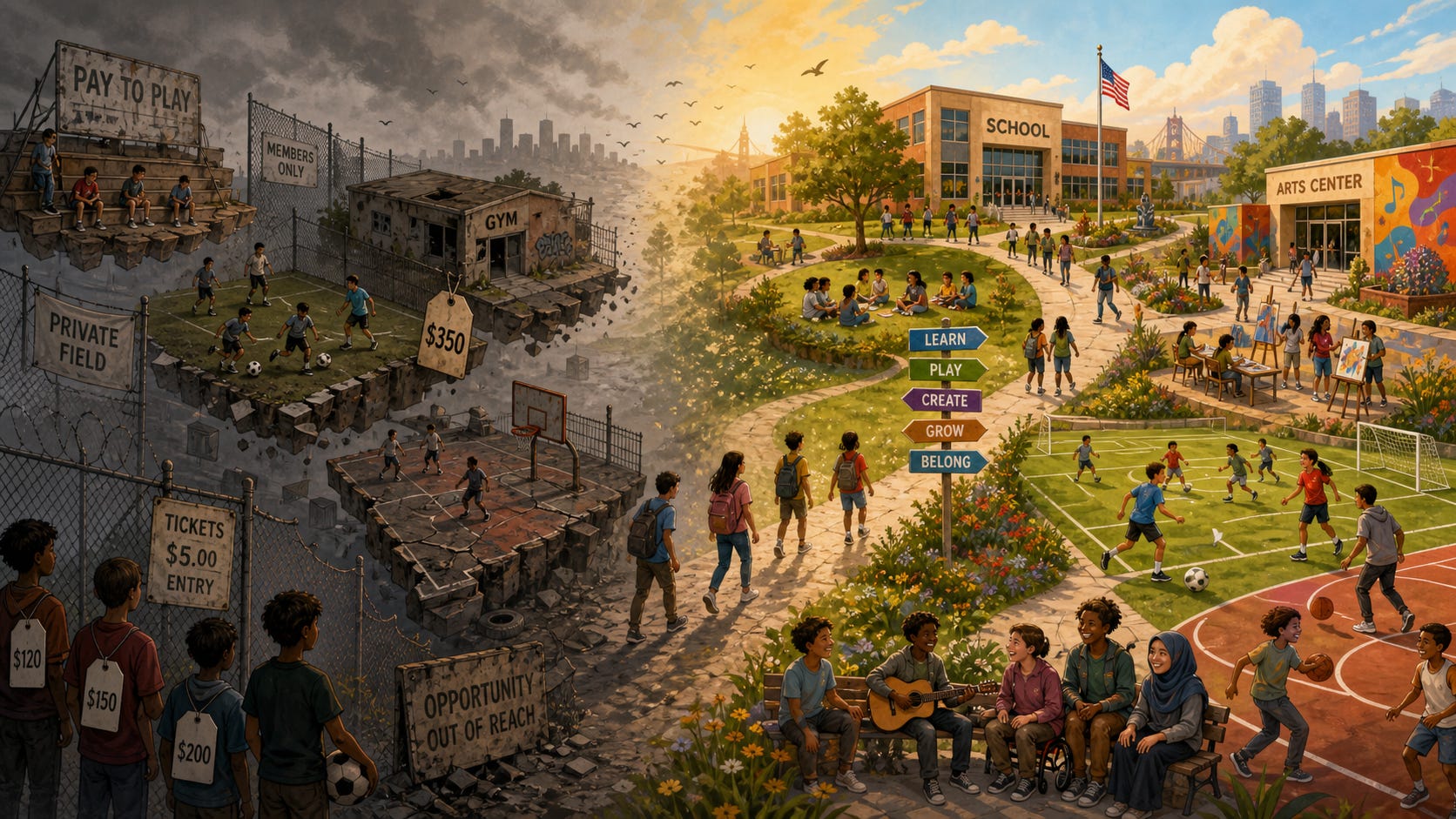
Private capital did not break youth sports. It moved into the vacuum that schools and communities created.
At the root of this shift is a decades-long erosion of school-based physical education, arts, and athletics. As institutions failed to keep pace with the needs of modern families and athlete development, the private sector stepped in to deliver what parents were willing to pay for.
The Long, Slow Decline of School-Based Sports and Arts
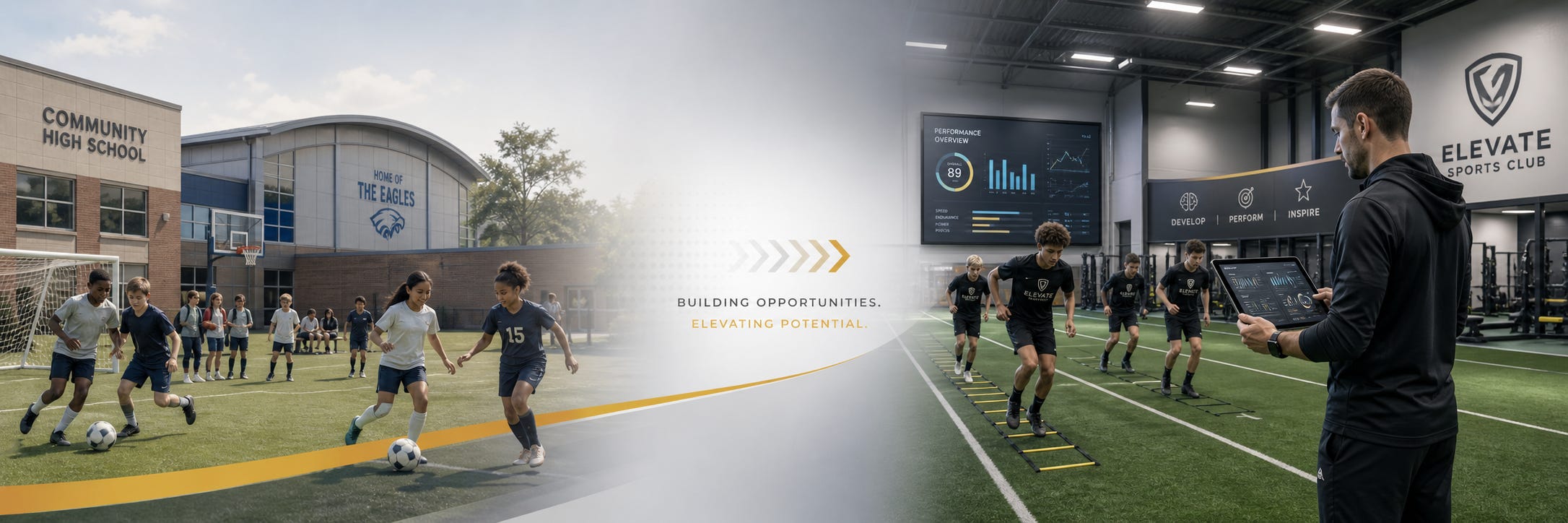
For most of the 20th century, the backbone of youth activity in America was simple: you went to school, you played for your school, and your identity as an athlete or artist was built in that environment. The gym, the chorus room, the playing field, and the auditorium were central to how communities saw themselves.
Over the last few decades, that model has been quietly hollowed out.
Several trends can be attributed to driving the decline:
Academic pressure and a testing culture pushed physical education and the arts aside.
Liability, compliance, and risk management made school sports more administratively complex and costly.
Facilities aged without commensurate reinvestment, especially in resource-constrained districts.
The teacher-coach pipeline weakened as compensation, workload, and expectations diverged.
The result is fewer robust school-based programs, less consistent daily physical education, and more variability in what a student can access depending on their zip code.
Importantly, some public and private schools have resisted this trend. There are districts and programs that still offer exceptional arts and athletics, retain athletes in local systems, and reduce reliance on travel teams through smart scheduling and community alignment. But they are the exception, not the rule.
When Schools Retreat, Demand Doesn’t Just Vanish
Demand for and the reliance on athletics and arts has only increased, and become more relevant on college applications.
To be well-rounded, competitive, and stand out on college applications, students and parents still want:
Safe, structured environments to move, learn, and compete.
Pathways that align with college recruiting, scholarships, and increasingly NIL opportunities.
Development models that look more like professional systems: year-round, specialized, and data-informed.
As school systems pulled back, two things happened simultaneously.
First, local recreation struggled to absorb the gap. Municipal budgets and volunteer-led models often lacked the resources and sophistication to replace what schools had once delivered at scale.
Second, the market spotted an opening. Entrepreneurs, clubs, facility operators, and eventually private equity saw a fragmented, emotionally charged, and underserved space and began to organize it.
This is the critical distinction. Private operators did not invent the desire for youth sports and arts. They monetized the explosive growth and unmet demand.
How Private Equity Rewired the Youth Sports Ecosystem
The youth sports industry in the United States is now commonly described as a multibillion-dollar market, and that scale naturally attracts institutional capital. Private equity has moved aggressively into facilities, event operators, club systems, licensing, and technology platforms tied to participation and exposure.
Headlines focus on the downside:
Families are paying thousands of dollars a year for travel sports.
Consolidation and near-monopoly control over venues, fields, and ice time.
Pricing and policies that push working-class families out of the system.
Those concerns are real and demand attention, but they are symptoms of a deeper structural reality. The center of gravity in youth sports shifted from an institution-based model rooted in schools to a market-based model rooted in the private sector, and financial optimization followed.
When the operating logic changes from serving every student in a district to maximizing return on invested capital, the ecosystem behaves differently.
That is not inherently evil, but it is inherently selective.
The True Power Shift: From Schools to the Private Sector
At the center of the system are youth talent and families, the kids and parents making daily choices about time, money, and identity. Around them, two systems now compete for influence.
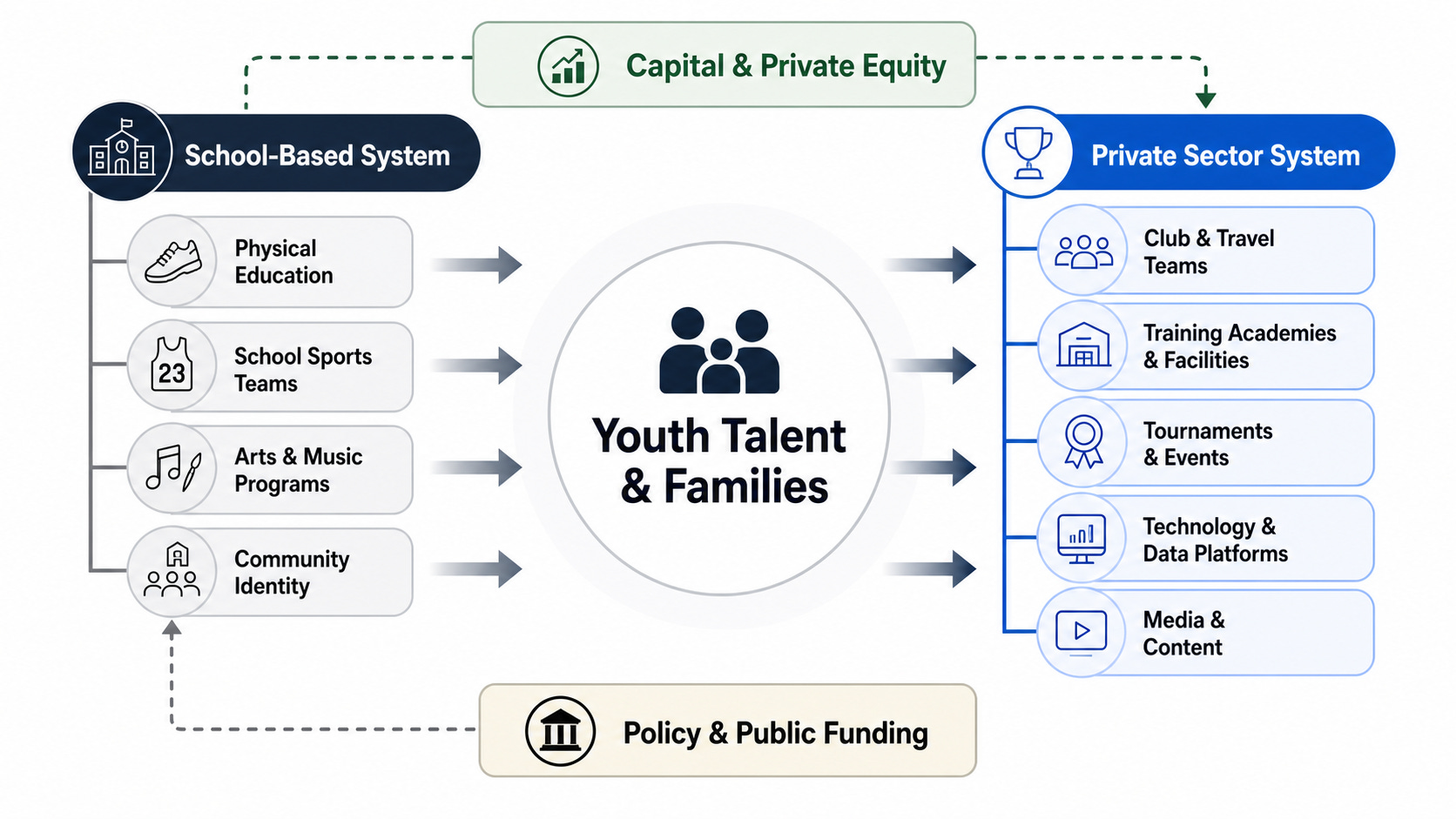
On one side is the school-based system:
Physical education
School sports teams
Arts and music programs
Community identity and hometown allegiance
This system is tied to policy and public funding and historically had the mandate to serve broad populations regardless of income.
On the other side is the private sector system:
Club and travel teams
Training academies and performance centers
Tournaments and showcase events
Technology and data platforms
Media, content, and branding
This system is tied to capital and private equity and optimizes for growth, revenue, and perceived competitive advantage.
Over the last 20 to 30 years, the arrows have shifted. Participation, especially for ambitious or elite-track athletes, now flows heavily toward the private sector, and identity is increasingly built around clubs, circuits, and training brands rather than hometown high schools.
Private equity is not ruining youth sports as much as it is scaling a model that emerged when schools couldn’t keep up.
Why Politicians Target Private Equity Instead of Fixing Schools
This is where the current political conversation starts to break down.
Local and federal politicians are focusing on private equity because it offers a clean villain and a media-friendly narrative. Bills like the Let Kids Play Act make it easy to say that lawmakers are protecting families from financial actors, and local TV coverage reinforces the message that private equity ownership is the direct cause of rising fees.
Across the country, local officials argue that private equity-backed youth leagues are pricing families out, with one report citing league fees rising by 50 percent over five years and some parents facing costs of $2,000 to $3,000 per season. That is a powerful sound bite, but it is not the same as a complete solution.
Fixing the issue at the school level is much harder. It requires school boards, mayors, county leaders, and state officials to make long-term budget choices around PE, facilities, coaching, transportation, and arts programming. It also forces politicians to confront tradeoffs, including taxes, staffing, scheduling, and whether sports and arts are treated as core youth infrastructure rather than optional extras.
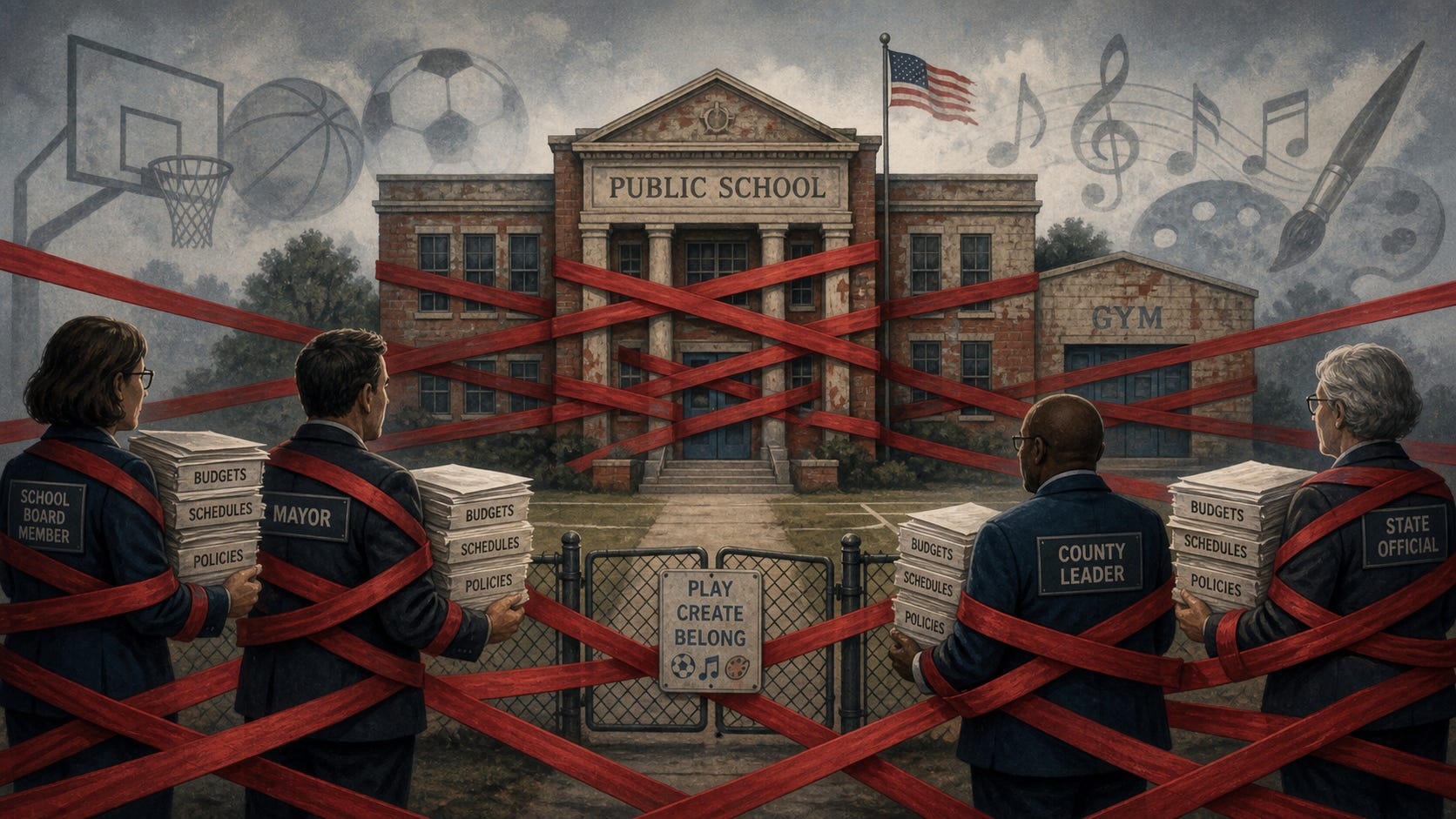
Divestment, by contrast, is politically safer. It sounds like action without requiring a detailed follow-on plan for who will fund, operate, and maintain leagues, facilities, and development pathways if institutional capital exists. That is why so much of this debate feels incomplete: it names a problem in ownership structure without rebuilding the public system that created the opening in the first place.
To be fair, some local leaders are funding access programs, grants, and community sports initiatives. But these efforts are fragmented and generally too small to reverse the broader shift away from school-based sports and arts.
Risks That Must Be Addressed
None of this absolves private equity or the broader private sector from criticism. There are serious risks in the current trajectory.
First is access and equity.
Pay-to-play models disproportionately exclude lower-income athletes and communities, deepening existing inequities in health, opportunity, and representation.
Second is over-scheduling and early specialization.
The race to year-round, sport-specific training can drive burnout, injury, and reduced overall physical literacy.
Third is community erosion.
When top athletes no longer play for their local schools, the shared identity that school sports once provided starts to fracture.
Fourth is data and commercialization.
As technology platforms track performance, recruiting, and monetization, youth development risks becoming hyper-transactional.
These are design problems in the system, not simply individual bad actors. They require intentional correction, not nostalgia for a model that, in many places, no longer exists.
The Emerging Hybrid: Where Solutions Live
The most interesting and hopeful developments are happening in the middle ground between pure school-based models and pure privatization.
Public school districts can partner with private facilities and training providers while keeping athletes anchored in school teams. Community-backed schools can invest in modern facilities and coaching without replicating full pay-to-play pricing. Nonprofit and municipal models can blend performance training with access, subsidizing costs for families that would otherwise be locked out.
This hybrid approach acknowledges reality. The private sector is not going away. Institutional budgets will remain constrained. Families will continue to vote with their wallets and calendars.
Where the Hybrid Model Is Already Emerging
This hybrid model is not theoretical. It is already taking shape in communities that are tired of choosing between underfunded school sports and expensive, fully privatized pathways.
In cities like Boston, municipal leaders are using public funds to support community-based youth sports organizations that operate alongside school teams rather than in competition with them. These nonprofits and clubs often rely on school and city facilities, extend programming beyond the school day, and keep fees in check through grants instead of passing the full cost on to families.
At the county level, counties like Dutchess, Schuyler, and Yates in New York are directing public dollars to local youth sports nonprofits to help cover equipment, coaching, and operating costs. Those organizations, in turn, serve as a bridge between school teams and the private market, giving more kids access to quality play and development without fully embracing a pay-to-play model.
Nationally, playbooks from groups such as the Aspen Institute’s Project Play and the federal National Youth Sports Strategy highlight local models in which schools, parks departments, nonprofits, and private clubs are coordinated rather than siloed. In these systems, schools may provide facilities and a participation mandate, while community and private partners bring coaching expertise, programming, and tournaments under shared expectations for access and affordability.
This is what the emerging middle ground looks like: public institutions still anchoring identity and access, with private and nonprofit partners filling gaps in capacity, expertise, and specialization.
The real question is whether schools, communities, and private operators can be organized into a balanced ecosystem rather than a zero-sum fight. The goal should be to keep identity and access rooted locally while using private innovation and capital intelligently.
A Better Narrative for Youth Sports
The prevailing narrative that private equity is destroying youth sports misdiagnoses the problem and misdirects the anger. It suggests there was once a healthy, equitable, sustainable system that was suddenly disrupted from the outside.
In reality, school-based systems have been eroding for decades. Families have been pushed toward private solutions by necessity as much as ambition. Private equity is now scaling and consolidating what the market had already started to build.
Private equity did not break youth sports. It exposed where the system was already broken and built a business around fixing it for those who could pay.
That framing does not let capital off the hook. It reframes the challenge in a way that invites solutions: reinvest in school-based physical education, arts, and sports as essential infrastructure, design public-private partnerships that protect access and community identity, and use policy to guard against predatory practices without freezing beneficial innovation.
If youth development, health, and opportunity truly matter, the fight is not schools versus private equity. It is fragmented, inequitable systems versus intentional, balanced ecosystems where every child, not just the ones whose parents can pay, has a pathway to move, play, create, and compete.