

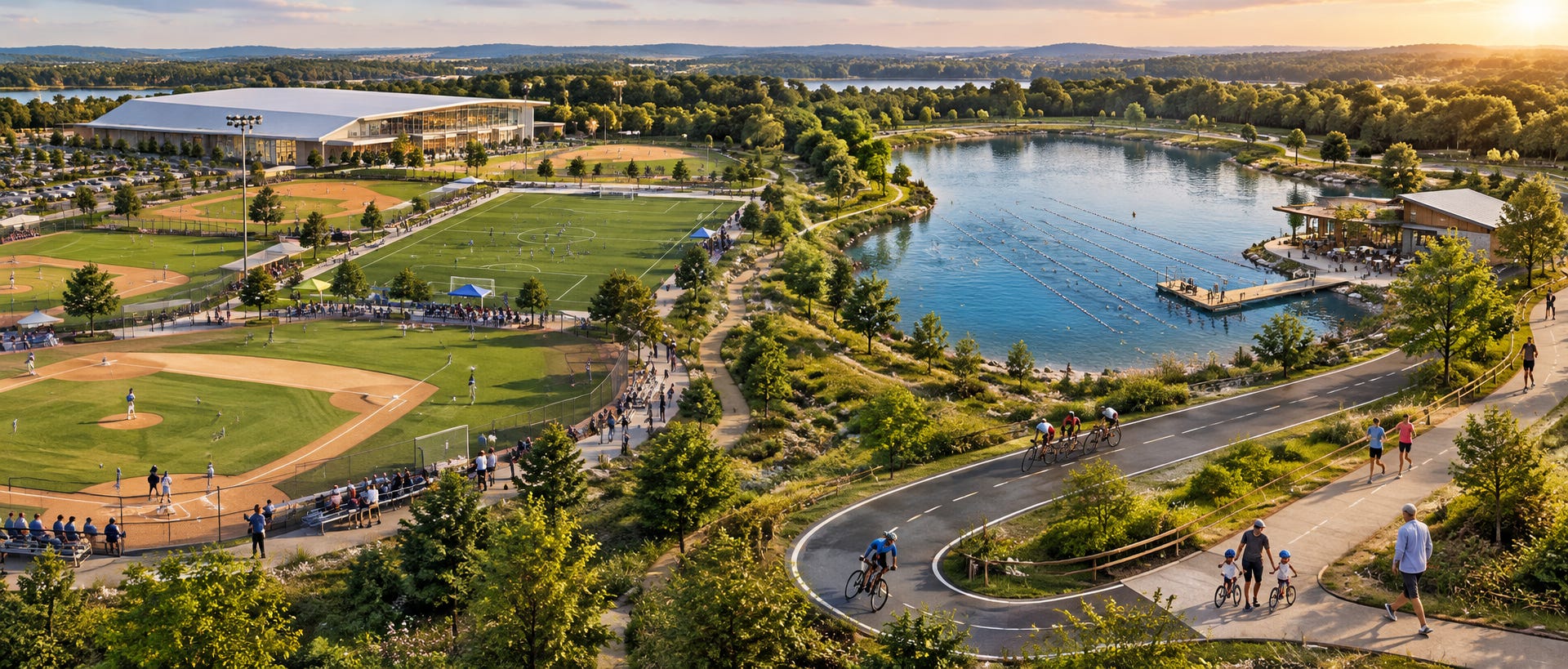
Reading about Capacity Sports Group’s acquisition of LakePoint Sports outside Atlanta took me right to TriHabitat and the investments being made in youth sports facilities, because it reflects an approach to sports infrastructure that I believe has applications well beyond youth tournaments. The transaction brings together established sports businesses, experienced operators, and a permanent location where they can expand programming.
Even though I am cautious with PE and all the money flowing into youth sports, I support that kind of investment. Having spent a career in sports and plenty of time around youth athletics, I want young people to have better facilities, capable coaches, and well-run places to develop. At the same time, I find myself asking why we do not apply comparable attention to the infrastructure that helps people remain active throughout their lives.
If we can bring capital, real estate, operating expertise and programming together around youth competition, why shouldn’t we evaluate the same approach for running, cycling, swimming and everyday fitness? A community could have a place where children learn to ride, parents exercise without negotiating traffic, older adults walk comfortably, and competitive athletes prepare for events. Those customers would not necessarily use the same spaces at the same time, but their needs could inform the design and operation of the same property.
That was the premise behind our TriHabitat article in March. We began with the idea of an endurance sports park, but the larger opportunity is to build a business around participation that continues long after someone’s competitive ambitions change.

LakePoint’s Operating Model Is the Key
Youth Sports Business Report describes the acquired LakePoint property as a 78-acre site with eight baseball fields and three multiuse fields, alongside an agreement to operate the 170,000-square-foot Champions Center. The indoor facility can accommodate 12 basketball courts or 24 volleyball courts. Those assets provide considerable programming capacity, but the more instructive question is how Capacity intends to put them to work.
Prep Baseball has operated tournaments at LakePoint since 2019, giving Capacity an established relationship on which to build a broader multisport calendar. The company is pairing facilities with businesses that already understand how to organize competition, attract participants, and serve their customers. Capacity CEO Ken Kocher also told Sports Business Journal that owning every facility is not the objective. Leases and management agreements can provide another way to bring the company’s brands and operating capabilities to existing or planned complexes, with the goal of operating them “365 [days a year], if possible.”
Endurance sports already understands how to build event calendars, attract participants, and manage competition. What the industry has generally done without is a permanent home, relying instead on roads, parks and other public spaces that operators must effectively “rent” each time they stage an event. The opportunity is to bring that operating experience into venue ownership, connecting a suitable property with a dependable calendar and customers who have specific reasons to use it repeatedly.
Many event operators already have portfolios of events and established event management relationships, yet continue to search for suitable places to host them. Those relationships could provide a foundation for a permanent venue, but producing events and managing a property year-round are different businesses. Ownership brings ongoing responsibilities for maintenance, staffing, access, and programming between events. The challenge is to connect the demand operators already understand with the property management capabilities they may need to develop or secure through a partner. Without both, even a beautiful facility can become an expensive maintenance obligation rather than a sustainable business.
The Customer Base Should Extend Beyond Endurance Athletes
Our original TriHabitat proposition focused on controlled cycling circuits, running trails, managed open-water swimming and permanent facilities for training and events. I still believe in those elements, but I would broaden the emphasis beyond people who identify as endurance athletes. The same property should have value for someone preparing for a competition and someone who simply wants a comfortable place to be active.
Central Park offers a useful example, right in the heart of New York City. Its roughly six-mile drive loop serves runners, walkers, cyclists, and other recreational users within a shared setting. People arrive with different abilities and objectives, yet use the same basic infrastructure. That shared use requires rules, designated lanes, and consideration for differences in speed, but it demonstrates that a place does not need to be defined by a single sport or level of performance.
That is closer to how I would frame TriHabitat today. I am thinking about a parent returning to exercise, a teenager who does not participate in school sports, or an adult who owns a bicycle but is uncomfortable riding in traffic. An older resident looking for a predictable walking route, a restroom, and somewhere to sit afterward should have an equally clear reason to visit.
Their participation should be part of the operating plan from the beginning, not something accommodated only when the competitive calendar leaves room.
PeopleForBikes estimates that 112 million Americans ages three and older rode a bicycle at least once in 2024, while its research also found that 53% of riders worried about being hit by a car. Those findings do not establish demand for a particular facility, but they help explain why occasional participation does not necessarily become a regular habit. Having a bicycle and wanting to ride are different from having a place where someone feels comfortable returning week after week.
A controlled cycling circuit would not replace safer streets or connected public trails. It would provide another choice, and its value would depend on how well that choice serves different users. Much of the property could support shared everyday activity, with designated spaces or scheduled sessions for instruction, organized training, and higher-speed riding. The objective would not be to give every customer a separate facility, but to manage the property so that a beginner feels welcome and an experienced athlete can still train productively. That is how I would connect the original endurance sports concept to the broader opportunity: a permanent place that makes being active easier to begin, more enjoyable to repeat, and practical to sustain.
The Experience Economy Provides a Broader Investment Lens
The experience economy is a useful framework for understanding what a venue like this would actually sell. Joseph Pine and James Gilmore distinguish experiences from goods and services by emphasizing the value of engaging people in something personal and memorable. The customer is not simply purchasing a product or having a task completed; the experience itself is part of what makes the offering valuable.
Applied to TriHabitat, a cycling circuit is a physical asset, and a coached lesson is a service. The experience is a child becoming confident enough to ride independently, a beginner finishing a group session without feeling left behind, or a parent finding an activity to share with a teenager. The infrastructure makes those moments possible, but the operator must organize the programs, staffing, and environment that allow them to happen consistently.
This is why I would be cautious about positioning TriHabitat only as a place to train. Training would be an important use, but the broader proposition is a place where people can make activity part of their lives. One customer might be preparing for a race, while another is looking for a dependable Saturday routine or a group of people who make exercise more enjoyable.
Consider how a family might use the property. One parent could join a coached swim while another takes a beginner cycling session, and their child could participate in a learn-to-ride program. If those activities finish at similar times, the family could meet for breakfast and spend additional time together. That is a proposed customer experience rather than evidence of demand, but it illustrates why the planning process should consider the household’s entire visit instead of treating each activity as an isolated transaction.
The commercial question then becomes more useful. Instead of asking only how many athletes can fit on a course, we can ask whether the property provides an experience that people value enough to repeat and whether we can deliver it at a sustainable cost.
A Repeatable Local Experience May Matter More Than a Destination Event
The experience economy is often associated with trips, concerts and special occasions, but I see considerable potential in experiences that become part of an ordinary week. A walking group that finishes with coffee, a beginner cycling session held at a reliable time, or a recurring club workout could be central to how customers use the property.
That does not mean we should assume that a community will form simply because we provide a gathering space. The operating plan needs to explain how someone moves from a first visit to regular participation. A newcomer should understand where to go, what level of ability is expected, and what opportunities follow an introductory session. Staff should be prepared to welcome people who arrive alone, and the schedule should make it possible for customers to establish routines.
Pine and Gilmore’s work also connects experiences with transformation, or what an experience helps a person become. For TriHabitat, I would interpret that in practical terms rather than as a sweeping health promise. Learning to ride, becoming comfortable in open water, completing a first 5K, or returning to regular exercise are specific objectives around which programs can be organized.
A venue cannot guarantee those outcomes, but it can provide instruction and opportunities to practice. That creates a more meaningful relationship than selling access alone, while giving the operator a customer journey that can be tested and improved.
Build the Calendar and Customer Relationships Before the Campus
None of this makes the youth sports comparison a substitute for a business plan. Tournament facilities can draw on organized teams, established schedules, and travel commitments. An endurance and community fitness park would need to demonstrate its own demand rather than borrow confidence from another category.
Before drawing a master plan, I would want the development team speaking with local running and cycling clubs, coaches, race organizers, schools, masters programs, employers, and community organizations. The questions should go beyond whether they like the concept. We need to understand what they would use, when they would use it, what operational support they would require, and what they would commit to paying.
Potential revenue could come from memberships, day access, coaching, beginner instruction, club sessions, camps, races, and institutional programming. Sponsorship, concessions and compatible rentals might provide additional income. Each of those sources needs evidence behind it, including the cost of delivery and its effect on other customers.
The same process should inform the physical development. A café should be included because it serves a demonstrated customer need and has a credible business case, not because it makes the rendering more attractive. Retail, recovery services, and lodging deserve the same scrutiny. I would rather see a modest first phase supported by committed users than a sprawling campus justified by a large national participation number.
The ownership structure also deserves an open mind. As Capacity’s approach suggests, a lease, management agreement, or partnership with an existing landowner may offer a better starting point than acquiring and developing an entirely new property. The right structure is the one that supports the operating plan without burdening the business with unnecessary capital requirements.
Collegiate Programs/USA Triathlon Are Worth Evaluating as Customers
Collegiate triathlon belongs in this demand assessment because it provides a defined group of potential institutional customers. USA Triathlon lists women’s varsity programs across Divisions I, II, and III, including Arizona State, Queens, TCU, the University of Arizona, and Wingate. Those programs give a developer specific coaches and athletic departments to consult rather than an abstract market to describe.
Existing development programs also provide examples of how structured training can be organized. Playtri’s collegiate summer program combines coached swimming, cycling, running, and strength work with individual training guidance and race support. Its eligibility criteria include NCAA women’s triathletes and collegiate club athletes with draft-legal experience.
A TriHabitat-style venue could ask coaches whether controlled cycling, open-water access, and multiple training disciplines on one property would address problems they face. The business discussion would then need to establish dates, athlete numbers, staffing needs, lodging arrangements, and pricing.
I would not treat a collegiate roster as a reservation or a positive conversation as a contract. These programs could support part of the operating calendar, but only if their requirements and commitments justify that conclusion. The objective is to determine whether serving them creates a viable line of business, not to add university names to a presentation.
TriHabitat could also provide a home for USA Triathlon’s training, development and competition activities, giving the sport a permanent venue that serves more than the next race.
In a letter endorsing the project, USA Triathlon CEO Victoria Brumfield identifies its potential to host National Championships, camps, clinics, and year-round programming for national teams, Olympic and Paralympic hopefuls, collegiate programs, age-group athletes, and youth participants. That vision connects the competitive purpose of the venue with the broader participation opportunity: a place where athletes can pursue ambitious goals while children, beginners and local residents have their own reasons to participate. The endorsement is not a commitment to a specific event calendar, but it provides a meaningful foundation for discussions about programming, facility requirements, and long-term use. For me, the opportunity is to turn that shared vision into an operating relationship that gives the sport a dependable home and the property a purpose throughout the year.
The Safety Argument Must Be Both Human and Operational
In February 2026, Hannah Henry, a former Arizona State triathlete who won individual collegiate national titles in 2017 and 2018, was killed by a driver while cycling in Phoenix. She was 26, and reporting on the crash states that she was riding in a designated bike lane. Her death deserves acknowledgment on its own terms, not treatment as a development talking point.
It also makes the discussion of training environments painfully concrete. Athletic experience and accomplishment do not eliminate a cyclist’s exposure to motor vehicles. A controlled circuit cannot solve road safety, replace safer streets, or relieve drivers of responsibility. Nor should cyclists be expected to leave public roads to protect themselves. What a purpose-built venue can provide is another choice for people who want to learn or train without sharing their riding space with traffic.
That choice carries an operating obligation. Appropriate surfaces, clear rules, and separation between beginners and high-speed training are essential to the cycling experience. Swimming requires qualified supervision, water-quality management and emergency procedures, while trails require maintenance and consideration for different users.
Those costs belong in the budget from the beginning, along with restrooms, shade, accessible routes, useful opening hours and welcoming staff. Calling a property safe or inclusive does not make it so; the design and daily operation must support the claim.
Public Value and Private Return Need Separate Tests
The experiential economy explains how a venue might create value for customers, but it does not establish that the business can capture enough of that value to sustain itself. A memorable opening weekend is not recurring demand, and a crowded festival does not prove that weekday programming will work. Even longer visits need to be understood in relation to spending, staffing, and operating costs.
I would want to know how many first-time visitors return, how many introductory participants move into recurring programs, and what each program costs to deliver. I would also want to understand whether members can use the property when they want to. An event that generates revenue while repeatedly displacing regular customers could weaken the experience on which membership retention depends.
LakePoint itself is a reminder that sports developments are not automatically successful investments. Sports Business Journal reports that its previous owner, Rimrock Capital Management, acquired the property out of bankruptcy in 2018. That history is a reason to underwrite these projects carefully, not a reason to abandon the category.
For TriHabitat, the analysis should separate three questions: Can the venue support its capital requirements and ongoing operations? Can local residents afford and regularly use it? If public resources are involved, what specific public benefits are being purchased?
A facility can create community value without generating an attractive private return, just as it can attract visitors without providing affordable local access. Visitor spending should not be confused with venue revenue, and projected health benefits should not be treated as contracted income. If a municipality contributes land or infrastructure, the agreement should define what residents receive through affordable access, protected community hours, school programming, or other measurable commitments.
The private business and public purpose can reinforce each other, but neither should be used to disguise weaknesses in the other.
We Should Build for a Longer Relationship With the Participant
I do not see this as an argument against youth sports investment or as a choice between competition and recreation. I see an opportunity to think more broadly about how long a sports facility can remain relevant to the same person.
A child could learn to ride at a venue, return with a school group, join a club as a young adult, and eventually bring a family. Later in life, that same property could offer a comfortable place to walk and maintain social connections. The activities would change, but the relationship with the place could continue.
That is what I think we undervalue when we focus primarily on the next tournament or the next level of competition. We understand why a family travels to a destination event. We should apply comparable effort to understanding what would bring that family back to a local participation venue throughout the year.
LakePoint does not prove that TriHabitat will work. It does offer an approach worth adapting: connect sports expertise, a dependable home, and programming that makes productive use of the property. The next step is to test whether that approach can serve a broader population through more stages of life.
I believe we should pursue that question with the same seriousness we bring to other sports investments. That means validating customers, choosing an appropriate site, building a credible operating plan, and protecting community access when public resources are involved. We already invest in places that help people pursue the next level of competition. We should be equally prepared to evaluate places that help them keep participating when there is no next level to pursue.