

The Participant Is the Market
For decades, the dominant logic of sports investment has pointed in one direction: find the spectators, capture their attention, monetize their eyeballs. Stadiums, media rights, franchise equity, the entire financial architecture of professional sports is built on the premise that value lives in the stands and on the screen. Private equity firms are now deploying tens of billions of dollars into that paradigm, with Apollo Global Management alone planning to deploy approximately $6 billion through its newly formed Apollo Sports Capital unit and estimating a $2.5 trillion financing gap across sports.
But there is a parallel economy, quieter, faster-growing, and largely overlooked by institutional capital, where the participant is the revenue source, the sponsor audience, the media subject, and the community anchor all at once. That economy is mass-participation endurance sports. And the purpose-built infrastructure designed to serve it may be the most compelling under-the-radar investment opportunity in all of sport.
A Market Running at Full Speed — Across Every Discipline
Endurance and mass-participation sports are not a single market. They are an ecosystem of overlapping disciplines, each with its own participant base, event calendar, governing body, gear economy, and infrastructure demands, and each growing simultaneously.
Running is the foundation. The 2024 Running USA Top Races Report celebrated what a “historic year” it was, with participation levels at or surpassing 2019 across all distances, with ten races drawing more than 25,000 finishers and the 25 largest events spread across 15 different states. Gen Z is driving the surge: the percentage of marathon finishers aged 20 to 29 rose from 16.4% to 24.5% between 2021 and 2024; in the half marathon, that figure climbed from 17.1% to 26.2% over the same period. The RaceTrends Report from RunSignup confirmed that average race participation grew by 8.2% in 2024, with race churn at its lowest rate since tracking began in 2018. Running is no longer recovering from the pandemic. It is thriving.
Cycling has crossed a threshold no one anticipated. A record 112 million Americans, 35% of the entire population aged three and older, rode a bicycle at least once in 2024, the highest participation rate since PeopleForBikes began tracking the metric in 2014. Youth ridership surged from 49% to 56% in the same measurement period, reversing a years-long decline. Competitive and gran fondo cycling events continue to grow their participant bases, with USA Cycling‘s national series and the UCI Gran Fondo World Championships drawing athletes aged 19 to 87 from dozens of qualifying events throughout the year.
Triathlon is the sport in which all three disciplines converge, and its trajectory is among the strongest in sport. The global triathlon market was valued at $8.7 billion in 2025 and is projected to reach $16.1 billion by 2033 at a compound annual growth rate of 8.5%. USA Triathlon counts more than 302,000 active members, with annual multisport spending per member rising 12% in 2023. Gen Z triathlon participation grew 33% year over year, average registration revenue climbed 36%, and athletes are registering earlier, giving event organizers stronger forward revenue visibility than at any point in the sport’s history.
Obstacle Course Racing has evolved from novelty into a category with institutional scale. Spartan, the global leader in OCR, recorded 1.45 million finishers across 658 races in 25 countries in 2025 alone, across its Spartan, Tough Mudder, Spartan Trail, and DEKA brands. The global OCR market was valued at $2.1 billion in 2024 and is forecast to reach $4.7 billion by 2033, growing at a 9.2% CAGR. OCR’s inclusion in the 2028 Olympic Games within the modern pentathlon will drive additional credibility and media attention to the category.
Open-water swimming continues its quiet but sustained expansion. Once the province of elite long-course specialists and IRONMAN triathletes, the sport has broadened dramatically through masters competitors, age-group triathletes, and standalone event formats. USA Swimming‘s 376,320 registered members represent only competitive club programs; the open-water recreational participant base, fueled by triathlon growth, wellness trends, and post-pandemic demand for outdoor activity, is orders of magnitude larger. The sport is expanding geographically, with new events and governing body investment in standalone open-water formats that draw participants who never intend to compete in a triathlon.
In aggregate, this is not a niche. The global sports market reached approximately $515 billion in 2024, with the participatory sports segment, the largest, accounting for 63%, or roughly $324 billion, of the total market value. The outdoor recreation participation rate in the United States reached 51.9% in 2023, its highest level on record, with 7.7 million Americans trying an outdoor recreation activity for the first time that year. The endurance sports participant, runner, cyclist, triathlete, OCR finisher, and open-water swimmer is not a marginal consumer. They are the mainstream.
The Fundamental Problem: The Street Can No Longer Host the Race
Producing a triathlon, gran fondo, open-water swim, OCR, or road race in 2026 requires threading a needle that grows narrower every year. Organizers must secure bodies of water, long stretches of traffic-free roads, natural terrain for obstacles, and run courses free of vehicles, all of which are increasingly difficult to find as urban and suburban sprawl consumes previously viable locations. Municipal permitting has become a protracted, expensive, and politically sensitive undertaking. Local residents resist race-day disruptions. Law enforcement resources are strained. The cost of venue rental, traffic control, permitting, temporary infrastructure, and equipment logistics compounds annually.
The result is an industry in which demand is growing across every discipline, while supply is contracting. Event organizers face compressed margins. Participants endure degraded experiences on courses designed for cars rather than athletes. Governing bodies struggle to find facilities that meet national championship standards. OCR operators need natural terrain, elevation changes, and water features that simply do not exist in most urban markets. Open-water swim events require access to lakes or oceans, which is increasingly contested by recreational and residential development and environmental restrictions. The race calendar itself is under structural pressure, and every cancelled or degraded event is a lost revenue cycle, a lost participant, and a lost community touchpoint.
The Purpose-Built Solution: From Borrowed Space to Owned Venue
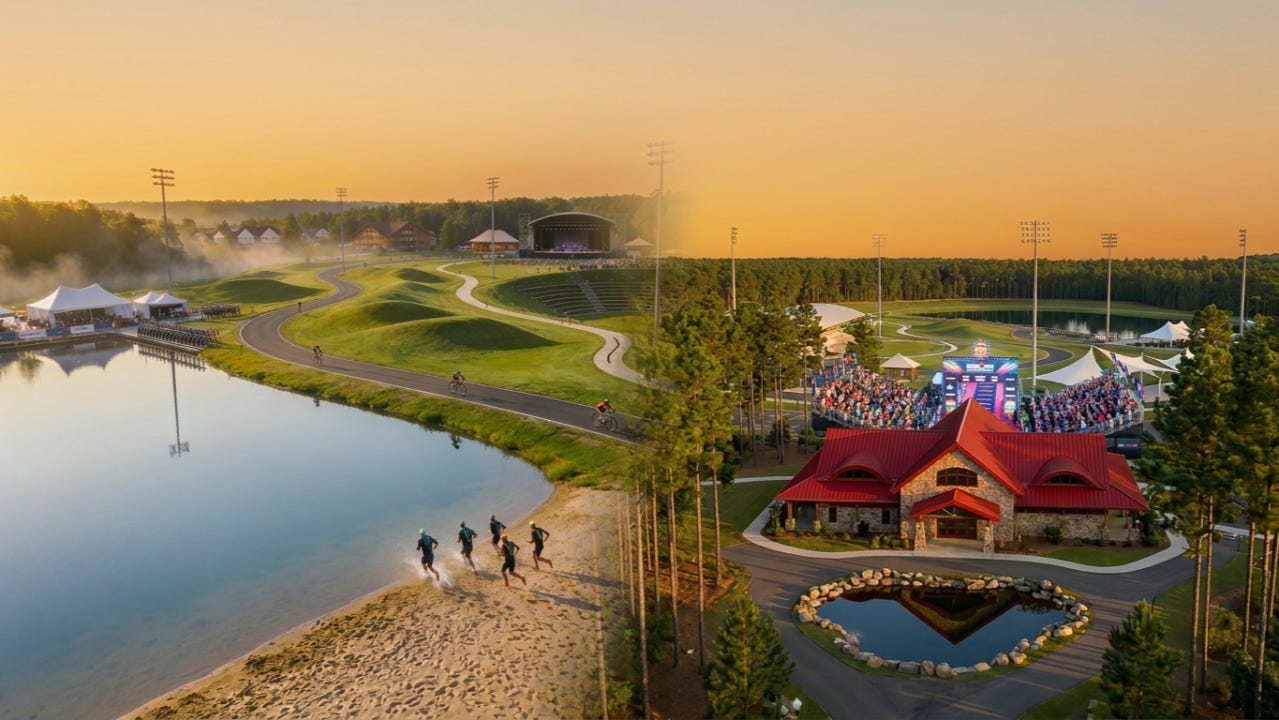
The vision for purpose-built endurance sports parks directly addresses this structural failure. Rather than borrowing public infrastructure never designed for athletic events, the model inverts the logic entirely: build a private, permanent venue designed from the ground up for the specific demands of multi-discipline endurance sport.
That means a custom-engineered lake for open-water swimming and triathlon transitions. A closed-loop cycling circuit that works for gran fondo training, criterium racing, and triathlon bike legs without road closures. Marked trail and run course systems calibrated to race distances. Natural terrain features: hills, berms, water crossings, and walls that serve OCR programming. Permanent aid stations, athlete facilities, spectator infrastructure, and medical staging that bring fans inside the experience rather than corralling them on a sidewalk.
A dedicated venue eliminates permitting costs, reduces law enforcement requirements, and removes the risk of cancellation due to road access issues. Lighted courses enable nighttime events, dramatically expanding the programming calendar. Permanent safety infrastructure: lifeguard stands, course marshals, and medical stations reduce liability and improve outcomes. Production costs per event drop significantly when the facility itself is the asset rather than an assembly of rented equipment, borrowed roads, and temporary structures. And critically, the facility can host events across every endurance discipline from a single footprint: running races, cycling events, triathlons, open-water swims, OCR, duathlons, and aquabike with minimal incremental setup cost per event.
Global Proof Points: The Model Already Works
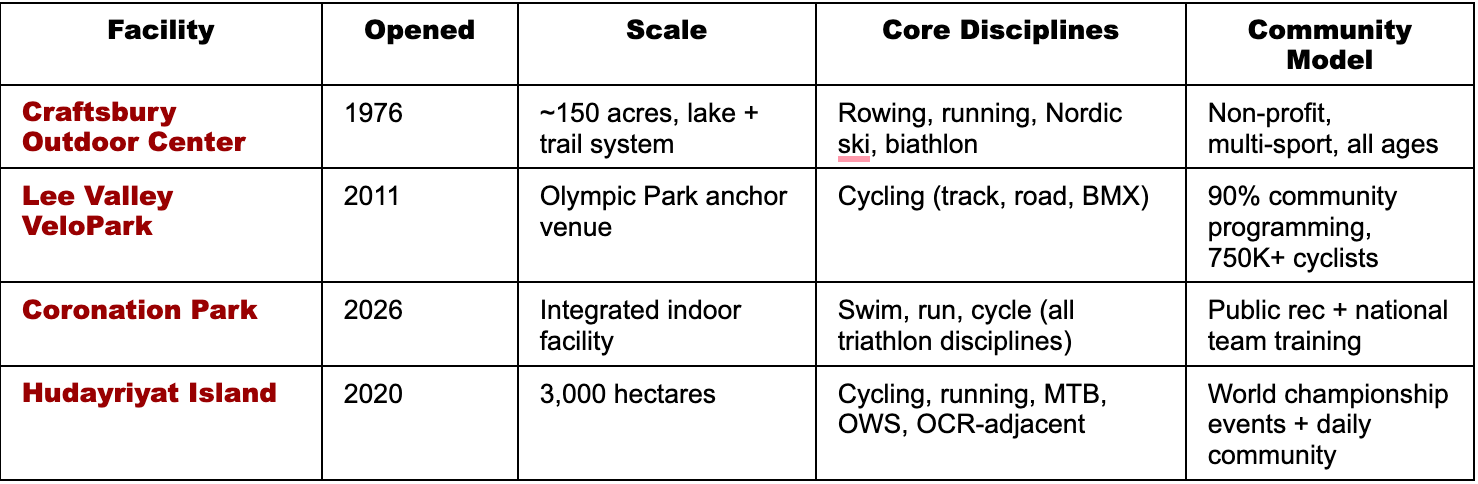
The purpose-built endurance and multi-sport park is not a speculative concept. Four facilities on three continents, at vastly different scales, funding structures, and market contexts, have each proven a critical dimension of the thesis. Together they form a global proof-of-concept portfolio that should silence skepticism about whether dedicated endurance infrastructure can generate sustained community engagement, institutional partnerships, and durable operating revenue.
Craftsbury Outdoor Center — Craftsbury Common, Vermont (Est. 1976)
The oldest and most instructive example sits on the shores of Big Hosmer Pond in northern Vermont. Founded in 1976 and built entirely around water, trails, and athletic programming, the Craftsbury Outdoor Center has spent nearly five decades proving that a single, carefully stewarded piece of land organized around endurance sport can generate year-round revenue, develop athletes from youth to Olympic level, and serve a multigenerational community without public subsidy. Its programming stack: sculling camps, running camps, Nordic skiing, biathlon, and community rowing for ages 12 to 85, is not assembled from borrowed venues or municipal permits. It is delivered from the infrastructure the facility owns outright.
What Craftsbury proves above all is durability. Its trail network spans over 85 kilometers of groomed terrain and 40 kilometers of single-track running trails. Its elite development program has produced athletes competing at the Olympic level in Nordic skiing, biathlon, rowing, and running. Its sculling camps, staffed by world-class coaches offering video analysis, rigging, and progressive skill development, produce deeply loyal, returning participants who function as a recurring revenue flywheel. Craftsbury has never needed a major event on public roads to validate its existence. The facility is the event — and has been for fifty years.
Lee Valley VeloPark — London, United Kingdom (Est. 2011)
Built for the London 2012 Olympic and Paralympic Games on Queen Elizabeth Olympic Park, the Lee Valley VeloPark is definitive proof of what happens when Olympic-grade cycling infrastructure is handed over to the community after the Games end. In the decade following London 2012, over 750,000 people have cycled at the VeloPark, contributing to more than 13 million total visits across Lee Valley’s three Olympic legacy venues. The facility, hosting a 250-meter indoor velodrome and a UCI-standard outdoor BMX and road circuit, devotes approximately 90% of its programming to community use: school groups, club riders, beginner adult cyclists, over-40s sessions, female track cycling programs, and toddlers on balance bikes.
That balance, Olympic infrastructure, and community soul is the precise mandate the endurance park model requires. The VeloPark generates revenue from elite competition and televised events while simultaneously serving as a neighborhood sports hub for East London. More than 5,000 school pupils and 11,000 club riders use the facility annually, and demand for access has consistently outpaced capacity in the decade since the Games. Lee Valley Regional Park Authority CEO shaun dawson framed the mission directly: “We’ve kept the promise of the Olympic legacy.” The lesson for endurance park investors is clear: community programming at the base is not charity. It is the occupancy engine that fills the facility calendar and sustains the operating model between marquee events.
Coronation Park Sports and Recreation Centre — Edmonton, Canada (Est. 2026)
The most recently opened facility on this list, and the one closest in concept to what a purpose-built endurance park represents, opened in January 2026 as North America’s first purpose-built indoor triathlon training facility. The Coronation Park Sports and Recreation Centre integrates a 50-meter competition pool, a 333-meter running track, and a 250-meter Category A velodrome under a single roof, co-locating all three triathlon disciplines for year-round, weather-independent training and competition. The Canadian federal government invested $1.025 million to support equipment and operations, developed through a partnership between the City of Edmonton, the Alberta Velodrome Association, and World Triathlon Series Edmonton.
The Edmonton model is significant not only for what it is, the first integrated triathlon training facility in North America, but for what it signals about where the market is headed. Communities are now commissioning facilities designed from first principles around multi-discipline endurance athletes rather than retrofitting existing single-sport venues. Critically, it is designed as a dual-use space: national team preparation by day, open to public recreation by evening and on weekends. That “high performance by day, recreation by night” philosophy is the operating template American endurance park developers should study.
Hudayriyat Island — Abu Dhabi, United Arab Emirates (Est. 2020)
At sovereign scale, and in the most resource-rich context, Hudayriyat Island represents what committed capital can build when it fully embraces the endurance sports park concept. Developed by Modon Properties across 3,000 hectares, designed for sport, lifestyle, and community, Hudayriyat is the closest existing equivalent to the purpose-built endurance park vision realized at full scale. The island features dedicated cycling tracks, calibrated running paths, mountain biking trails (15 kilometers across four difficulty levels at Trail X), open-water swimming access, beaches, splash parks, skate facilities, and BMX courses, all alongside a rapidly expanding dining and residential district.
Critically, Hudayriyat is not a passive amenity. It is an active programming venue. It hosts the World Triathlon Championship Series Abu Dhabi, one of the premier stops on the global triathlon calendar, billed by World Triathlon as “Abu Dhabi’s purpose-built home of sport, endurance and community participation.” TrainYAS at the adjacent Yas Marina Circuit opens the Formula 1 racing surface to cyclists, runners, and walkers on regular evenings, creating consistent community engagement outside of event weekends. The Gulf region’s investment in endurance infrastructure is coordinated and accelerating: Saudi Arabia’s SURJ Sports Investment has led major funding into the Professional Triathletes Organisation, Qatar has secured a five-year agreement to host the T100 World Championship Final, and sovereign wealth funds now lead 24% of global sports investments. These are not vanity plays. They are coordinated investments in tourism infrastructure, community wellness, and global positioning, each of which an American endurance park platform is equally positioned to capture.
What the Four Facilities Prove Together
These four venues span five decades, four countries, and investment scales from a Vermont non-profit to a sovereign development authority. What they share is more important than what separates them: each demonstrates that purpose-built infrastructure for endurance and multi-sport participation generates something that borrowed municipal venues never can, a permanent relationship between athletes, community, and place.
The Collegiate Triathlon Surge: A Built-In Institutional Customer
One of the most underappreciated demand drivers for purpose-built endurance infrastructure is happening on college campuses across the country, and it is accelerating. Women’s triathlon is one of the NCAA’s fastest-growing Emerging Sports for Women, with programs now spanning all three divisions across 25 states. Approximately 39 to 40 schools sponsor women’s triathlon at the varsity level, with Barton College announcing its addition in February 2026 and Kentucky State University, the third HBCU to sponsor the sport, announcing its program in March 2026. USA Triathlon has invested more than $3.5 million in grants to help NCAA member institutions launch and sustain varsity programs, and the sport is advancing toward full NCAA championship status.
The participation numbers are significant: approximately 320 to 360 collegiate women currently compete in varsity NCAA triathlon, and programs are actively growing their rosters. When full championship status is granted, a determination likely within the current approval cycle, the number of programs and athletes will grow rapidly, along with institutional demand for dedicated training venues.
The Training Trip Market: An Immediate Revenue Opportunity
Here is where the endurance park investment thesis gains a dimension that is consistently overlooked: collegiate triathlon teams are not just local event participants. Like college swim teams, which have traveled to purpose-built aquatic destinations for training camps since 1933, they are institutional travel customers who need turnkey environments for pre-season and mid-season training.
The college swimming model is instructive. The College Swimming and Diving Coaches Association (CSCAA) organizes formal winter training trips to facilities across Florida, Arizona, California, and North Carolina, where programs offer long-course competition pools, dry-land training areas, lodging, and dining as part of a single destination package. Teams arrive, train at purpose-built aquatic facilities, stay in adjacent accommodations, and leave having spent institutional budget dollars in the host community.
Collegiate triathlon programs need the exact same model, and it does not yet exist at scale in the United States. A training trip for a collegiate triathlon team requires open-water access with coaching support, closed cycling circuits for interval work, marked run courses, video analysis capability, transition practice areas, and proximity to lodging and dining. These requirements precisely describe a purpose-built endurance park. No municipal venue, no state park, and no urban racetrack built on public roads can offer this package in a single location with the reliability that a collegiate athletic program demands.
Beyond triathlon specifically, the adjacent institutional training travel market is substantial: collegiate cycling clubs, open-water swim programs, masters triathlon groups, duathlon competitors, DEKA fitness programs, and USA Triathlon’s own High Performance Training Camps. A purpose-built endurance park with on-site or adjacent lodging and dining can market directly to athletic directors, national governing body program directors, and coaches, generating multi-night institutional revenue during the shoulder weeks between consumer events.
The Golf Course Conversion: America’s Greatest Stranded Land Asset
While developers hunting for endurance park sites typically face significant land acquisition costs, there is a massive and largely overlooked inventory of shovel-ready land sitting idle across the country: former golf courses. Since 2006, more golf courses have closed than opened in the United States every single year. Approximately 1,500 golf courses have closed since 2014 alone, and more than 2,360 have shuttered since the market began its self-correction in 2006. At an average of 150 acres per course, that represents an extraordinary inventory of green, open, often water-adjacent land; much of it already equipped with parking, grading, cart paths, water features, and utilities.
Huddle Up Group, LLC, a sports tourism consultancy trusted by over 450 sports organizations nationally, identified getting golf courses off municipal books as one of the top parks and facility trends in its 2025 industry report, alongside decommissioning public pools and converting tennis courts to pickleball. The common thread in all three: communities are actively asking, “what is the highest and best use of the real estate and facilities we have?” For endurance sports, that question has a compelling answer: a purpose-built park that serves athletes, community members, event organizers, and non-sports programming simultaneously.
The conversion opportunity is already unfolding across the country:
In Cape Coral, Florida, the city purchased a 175-acre abandoned golf course in August 2024 and commissioned environmental surveys and a community-driven master plan for recreation and programming.
In Geauga County, Ohio, a former course became Veterans Legacy Woods, a 180-acre public park with hiking trails, native forest restoration, cold-water streams, and lodge spaces less than 40 miles from Cleveland.
In Chester Township, Ohio, the 237-acre Orchard Hills Park was transformed from a golf course into a multi-use destination where residents hike, run, and cross-country ski, with cart paths repurposed as trails.
In each case, the infrastructure left behind by a defunct course proved purpose-made: parking lots, path networks that convert directly to cycling and run circuits, water features large enough for open-water training, and rolling terrain originally selected for its aesthetic and functional qualities.
The 42% of closed courses carrying no clear plans for future use represent a standing invitation for visionary developers to propose exactly the kind of multi-use endurance and community park that serves every stakeholder. The land is there. The community need is there. The investor framework is being assembled.
Community Validation: The Youth Sports Infrastructure Movement
The financial and civic case for community sports investment no longer requires advocates to make a speculative argument. Communities across the country are committing between $7 million and $120 million for individual youth sports facility projects, with the investment rationale grounded in documented economic returns. A single 174,000-square-foot indoor facility in Hillsborough County, Florida, was projected to generate 44,000 hotel room nights annually and $24.5 million in direct economic impact by its third year of operation. The Round Rock Sports Center in Texas generated more than $16 million in economic impact in a single year. Youth and amateur sport-specific venues have spurred more than $9 billion in direct spending since 2017.
Local park and recreation agencies across the United States generated more than $201 billion in economic activity and supported nearly 1.1 million jobs in 2021. The youth sports industry generated $52.2 billion in direct spending in 2024 and is projected to approach $77.5 billion globally by 2026. Families traveling for youth sports tournaments spend an average of $700 to $1,000 per month, much of which flows directly into the host community through hotels, restaurants, retail, and local services.
Huddle Up Group, founded by Jon Schmieder and trusted by over 450 sports organizations nationally, has built its consultancy around quantifying and acting on this dynamic. Their services include strategic planning for CVBs, DMOs, and sports commissions; facility feasibility studies; and regional venue inventories that identify infrastructure gaps. Their explicit finding: communities adopting creative, non-traditional funding mechanisms are delivering tourism-driving facilities “faster and more effectively” than those waiting for voter-approved bonds. Their Sports Tourism Index maps thousands of facilities and events nationwide, making it a natural tool for identifying where a purpose-built endurance park network has the least competition and the greatest unmet demand. The public-private partnership models that endurance parks will rely on are already well-validated across all market sizes, from Myrtle Beach to Las Vegas, with smaller markets securing over 60% of public funding for sports facilities, while major metros rely more heavily on private investment.
A Venue for Everyone: Programming Beyond the Podium
A purpose-built endurance park is not a niche sports facility. It is a public gathering place with green space, water access, parking, restrooms, food-and-beverage infrastructure, and a natural amphitheater formed by the terrain. The same footprint that hosts a triathlon on Saturday morning can host a farmers market on Sunday, a food truck festival on Friday evening, a classic car show in the fall, a summer concert series, and a holiday 5K in December. The 175.8 million Americans who participated in outdoor activities in 2023, 57.3% of the entire U.S. population, are not all endurance athletes. They are families, casual walkers, music fans, food enthusiasts, and neighbors looking for a reason to gather outdoors.
The economics of non-sports programming are not peripheral. A single arts and crafts festival in Ocean Springs, Mississippi, drawing 100,000 people to a community of 18,000, generated $13 million in local economic impact. The Cincinnati Flying Pig Marathon / Pig Works brought $22 million in economic impact to Cincinnati in a single year. Diverse programming also solves one of the most common failure modes of single-use sports facilities: seasonality and idle time. A venue that programs 52 weekends a year with races, collegiate training camps, community markets, concerts, outdoor festivals, and private gatherings compresses the payback period for fixed costs and builds the community identity that sustains the brand over the long term. Research consistently shows that sustained, diverse programming in parks reduces vandalism, lowers crime, and increases community stewardship.
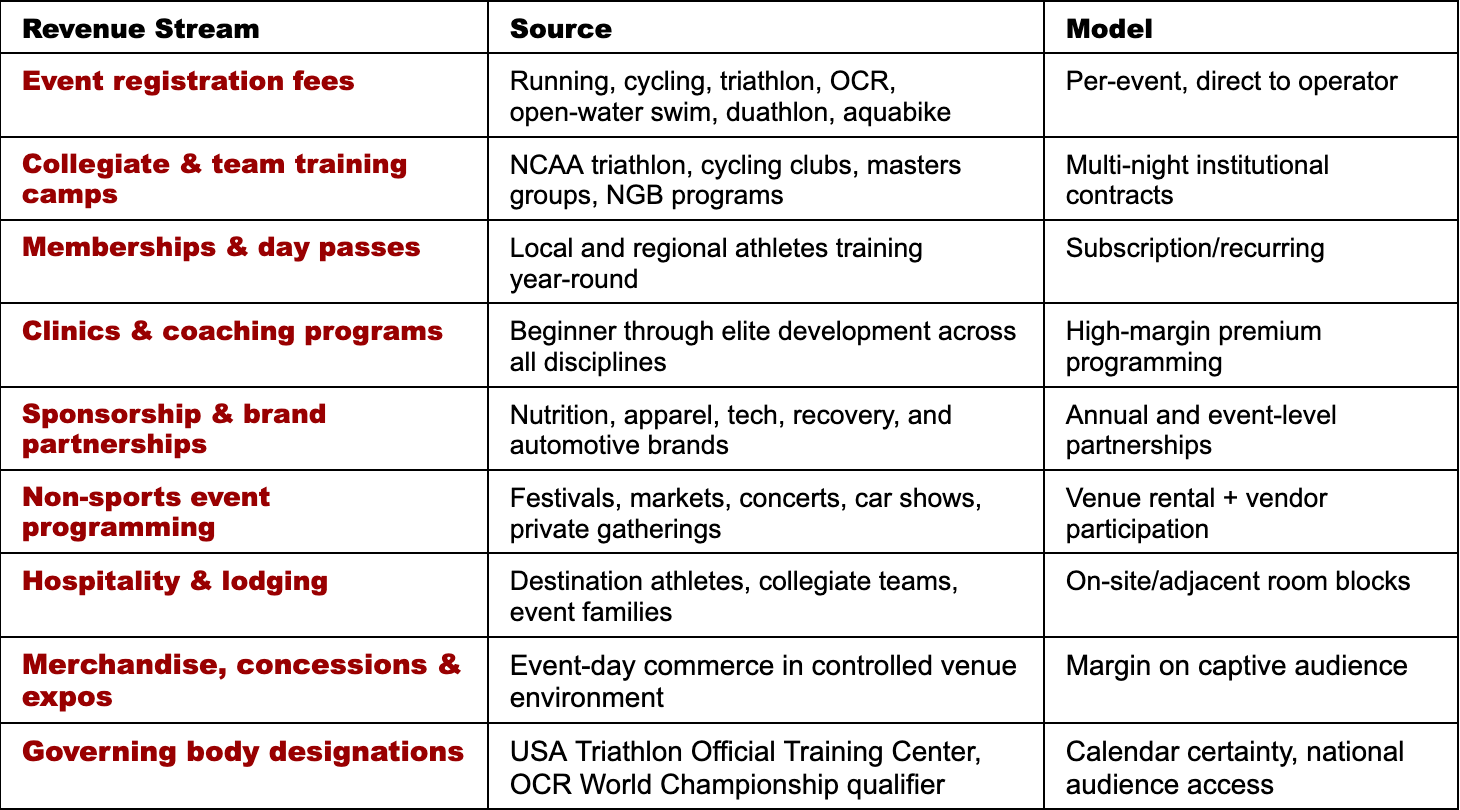
The Investment Architecture: Multiple Revenue Streams on a Single Asset
The Macro Tailwind: Institutional Capital Is Turning This Direction
Private equity investment in sports infrastructure is accelerating globally. The global sports market is projected to reach $680 billion by 2029, and institutional capital is converging on the realization that the participatory sports segment, already representing 63% of the total market, has been chronically under-infrastructured relative to the spectator side. Apollo’s thesis makes the point directly: venue and ancillary development economics are essential to generating the cash flows required to service institutional leverage on sports investments.
Youth sports facilities are already described as the “hottest mixed-use anchor” in real estate development, with private equity, sovereign wealth funds, and real estate developers converging on the asset class. Sovereign wealth funds now lead 24% of global sports investments. Youth and amateur sports generated $52.2 billion in direct spending in 2024. What is missing from this landscape is the community-scaled, purpose-built endurance park: not a sovereign wealth fund mega-event venue, not a general-purpose youth rec complex, but a dedicated facility designed for the 112 million American cyclists, the tens of millions of runners, the 1.45 million annual Spartan finishers, and the growing millions of triathletes, and for the collegiate programs, community events, and families that orbit their world.
Where the Athlete Meets the Investor, and the Neighbor
The endurance sports park sits at the intersection of converging forces: an ecosystem of participation sports: running, cycling, triathlon, OCR, open-water swimming each in sustained, demographically broad growth; a new generation of collegiate programs urgently seeking the purpose-built training infrastructure that swimming has enjoyed for nearly a century; a structural failure in the current event production model that creates demand for dedicated solutions; and an investment environment increasingly receptive to sports infrastructure as an institutional asset class. Add one more force: tens of millions of square feet of abandoned golf course land sitting in communities that want green space back and are looking for a development vision worthy of the opportunity.
The concept has been validated on the shores of Big Hosmer Pond in Vermont, where Craftsbury Outdoor Center has spent nearly five decades proving that water, trails, coaching, and community are the foundation of something athletes return to year after year. It has been validated in East London, where Lee Valley VeloPark turned an Olympic cycling venue into a community institution serving 5,000 school children and 11,000 club riders annually, while still hosting world-class competition. It has been validated in Edmonton, where North America’s first purpose-built indoor triathlon facility opened in January 2026 to serve both national team preparation and neighborhood recreation on the same footprint. It has been validated at sovereign scale in Abu Dhabi, where Hudayriyat Island demonstrates what a fully committed, purpose-designed endurance destination looks like when it hosts World Championship events in the morning and community cyclists, runners, and families in the afternoon.
The endurance sports park is not a niche bet. It is a community infrastructure play, an experiential real estate asset, a multi-discipline participation sports platform, a collegiate training destination, and a civic gathering space, all anchored by the simple, durable proposition that people will invest time, money, and loyalty in the places built specifically for them.
If you are interested in Trihabitat, please reach out to me.