

This is a follow-up to The Endurance Sports Paradox: Why the Rise of the Crowd Is Fueling the Flight to the Frontier. If you haven’t read that piece, the short version: as road marathons and gran fondos hit record participation numbers, a parallel migration toward trail running, gravel cycling, and mountain biking is accelerating, driven by the same athletes who once powered the road racing boom. The crowd creates the frontier.
After publishing that piece, one of the most pointed responses came from an independent event operator. The question was direct and worth digging into:
“So if marathons are up 3 to 6%, but it appears to be all in the majors, where does that leave small business event promoters? Focus on the frontier? Isn’t that what the majors want us to do so they can continue to grab more market share? If you were me, what would you focus on?”
I spent a long morning run working through it in my head and talking it out to myself into my notes app. Here’s what I’ve landed on, and it’s more strategically interesting than either the question or the headline numbers suggest.
The Concentration Problem Is Real, But It’s Not the Whole Story
Let’s acknowledge what the data actually shows, because the optimistic read requires an honest look at the challenging one first.
The marathon recovery has been led by a handful of events at the top. The world’s largest marathons are setting all-time records simultaneously. One major broke the global finisher record in the spring, another reclaimed it in the fall of the same year. One event received over 200,000 applications for a field that accepts roughly 1 in 3 applicants. The power at the top of the market is real and intensifying.
Gran fondo cycling is following the same pattern. The UCI’s flagship mass-participation series now spans 36 events across five continents, with its world championship moving to Asia for the first time. The platforms with established brand equity, lottery systems, and international marketing infrastructure are growing faster than the overall market.
Meanwhile, RunSignup’s annual Race Trends data tells an honest story: 87% of all races have fewer than 500 participants, and small local events account for nearly 40% of all runners in America. The base of the pyramid is enormous. But the growth headlines belong to the peak.
So the question stands: what does a small operator actually do with this?
The Majors Are Great at the Harvest. They Don’t Do the Planting.
Here is the reframe that changes the strategic picture entirely.
The large destination marathon is almost never someone’s first endurance event.
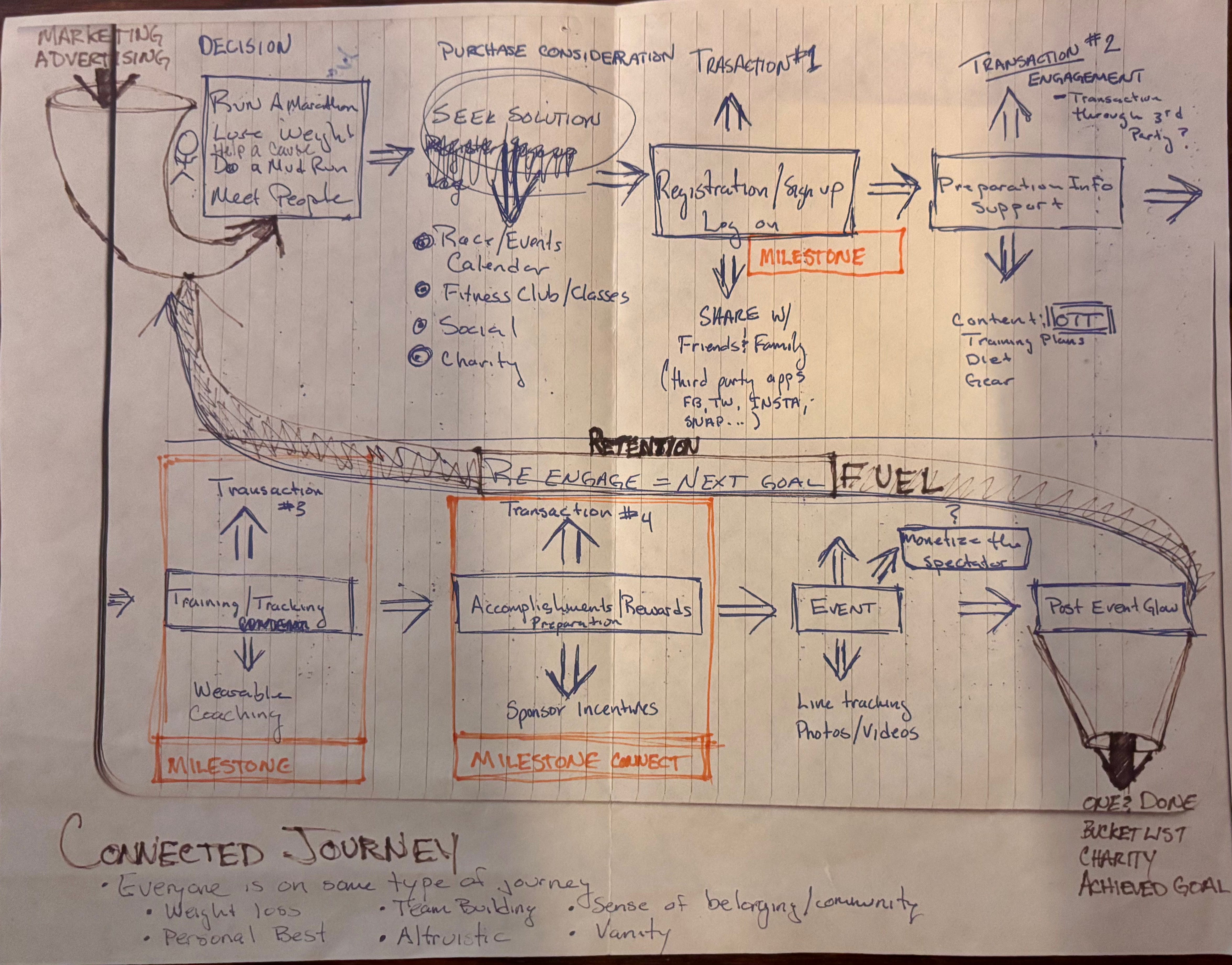
Think about the actual consumer journey. A person decides to try running. They sign up for a local 5K, or a fun themed event with family or friends, a relay with a charity group, or a short trail race someone at the office is doing. They finish. They feel something. They sign up again. Over months and years, they go longer. They go faster. They try a new discipline. And eventually, years into that journey, they put a major on their bucket list.
By the time that runner crosses the finish line of a major, a dozen operators shaped who they became as an athlete. The major sees them at peak identity. It harvests the investment that others made.
This is not a criticism of the majors. They have built extraordinary products. But the harvest model has a structural dependency: it requires a continuous supply of athletes who already identify as serious participants or have set a “bucket list” goal. Someone has to create those athletes. Someone has to introduce them to the sport, give them their first finish line, nurture their confidence across distances and disciplines, and build the community that keeps them coming back.
That is the independent operator’s business. And it is not a lesser version of the major’s business. It is a categorically different one, and in several important ways, a structurally stronger one.
The Upstream Advantage
You are upstream of the majors. Not behind them. Upstream of them.
The first-time participant who does a fun, accessible, occasion-driven event is not yet on the major’s radar. They haven’t created the bucket list or self-identified as a serious athlete. They are simply having a good time and feeling something they want to feel again.
Whoever holds that first relationship has something the majors cannot buy retroactively: trust. The operator who introduces a participant to endurance sport, keeps them engaged across distances, and meets them where they are across a progression of events earns a kind of loyalty that no marketing spend can manufacture. The participant doesn’t just remember the race. They remember who made it accessible. Who made it fun. Who made them feel like they belonged.
That is the upstream advantage. It compounds quietly over time, and it is genuinely defensible in ways that road race market share is not.
The Frontier Question, Answered Honestly
Now to the pointed part of the question: isn’t focusing on the frontier exactly what the majors want independent operators to do, so they can consolidate road racing at the top?
It’s a smart and legitimate concern. The pattern exists. Scaled operators are already in gravel and trail. The discipline pioneers did the cultural work; the big platforms arrived with capital. It will happen again.
But here’s what the concern misses: the independent operator’s advantage in frontier disciplines is not primarily about being early to a format. It’s about being deeply rooted in a community and place in a way that scaled operators structurally cannot replicate.
The data from the fastest-growing trail and gravel events is instructive. More than 70% of participants at the world’s largest trail running series come from the host country or a neighboring region. Repeat attendance rates in trail and gravel significantly outpace road racing. The events winning in these disciplines are not winning on scale. They are winning on belonging. On the sense that this event, in this place, was built by people who live here and care about this community.
That is not a competitive position a major can buy. They can acquire the event. They cannot acquire the legitimacy.
Two Lanes. One Portfolio.
The most durable answer to the question, “what should an independent operator actually build?” is not a single lane. It’s two, and they hedge each other in ways that make the portfolio genuinely resilient.
Lane One: Occasion-Driven and Branded Events
Fun, themed, accessible events built around identity and experience rather than sport performance are a powerful tool for reaching first-time participants. These events don’t compete with majors. They compete with other leisure occasions: a weekend trip, a concert, a group activity. The participant is buying a social experience that happens to involve physical activity.
The strategic strength is differentiated acquisition. You are reaching net-new entrants to endurance, and you are their first introduction to it. The strategic risk is dependency. Branded and licensed events rely on IP that belongs to someone else. If this is the only lane, the operator is a contractor with a great client, not a brand with owned equity.
Lane Two: Community-Rooted Events in Emerging Disciplines
Trail running, gravel cycling, mountain biking, and adventure formats are the fastest-growing segments in endurance sports, and they are dramatically underserved at the regional level in most markets. These events derive their value not from a licensed property but from terrain, community, and the sense of place that a well-run regional event builds over time. That equity is owned. It compounds. It cannot be taken away.
Together, these two lanes form a portfolio that makes structural sense. Lane One drives volume, cash flow, and top-of-funnel reach with first-time participants. Lane Two builds owned equity, loyalty, and long-term defensibility. And the participant who enters through a fun branded event today is a candidate for your trail series or gravel event next year, if you build both lanes and connect them deliberately.
The Flywheel the Majors Are Ignoring
There is a consumer flywheel operating in endurance sports that almost no one is talking about explicitly. It works like this:
A first-time participant enters through an accessible, low-intimidation event
They finish. They feel something. They return.
The operator who guided that experience introduces them to longer distances, new disciplines, and deeper community
The participant’s identity as an athlete develops, and so does their lifetime event spend
Eventually, some percentage of them puts a bucket list major on their calendar
Step five gets all the press. Steps one through four create the athlete who gets there.
The independent operator who builds and nurtures this journey deliberately is not a feeder system for the majors. They are the architect of the participant’s athletic identity. They hold the first, most trusted, and longest relationship in that athlete’s event career.
The majors only see the runner at the finish line. You can see them at the starting line, the very first one, when they weren’t even sure they were a runner yet.
But only if you remember them.
The Data Layer: Turning the Flywheel Into a Business Asset
The upstream advantage is only as durable as your ability to remember the participant.
This is where most independent operators leave the most value on the table. A first-time participant crosses your finish line, feels something, collects their medal, and then disappears into a registration platform’s database that you may or may not own, a timing file that lives in a spreadsheet, and a social media follower count that an algorithm controls. The relationship existed. The data didn’t go anywhere useful.
The majors have solved this problem with scale: dedicated CRM teams, loyalty programs, and marketing technology stacks that would embarrass most mid-size companies. What most independent operators don’t realize is that the tools to build a functionally equivalent zero and first-party data infrastructure are now accessible at a fraction of that cost. The gap is not money. It is intentionality.
Registration is a data collection event, not just a transaction. Every registration is an opportunity to learn who your participant is, where they came from, what they’ve done before, and where they want to go. A well-designed registration flow asks a few questions beyond the basics: Is this your first endurance event? What other disciplines are you curious about? How did you hear about us? What’s on your bucket list? That data, collected consistently over time, builds a participant profile that tells you exactly where each person sits in the journey and what the right next offer is.
Own your email list like the business asset it is. Social media reach is rented. Email is owned. An engaged list of participants who have crossed one of your finish lines is worth more than a multiple of social followers, because you control the channel, the timing, and the message. The operators winning on retention send communications that feel like they come from someone who knows the participant, because they do. Segmentation by distance history, discipline, and event tenure turns a broadcast list into a personalized conversation.
Use post-event data to map movement through the flywheel. Which participants who did your entry-level event came back for something longer? Which road runners tried your trail event? Which first-timers became annual attendees? This movement data is the most valuable intelligence an independent operator can possess. It tells you which events are feeding which other events, where participants are dropping off the flywheel, and where a well-timed communication could re-engage someone who hasn’t returned. Most operators have this data in fragmented form across registration systems and timing files. Consolidating it into even a basic CRM creates a participant journey map that fundamentally changes how you market and program.
Build a loyalty structure that rewards the journey, not just the event. The participant who has attended five of your events across three disciplines over four years is your most valuable asset: as an attendee, a referral source, and a brand ambassador. Most operators treat every registration as a discrete transaction. The operators building durable businesses treat multi-event, multi-year participants as members of something. A simple loyalty program, including priority registration, recognition at events, and earned discounts, costs relatively little to operate and dramatically increases the data signal you receive about your most engaged participants.
Respect the data and the relationship in equal measure. Zero and First-party data is only a competitive advantage if participants trust you with it. The operator who uses participant data to send relevant, timely, genuinely useful communications builds something the majors struggle to replicate at scale: the feeling that someone is paying attention. Use it to tell participants about events that fit where they are in their journey. Use it to celebrate milestones. Use it to ask what they want next.
The majors have the marketing budgets. Independent operators have the intimacy. Technology makes intimacy scalable, but only if you build the system intentionally, starting at the first finish line.
What This Looks Like in Practice
Map the participant journey, not just the event. What does your participant look like at year one, year three, year five? Build a portfolio of events and experiences that serves the whole arc, not just the entry point.
Connect the lanes deliberately. If you run branded occasion events and frontier discipline events, make sure participants in one know about the other. The crossover rate will surprise you. The person who ran your themed 5K is more open to trying a trail 10K than you think, especially if the invitation comes from an operator they already trust.
Build community between events, not just at them. The operators winning on retention are building engagement year-round through training groups, local partnerships, social runs, and online communities. Community is what converts a one-time participant into a multi-year follower. It is also the thing that scaled operators, with their global infrastructure, are worst at.
Own a discipline before you scale it. The fastest-growing independent operators in trail and gravel right now are the ones who planted a flag early in a specific region and built the culture before the discipline went mainstream. First-mover advantage in frontier formats is real. It is also closing.
Tell the upstream story. The participant who did your entry-level event in year one and is now training for their first trail race or century ride is a story worth telling: to your community, to potential sponsors, and to the industry. That narrative is your competitive moat made visible.
Build the data infrastructure before you need it. Registration, email, post-event survey, CRM. These are not marketing tools. They are the memory of your business. Every participant who passes through your corrals without a meaningful data touchpoint is a relationship you held briefly and let go.
The flywheel only compounds if you remember who is on it.
The Bigger Picture
The endurance sports paradox described in the previous article; that the more crowded the mainstream becomes, the more valuable the frontier gets is not just a cultural observation. It is a business structure.
The majors win by harvesting. Independent operators win by cultivating. These are not competing strategies in the same market. They are complementary roles within the same ecosystem, with different time horizons, competitive dynamics, and sources of durable advantage.
The question for the independent operator is not whether to focus on the frontier or defend the mainstream. It is whether to build a portfolio that captures the origin of the participant journey and nurtures it across the full arc of athletic identity development. With the right events in the right lanes, backed by a zero and first-party data infrastructure that remembers every participant at every step, the flywheel doesn’t just turn.
It compounds.
The majors are getting bigger. The base of the pyramid is not getting smaller. And the operator who owns the first, most trusted, and longest relationship in an athlete’s event career is not behind the majors.
They are upstream of them.
That is not a consolation. That is a strategy.