

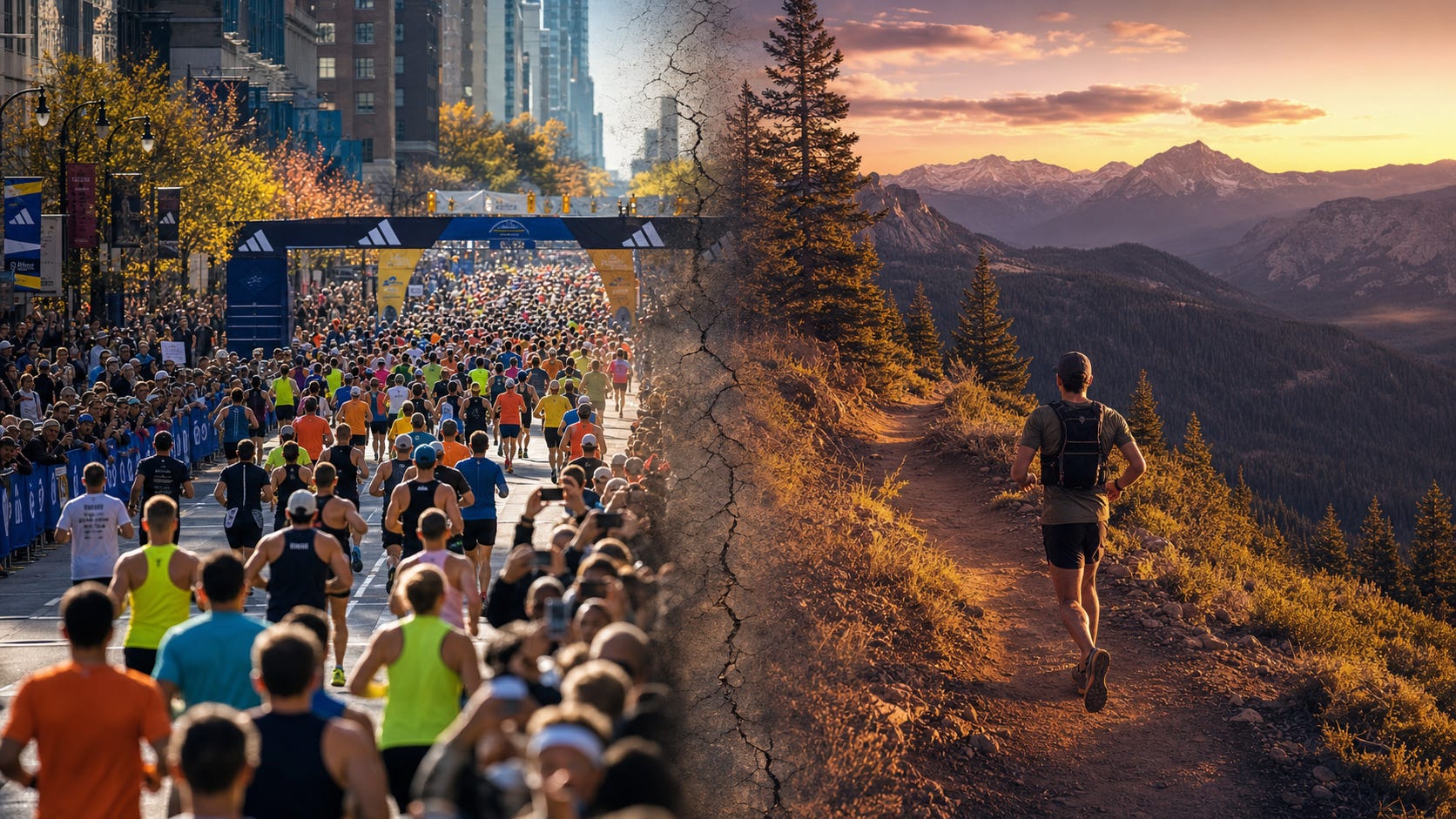
As road marathons return to being bucket-list experiences and status symbols, packed with influencers, medal chasers, and Type-A personalities, a parallel migration is underway to the dirt. Trail running, mountain biking, and gravel cycling are no longer fringe pursuits. They are the fastest-growing sectors in endurance sports, and their growth is not incidental to the mainstreaming of road racing.
It is caused by it.
This is the endurance sports paradox: the more crowded the mainstream becomes, the more valuable the frontier gets.
The Marathon Is Having a Moment, and That Is Dominating the Industry
Let’s address the known: marathons are experiencing a genuine resurgence in participation:
The U.S. marathon ecosystem grew an additional 3% to 6% over the Running USA report finisher baseline of 432,562 marathon finishers in 2024.
The 2025 TCS New York City Marathon recorded 59,226 official finishers, the largest field in its history.
Chicago 2025 drew 54,318 finishers, up 12.2% from 2023, and is expanding to 55,000+ for fall 2026, its largest field ever.
Boston 2026 recorded 29,033 finishers, a 9% jump from its 2023 post-pandemic high, and the BAA is actively working with crowd scientists to keep expanding the field.
That surge in participation is real, and it’s commercially significant. But something else is happening alongside it. The marathon, once a badge of personal transformation, has become a social media currency. Gen Z is running marathons as their generation’s answer to luxury goods, with Fortune noting that marathon times are replacing designer suits as status symbols on Wall Street. A sport built on solitary suffering has become a performance for an audience.
For a meaningful and growing segment of athletes, that’s exactly the problem.
The Counterculture Counterpart
Enter the frontier disciplines.
Trail running is now a $20 billion economy, with participation up 231% over the past decade. Trail run uploads to Strava have doubled over the past three years. UTMB World Series participants surged 2.4x since 2022, with over 800,000 race starts in just the first half of 2025. Strikingly, 42% of those UTMB participants were competing in their first-ever trail event. Trail running is no longer only a sport for grizzled veterans. It’s a sport welcoming newcomers who are making a deliberate choice to go off-road.
Gravel cycling tells a similar story. From 34 participants at the first edition of what is now Unbound Gravel in 2006, the event now draws 5,000 riders across five distances, generated an estimated $21.7 million in economic impact in 2024, and has spawned an entirely new segment of the cycling industry. Gravel bikes are among the few bicycle categories to have gained market share since before the pandemic, with a 55% increase in participation on Strava in 2023 alone.
Mountain biking had over 9.2 million Americans participating in 2023, a 4.1% increase year-over-year, and the global market is projected to grow from $10 billion in 2025 to $14 billion by 2029.
The numbers don’t lie. These are the growth curves that endurance sports hasn’t seen since the marathon boom of the early 2000s.
Same Athlete Profile. Different Values.
Here’s what makes this more than a market trend: the psychographic profile driving growth in trail, gravel, and mountain biking is largely the same as that of the core of road racing and gran fondos.
Affluent, fitness-driven, experience-seeking. Per Fitt Insider, 66% of trail runners earn $100K+. They’re not abandoning endurance sports. They’re graduating from the performative version of it toward something they consider more authentic.
Trail running, as Fitt Insider describes it, trades “external validation for flow states and ego death, the thrill of dissolving into nature.” Gravel riders talk about “authenticity, exploration, and connection to place.” Mountain bikers are building trail networks and communities.
The emotional currency is different. And in a world where social media has colonized every marathon finish line, that difference is increasingly priceless.
The Organizational Parallel: Mass Participation Formats Are Following
What’s fascinating from a sports business perspective is that the event infrastructure in these emerging disciplines is now intentionally replicating, and simultaneously trying not to replicate, the mass participation model that made road racing great.
UTMB World Series ran 55 events in 28 countries across five continents in 2025, bringing together 146,933 runners. Yet 73% came from the host country or a neighboring nation; the growth is deeply rooted in local community, not globalized spectacle tourism. More than 50% of runners arrive with friends or family, turning race weekends into shared adventures.
Gran fondos, the mass-participation cycling equivalent of road marathons, are evolving similarly, with organizers layering in festivals, multi-day experiences, and boutique distances alongside the signature ride. The small-scale event with under 200 participants and a curated experience is now the fastest-growing format in the gravel world.
The parallel to marathon evolution is striking: the sport formats that once felt exclusive are becoming accessible, and the once fringe sports are actively managing the tension between growth and soul.
The Strategic Implication for Sports Business
For those of us working in mass participation sports, this dynamic should force a genuine rethink.
The marathon and gran fondo formats are not dying; the participation numbers prove that. But the meaning that once differentiated them is migrating. The intrinsic motivation, the authentic challenge, the quiet grit, and the community earned through shared suffering are moving from urban settings to more remote destinations.
This creates a genuine opportunity for event operators, brands, and platform builders:
Don’t just build bigger. Build deeper. The events winning in trail, gravel, and MTB are not the ones with the largest fields. They’re the ones with the strongest sense of place and culture. Emporia, Kansas. Chamonix. Moab. These are not just race venues; they are pilgrimages.
Authenticity is a product feature. The brands growing fastest in trail running: HOKA, Norda, NNormal, SATISFY are not trying to be Nike. They’re building for the psychographic that is actively running away from mainstream. That’s a defensible position if you hold it with integrity.
The participation flywheel is just starting. With 42% of UTMB participants running their first-ever trail event and gravel cycling growing at double-digit rates globally, we are not at peak participation in these disciplines. We’re still at the early majority stage. The early adopter culture that makes these sports feel authentic today is the same culture that will power the mainstream wave of the next decade.
Going Deeper to Spot Patterns
Every generation of endurance sport follows the same arc. A difficult, countercultural pursuit is discovered by the mainstream, packaged for mass consumption, and spawns a generation of performative participants, thereby creating the conditions for the next countercultural pursuit to emerge.
Road racing → trail running. Gran fondo → gravel. Cross-country mountain biking → enduro and bikepacking.
The athletes aren’t leaving endurance sports. They’re chasing the next frontier. And the frontier keeps moving.
The question for our industry isn’t whether to follow them. It’s whether we can build platforms, events, and brands worthy of the journey without paving the dirt road in the process.
Really insightful. Great article.