

After almost two years leading the strategy for a new creator-focused sports platform, I have repeatedly confronted a central question: Will sports fans, athletes, teams, leagues, and creators ultimately consolidate on one dominant platform, or do they need an ever-increasing number of platforms?
Based on extensive analysis, informal interviews, ranging from deep dives into fan engagement across YouTube , Instagram , TikTok , X , and new start-ups to casual holiday party conversations about real viewing habits, and U.S. Ski & Snowboard Team‘s new partnership, the evidence points to a likely consolidation of sports content on a single leading player, despite ongoing experimentation.
YouTube’s new genre-specific TV Plans, set to launch in early 2026, mark a significant change from traditional subscriptions. The Sports Plan is designed to make YouTube the top destination for live sports, creator content, and fan engagement, all in one place.
This move gives executives a unique chance to take the lead in digital sports. YouTube is on track to outpace Instagram, X, TikTok, and traditional broadcasters by changing how fans watch and interact with sports. By leveraging YouTube’s ecosystem, leaders can refine their strategies, build stronger partnerships, and create new revenue streams through better decision-making.
This article examines how YouTube’s Sports Plans will transform the sports content industry and highlights key stakeholder groups. ‘Monetization Maximizers’ are companies that stand to gain the most revenue, such as Opendorse, vidIQ, TubeBuddy, WSC Sports, DAM platforms and Google’s advertising business. In contrast, ‘Distribution Orphans’ like Instagram, X, TikTok, cable networks, and regional sports networks lack the integrated features needed to keep viewers engaged. The article also explains why YouTube is likely to win and how AI will help personalize sports content for millions of fans.
US Ski & Snowboard and YouTube Partner to Develop Exclusive, Behind-the-Scenes, Creator-Led, Athlete Content
YouTube’s Content Rights and Strategic Positioning
The Legal Foundation: What YouTube’s License Allows
YouTube’s standard Terms of Service grant the platform a “worldwide, non-exclusive, royalty-free, sub-licensable and transferable license to use, reproduce, distribute, prepare derivative works of, display and perform” all user-uploaded content “in connection with YouTube’s service and YouTube’s business.” This broad legal grant permits YouTube to use sports videos in personalized feeds, algorithmically curated recommendations, highlight compilations, and social-style feed experiences without requiring fresh permissions for each specific use case.
However, this license has critical limits. While YouTube can repurpose user-uploaded videos within its platform, third-party copyrights embedded in sports footage (league footage, broadcast graphics, music) remain protected by copyright law, and contractual restrictions in league/broadcaster deals can limit how content is clipped, remixed, or redistributed beyond standard YouTube features like key plays and multiview.
YouTube’s acquisition of premium sports rights, particularly NFL Sunday Ticket and the opening game of the 2025 NFL season, which drew 18.5 million viewers and set records for concurrent livestream viewership, gives YouTube both ends of the sports content spectrum: premium live games and the creator ecosystem that produces social content around those games. This dual positioning is unique; no competitor combines both layers.
The Sports Plan: What Changes
Launching in early 2026, YouTube TV Plans will offer over 10 genre-specific subscription packages at lower price points than traditional YouTube TV, with the dedicated Sports Plan including:
All major broadcasters (ABC, NBC, CBS, Fox)
All ESPN networks (ESPN, ESPN2, ESPNU, ESPN News) plus ESPN Unlimited
FS1 and NBC Sports Network
Optional add-ons: NFL Sunday Ticket, RedZone, premium sports channels
Features: Unlimited DVR, multiview (watch four games simultaneously), key plays (replays of significant moments), fantasy view, and synchronized stats and engagement tools
By bundling these services, YouTube brings sports fans from different places onto one platform. This gives YouTube a unique chance to offer the complete sports experience, live games, highlights, creator analysis, athlete content, fan communities, and brand engagement, all in one place.
Benefits for Creators: Creators can leverage this integrated platform to reach broader audiences, enhancing engagement through a variety of content types, including live games and personalized highlights. This expanded reach allows for diversified revenue streams through YouTube’s monetization tools, including ads, memberships, and merchandise sales.
Advantages for Teams: Sports teams can capitalize on YouTube’s platform by forming partnerships, thereby increasing exposure and fan interaction. They can also streamline content distribution and utilize analytics to optimize their marketing strategies.
Opportunities for Brands: Engage directly with a highly targeted, engaged audience on YouTube. This enables precise marketing efforts and improved return on investment through tailored advertising strategies.
Sports and media executives can take advantage of this change by focusing on partnerships with YouTube, reallocating marketing budgets to make the most of its ecosystem, and developing content strategies that fit this new digital landscape. By acting early, they can reach engaged sports audiences and open up new revenue opportunities.
The Emerging Winners
Opendorse: The NIL Powerhouse
Why Opendorse Wins Big: Opendorse has transformed from modest pre-NIL beginnings into the dominant marketplace for college athlete NIL deals, now serving over 100,000 athletes and facilitating $250+ million in transactions, with the total NIL market projected to grow from $917 million in 2021-22 to $1.67 billion in 2024-25 and exceed $2.5 billion in the first year of revenue sharing. This rapid growth highlights Opendorse’s potential to capture a significant share of the NIL market as athletes and partners increasingly leverage its platform for maximizing opportunities. This rapid growth highlights Opendorse’s potential to capture a substantial share of the NIL market as athletes and partners increasingly leverage its platform for maximizing opportunities.
YouTube’s Sports Plan boosts Opendorse’s value because athletes can now mix one-time brand deals from Opendorse with ongoing YouTube earnings, such as ad revenue, memberships, and Super Chats. This makes both the athletes’ income and Opendorse’s business more appealing. Brands also pay higher rates for YouTube content since it delivers precise results through views, watch time, and conversions, unlike Instagram Stories, which don’t offer lasting ways to earn money.
Women athletes particularly benefit: they submitted 32.2% of NIL deal applications on Opendorse (43.8% excluding football), and their profiles are 2.8% more optimized than their male counterparts; YouTube’s long-form content advantages enable women athletes to build personal brands outside traditional spotlight sports.
Opendorse expects $328 million in NIL offers for college football alone in August 2025. As more deals happen and YouTube provides better ways to earn, Opendorse’s fees and user base should grow quickly. Still, risks such as new regulations, reliance on YouTube, or changes in NIL laws could impact this growth. Managing these risks will be key to staying successful.
vidIQ and TubeBuddy: The YouTube Creator Tool Duopoly
Why They Win: As millions of sports creators move to YouTube for larger audiences, VidIQ and TubeBuddy, two top YouTube growth tools, are likely to gain many new users. Creators will use these platforms to help their channels stand out in a crowded market.
VidIQ excels at real-time competitor tracking, AI-powered content ideation (daily video ideas and trend alerts), and strategic analytics to help creators decide what to publish. TubeBuddy focuses on productivity with bulk editing, A/B testing, and affordability for smaller creators. Both platforms support Shorts alongside long-form content, enabling comprehensive strategies.
IMG’s 2025 Digital Trends Report noted that YouTube creators using optimization tools grow 3-5x faster than those without, driving strong word of mouth as successful sports creators attribute their growth to these tools.
Pricing and Scale: VidIQ (Boost Plan: $7.50/month) and TubeBuddy ($9/month) subscription bases will expand dramatically as sports creators prioritize YouTube. Even capturing 5-10% of the estimated sports creator base (millions of channels) translates to tens of millions in annual recurring revenue.
WSC Sports: AI Highlight Automation
Why It Wins: WSC Sports serves over 525 global clients (NBA, NFL, NHL, PGA Tour, UEFA) and has processed over 398,000 unique live streams, delivering 950,000 hours of content for AI analysis. The platform’s Large Sport Model (LSM), a multimodal large language model designed for sports, enables the creation of customized, contextually relevant content across text, audio, and video formats.
YouTube’s Sports Plan will create a significant need for content. Live games will attract millions of viewers at once, driving greater demand for quick highlights, player clips, and custom videos. WSC Sports helps teams, leagues, and creators meet this demand by making content at scale without manual editing, solving the challenge of always needing new content.
Strategic Advantages: During the FIFA World Cup in Qatar, WSC Sports generated 807 hours of content, published 6,780 YouTube videos, garnering 337 million views, and enabled partners to post 17,808 highlights on Twitter, netting over 5 million likes. This demonstrates the WSC Sports platform’s ability to operate at scale with YouTube integration, locking in long-term contracts and recurring revenue.
Digital Asset Management Platforms: Tenovos, VSN (Video Stream Networks), ScorePlay
Why They Win: Sports organizations generate massive volumes of digital assets (game footage, interviews, training videos, historical archives) that must be ingested, tagged, rights-tracked, and distributed at speed to YouTube and other platforms. DAM platforms solve this bottleneck through:
Centralized repositories with AI-powered automated tagging (player names, plays, dates)
Streamlined approval workflows enabling “click-to-cloud” and “shot-to-social” publishing
Rights management automatically applies usage information and controls third-party access
Direct YouTube API integration, eliminating manual uploads and friction
As YouTube’s Sports Plan drives more content, more organizations will turn to DAM platforms. These platforms charge annual fees ranging from $50,000 to over $500,000, depending on the organization’s size and needs.
Google and Alphabet Inc.: The Advertising Infrastructure Beneficiary
YouTube advertising revenue reached $10.3 billion in Q3 2025, up 13-16% year-over-year, with total Alphabet revenue surpassing $100 billion quarterly for the first time. Consumers watch over 40 billion hours of sports content on YouTube annually, and the Sports Plan’s integration of live games and creator content will significantly increase this figure. This growth is primarily driven by YouTube’s closed-loop attribution, which enables advertisers to effectively track the customer journey from ad exposure to conversion. By providing this comprehensive data, YouTube enables CMOs to optimize budget allocations more efficiently, driving unprecedented ROI compared to traditional platforms that lack the same level of granular insights.
Google’s closed-loop attribution enables brands to track viewers from YouTube TV game broadcasts to creator content to conversions, optimizing campaigns with precision impossible on competing platforms. With exclusive NFL games drawing 18.5 million viewers, YouTube demonstrates it can compete with traditional broadcasters for premium sports rights, attracting brand advertisers who previously allocated budgets exclusively to linear TV. Furthermore, YouTube provides comprehensive access to audience insights and attribution data for brands and teams. Advertisers and sports organizations can access detailed viewer demographics, engagement metrics, and conversion data directly through YouTube’s analytics tools. This empowers brands to refine their marketing strategies based on real-time data patterns, ensuring that their ad spend is efficiently targeted toward the most responsive audience segments. By integrating these insights into their marketing efforts, teams and brands can create highly personalized campaigns, maximize reach, and optimize engagement across all stages of the consumer journey.
Total Incremental Ad Revenue: YouTube’s sports ad revenue is expected to grow faster than its overall revenue. The Sports Plan will unite highly engaged sports fans, creating a strong advertising environment that could add $5 billion to $10 billion or more each year.
Social Media Management Platforms: Hootsuite, Sprout Social, Buffer
While YouTube becomes the primary battleground, sports creators, teams, and athletes must maintain a multi-platform presence. SMM tools enable efficient cross-platform publishing, analytics, and engagement across YouTube, Instagram, X, TikTok, and Facebook.
Hootsuite (over 25 million users), with enterprise-grade permissions and trend discovery, helps teams manage complex creative/social/compliance/executive workflows. Sprout Social, Inc. differentiates itself with advanced analytics, native CRM integration, and sentiment analysis, turning social interactions into sales leads. Buffer focuses on simplicity and affordability for individual creators and small teams.
As more sports content is created, these platforms become essential for managing social media. This growth will lead to more subscriptions and larger contracts for social media management tools.
The Major Losers
X (Formerly Twitter): The Catastrophic Engagement Collapse
X faces the most existential threat from YouTube’s Sports Plan. The platform’s median engagement rate per tweet plummeted 48.3% year over year, from 0.029% in 2024 to 0.015% in 2025. Users now spend only 11 minutes daily on the platform, down more than 63% from historical averages of 30+ minutes, and brands have slashed posting frequency by 34.7%.
Sports content has kept X going, with a 0.073% engagement rate, almost five times the platform average, and sports teams posting about 44 tweets per week. But YouTube’s Sports Plan challenges this by offering real-time discussion, live updates, community engagement, live games, creator content, monetization, and content discovery, all in one place. For example, a well-known sports club recently dropped X from its social media plan, saying fan engagement had moved to platforms like YouTube. This shift shows that even established teams are rethinking their digital strategies.
X has attempted to fight back with new sports engagement features (NFL and MLB portals, live score widgets, in-stream video feeds). Still, Threads has simultaneously launched competitive features, signaling that sports communities are fragmenting away from X.
Strategic Reality: X risks losing its position as the primary platform for sports discussions. With YouTube offering monetization, live games, and better content discovery, X could face a severe decline.
Instagram Reels: The Content Saturation Crisis
Despite massive Meta investment and algorithmic prioritization, Instagram Reels faces a brutal reality: reach has plummeted 35%, and impressions dropped 39% year-over-year, even as creators post 35% more Reels in a desperate bid to maintain visibility.
Metricool’s 2026 Social Media Study analyzed over 1 million accounts and found that the average Reels reach fell from 14,922 in 2024 to 9,689 in 2025. Meta CEO Juan Pablo Tejela bluntly stated: “Creators can no longer rely on the hype of short-form video. Algorithmic saturation is real.”
Why YouTube Crushes Instagram Reels:
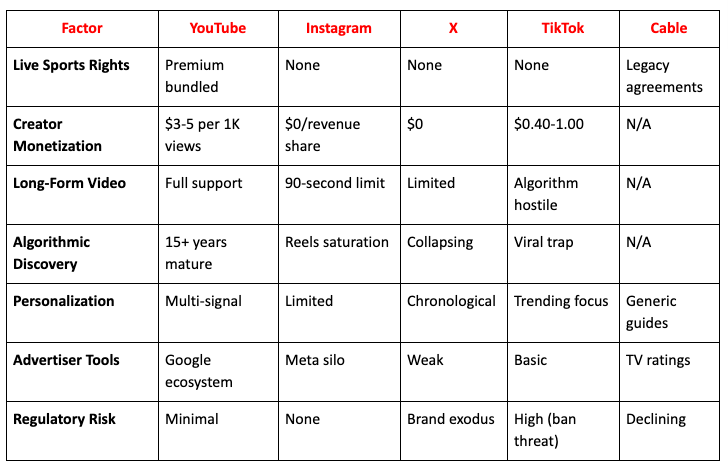
Monetization Gap: Instagram offers virtually zero direct ad revenue; YouTube pays $3-$5 per 1,000 views
Short-Form Trap: Reels limit creators to 90 seconds; YouTube’s long-form enables 10-30 minute breakdowns, generating higher revenue
Ephemeral Value: Reels disappear within 48 hours; YouTube content remains searchable for years
No Live Sports Integration: Instagram lacks premium live sports broadcasts; YouTube integrates them seamlessly
More sports creators now realize that YouTube is a better use of their time. The platform pays more, supports long-form content, offers live sports, and makes it easier for fans to find content over time, helping creators earn more.
TikTok faces a perfect storm: regulatory uncertainty that makes it an unreliable long-term platform, combined with structural monetization weaknesses that pale in comparison to YouTube’s Sports Plan integration.
The U.S. Court of Appeals upheld the Protecting Americans from Foreign Adversary Controlled Applications Act (PAFACA) in December 2024, requiring ByteDance to divest its U.S. TikTok operations or face a ban by January 19, 2025. While President Trump has extended the deadline multiple times (currently to December 16, 2025), the platform’s future remains uncertain. For sports teams, leagues, athletes, and creators, building a long-term audience and content library on a platform that may disappear or degrade is irrational, given that YouTube offers stability and integration. YouTube could capitalize on the potential TikTok ban to attract creators quickly, emphasizing its robust ecosystem and monetization options. Such a scenario would not only enhance YouTube’s hold in the sports content domain but also encourage creators to transition swiftly to secure their content futures.
Additional Weaknesses:
Monetization: TikTok pays $0.40-$1.00 per 1,000 views—one-tenth of YouTube’s rate
Algorithm Virality Trap: Prioritizes viral hits over consistent growth
No Live Sports Rights: Captures highlights but misses core live viewing events
Ephemeral Reach: Videos lose visibility unless continuing to trend
Even though TikTok has many sports video views, its low payouts and regulatory risks are pushing creators and athletes to switch to YouTube.
Traditional Cable and Regional Sports Networks: The Accelerating Death Spiral
YouTube’s Sports Plan accelerates the death spiral of traditional cable and Regional Sports Networks (RSNs). NBA local ratings dropped 50% or more for multiple teams in 2025, with the Chicago Bulls suffering a 62% decline mainly due to distribution disputes. For local fans, this has led to significant confusion and frustration, particularly because blackout restrictions prevent them from accessing games via both streaming and traditional means. A vivid example is a lifelong Bulls fan missing out on marquee games because regional networks no longer have the rights, forcing them to seek alternative, often unreliable, streams. This disruption in viewing habits highlights the challenges fans face as they transition to new platforms.
NBA Commissioner Adam Silver stated, “Local game broadcasts are caught in legacy media, which is rapidly declining. And our young fans... they’re cord-nevers. It’s not part of their lives to buy cable.”
Despite cable subscriber losses slowing slightly (Charter lost only 80,000 video customers in Q2 2025 vs. 408,000 in the prior year), the remaining cable subscribers are aging, and younger audiences have permanently migrated to streaming.
Why Cable and RSNs Cannot Compete:
No Creator Ecosystem: Only live games and studio shows; YouTube offers thousands of creators producing analysis, highlights, and reactions
No Personalization: Linear model forces viewers to watch on broadcaster’s schedule; YouTube enables on-demand, personalized experiences
Cost and Complexity: Long-term contracts, equipment fees, rigid bundles vs. YouTube TV’s month-to-month, app-based, genre-specific pricing
Measurement and Targeting: Rudimentary ratings data vs. YouTube’s closed-loop attribution and precise targeting
Cable and regional sports networks are losing their last stronghold, sports fans, because YouTube TV offers a better product, better prices, and a much-improved experience for both viewers and advertisers.
Twitch: Live Streaming’s Sports Opportunity Missed
Twitch recorded its lowest monthly viewership in five years in August 2025, with watch time dropping 9%, average viewers falling 8%, and peak concurrent viewership plummeting 73% compared to July. The platform’s crackdown on viewbotting exposed that 41,000+ channels showed signs of viewbotting, and the cleanup pushed Twitch’s metrics back to March 2020 levels.
Why Twitch Fails at Sports:
Gaming-First Identity: Sports content feels out of place and struggles for algorithmic visibility
No Premium Sports Rights: Cannot attract sports viewers for live games
Advertising Challenges: Advertisers fled following brand safety controversies
Poor User Experience: Mandatory pre-roll ads, unpausable live streams, removal of ad-free subscriptions
Twitch remains popular for gaming and esports, but because it cannot attract sports content, YouTube now leads the sports video space.
Facebook/Meta: The Video Platform That Failed
Facebook aggressively pursued video starting in 2016, paying athletes and media companies to produce Facebook Live content. By 2023, publishers reported a dramatic drop in Facebook referral traffic as Meta signaled its exit from the news business, with Zuckerberg and his team moving away from content partnerships that had defined the platform’s video ambitions.
Facebook Watch pulled back on original shows and live sports, and Facebook Live, once hyped as the future of sports broadcasting, faded into irrelevance.
Why Facebook Lost Video:
Creator Monetization Betrayal: Poor reputation after collapsing media startups, then abandoning the strategy
Reels Underperformance: Pays creators $0.60 per 1,000 views—fraction of YouTube’s rate
Algorithmic Demotion: News Feed no longer prioritizes video or external links
No Live Sports Strategy: Abandoned live sports rights
Facebook is no longer important for sports content. Today, it is mainly used for occasional Reels, and a few serious creators or athletes focus on it.
Why YouTube Will Emerge As the Premier Platform
Industry Validation
IMG’s 2025 Digital Trends Report explicitly names YouTube as the “priority platform” for the sports industry, with analysts stating it ranks number one because it can “reach, engage and monetise audiences” better than any competitor. This industry-wide endorsement reflects YouTube’s structural advantages across every stakeholder group.
One Unified Ecosystem for Live and Social
YouTube is the only platform combining:
Premium live sports (all major broadcasters, ESPN networks, NFL Sunday Ticket, RedZone, specialty channels)
Creator-driven content (highlights, analysis, reactions, vlogs, personal stories)
Athlete personal brands and monetization
Team and league direct-to-consumer strategies
Personalized algorithmic discovery across live and social content
Live games on YouTube TV start a positive cycle: fans come to watch live games, then find creator analysis and commentary through recommendations. This helps sports creators get more views and subscribers, even if they might struggle on other, more fragmented platforms.
Superior Economics for Every Stakeholder
For Creators and Athletes:
YouTube pays $3-$5 per 1,000 views for long-form content—10-50x more than TikTok ($0.40-$1.00)
Monetization stack includes ads, Premium revenue share, memberships, Super Chats, merchandise, and sponsored integrations.
Opendorse, Vimeo Creator Funds, and other NIL platforms increasingly anchor deal flow around YouTube due to its superior watch-time and audience stability metrics.
Long-form content, usually 10 to 30 minutes, helps creators build genuine relationships and loyalty with their audience. This leads to higher long-term value.
For Teams and Leagues:
YouTube provides global reach, fine-grained analytics, and data-rich fan relationships without requiring proprietary tech investment.
DAM platform integration (Tenovos, VSN ArenaPro) enables efficient asset management and “shot-to-social” publishing at scale.
Dynamic sponsorship tools allow rotating ad slots within content, creating recurring revenue from existing video libraries.
Closed-loop attribution demonstrates ROI to sponsors, driving advertiser investment.
For Fans:
Unified experience spanning live games, highlights, creator analysis, athlete content, and community discussion.
Personalized feeds powered by YouTube’s algorithm, learned preferences, and real-time engagement signals.
Features such as multiview, fantasy view, key plays, and unlimited DVR enable customized second-screen experiences.
Ability to directly support creators, athletes, and teams through memberships, Super Chats, and merchandise.
For Brands:
Precision targeting via Google’s advertising ecosystem, reaching specific audience segments with granularity impossible on competing platforms.
Dynamic sponsorships and AI-powered brand matching through YouTube BrandConnect.
Closed-loop attribution from game broadcast to creator content to conversion.
Premium sports audiences command high CPMs ($12-15+), driving advertiser investment.
Before looking at the details, it’s essential to see that YouTube’s unique strengths put it far ahead, making it hard for competitors to keep up. These advantages make it difficult for others to match what YouTube offers:
Product-Market Fit with How Fans Now Watch
By 2025, over 90 million people in the U.S. will stream sports each month. More viewers now prefer highlights, condensed games, creator commentary, and vertical videos instead of traditional broadcasts—formats where YouTube leads.
IMG’s Digital Trends Report notes that more fans now use a “second screen” and multitask, watching games on TV while using their phones for Shorts, stats, chat, and creator content. YouTube can succeed on both screens at once: TV for live games, and mobile for Shorts, community interaction, and creator content.
The Role of AI in Personalizing Sports Content on YouTube
AI will power nearly every part of YouTube’s sports experience. It will help decide what you see, how content is edited, and how it’s tailored to you. For example, sports leagues can use AI tools to analyze viewer engagement data in real-time, allowing them to fine-tune live broadcasts and highlight packages to maximize viewer satisfaction. Brands can leverage AI to personalize advertising content based on audience preferences and viewing habits, resulting in more targeted, effective marketing campaigns. Additionally, teams can adopt AI-driven analytics to offer fans personalized content packages tailored to their interests, from player statistics to game highlights.
Hyper-Personalized Feeds and Recommendations
YouTube’s recommendation systems already use machine learning to optimize for watch time and satisfaction; as sports become more central, these systems will learn fine-grained preferences like:
Teams and leagues you follow
Specific players and positions
Preferred formats (short vs. long, serious vs. entertaining)
Tone preferences (tactical analysis vs. memes vs. fan reactions)
Consumption patterns (when, on which device, duration)[63][64]
IMG’s Digital Trends 2025 states that the next era is “personalisation, not personalities”: fans want feeds that understand them as individuals, with platforms serving different mixes of live, highlights, and creator content across TV and mobile, exactly the “both screens” battle YouTube is positioned to win.
Automated, Customized Highlights at Scale
AI highlight engines like WSC Sports take live feeds, detect key events in real-time, and auto-create clips and packages; ESPN and others use their tech to generate thousands of short-form clips across 30+ sports.
These systems will evolve to build different edits for different fans:
One person gets all the dunks and three-pointers
Another gets only their fantasy team’s touches
Another receives a 2-minute game recap suitable for Shorts and mobile
Another gets a 15-minute tactical breakdown with advanced metrics overlay
With AI-driven customization, highlight content shifts from generic packages to dynamic, personalized experiences. Each fan receives a highlight reel tailored to them.
More innovative Packaging: Formats, Language, and Context
AI can automatically re-version content into multiple formats:
Widescreen for TV viewing
Vertical for Shorts and mobile
10-minute versions for deep-dive enthusiasts
30-second versions for casual scrollers
Different languages with real-time subtitles and dubbing
Localized context (references, team histories, player backgrounds relevant to each market)
IMG highlights AI-driven localization as key to how the industry will “scale and personalise” global sports output, enabling one piece of content to reach many regions with culturally adapted context.
Creator and Athlete Assistance Tools
Generative AI will help creators and athletes brainstorm topics, write titles and descriptions, generate thumbnail ideas, and even rough-cut videos, speeding up the shoulder-content pipeline around games.
Tools like Subscribr already use AI to suggest sports highlight niches based on demand data; similar systems living closer to YouTube itself will nudge creators toward the kinds of videos fans like them will engage with, creating a collaborative human-AI content strategy.
Fan Data to Product Feedback Loops
AI will fuse viewing signals (what you watch, skip, rewatch) with interaction signals (likes, comments, Super Chats, subscriptions) and external cues (search queries, generative-AI requests) to refine what sports content YouTube surfaces.
WSC Sports describes this as moving from “guessing to knowing”: using real-time signals to decide which clip to send which fan on which platform at which moment, something that maps directly onto YouTube’s multi-device, multi-format world, where fans might see WSC Sports’ AI-cut highlights on Shorts during work, then YouTube TV’s live game on a big screen at home, then a creator’s 20-minute tactical breakdown later that evening.
The Net Effect: Adaptive Sports Companion
AI makes YouTube’s sports section more than just a channel guide. It acts as an adaptive sports companion, curating games, highlights, creators, and athlete stories based on each fan’s habits and interests, something no human team could do at this scale.
A casual fan might receive an algorithm optimized for quick highlights, trending storylines, and team-focused content. A fantasy football enthusiast gets player touches, usage rates, and injury analysis. A coach or analyst receives full-game replays with coaching-film perspectives. An international fan gets real-time localization, cultural context, and adapted commentary.
All of this happens automatically, powered by AI that learns each user’s preferences over time and iteratively optimizes what gets surfaced.
The Broader Ecosystem of Beneficiaries
Beyond the primary winners (Opendorse, VidIQ, TubeBuddy, WSC Sports, DAM platforms, and Google), YouTube’s Sports Plan catalyzes a multi-billion-dollar ecosystem:
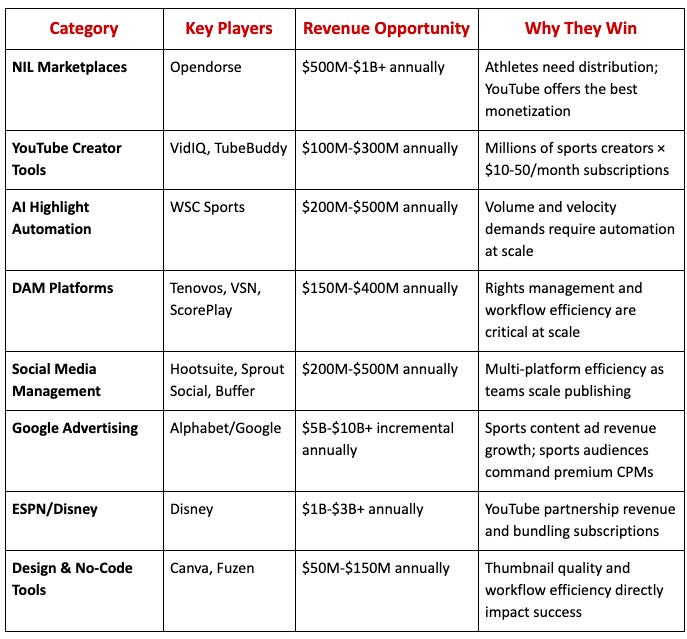
The total value of the ecosystem beyond YouTube is estimated at $7 billion to over $15 billion each year.
Strategic Imperatives Going Forward
For Sports Creators and Athletes
Priority #1: Build on YouTube. The economics are superior (10-50x better pay than competitors), the reach is unmatched (IMG validates YouTube as #1), and the monetization infrastructure is comprehensive (ads, memberships, Super Chats, merch, sponsorships). First-week action: Perform a YouTube channel audit to assess current content performance and identify areas for improvement.
Priority #2: Use creator tools strategically. VidIQ or TubeBuddy subscriptions are ROI-positive when they accelerate growth; prioritize YouTube-first optimization over generic social media strategies. First-week action: Draft a long-form video outline that leverages current trends and integrates feedback from VidIQ or TubeBuddy for maximum impact.
Priority #3: Integrate with NIL marketplaces. Platforms like Opendorse increasingly anchor brand deals around YouTube metrics; building a strong channel creates leverage for higher-value endorsement contracts. First-week action: Register on a NIL marketplace, such as Opendorse, and set up your profile to begin attracting brand partnerships based on YouTube metrics.
For Teams and Leagues
Priority #1: Consolidate digital strategy around YouTube. Rather than fragmenting content across 10 platforms, focus on YouTube as the primary distribution channel, with a careful secondary presence on Instagram and X.
Priority #2: Invest in DAM infrastructure. Platforms like Tenovos and VSN ArenaPro with YouTube integration become essential as publishing volume scales; poor asset management creates friction and lost revenue.
Priority #3: Partner with AI highlights teams. WSC Sports-type automation enables shot-to-social publishing at scale, turning live games into unlimited content opportunities across formats and languages.
For Brands and Sponsors
Priority #1: Shift budget to YouTube. Sports audiences on YouTube command premium CPMs ($12-15+), and closed-loop attribution proves ROI in ways X, Instagram, and TikTok cannot match.
Priority #2: Use dynamic sponsorship tools strategically. Rotating brand placements within long-form creator content generates recurring revenue and enables continuous campaign optimization.
Priority #3: Partner directly with creators. YouTube’s BrandConnect and Opendorse’s brand matching automate the influencer marketing process, reducing transaction costs and accelerating deal velocity.
The Inevitability of YouTube’s Sports Dominance
YouTube’s Sports Plan is more than just a competitive move. It changes how sports content is created, shared, and watched. By combining live sports rights, a strong creator community, proven monetization, advanced personalization, and Google’s advertising and data tools, YouTube has built an advantage that competitors can’t match. The data is precise:
IMG’s 2025 Digital Trends Report crowns YouTube the #1 priority platform for sports, explicitly noting its superior ability to reach, engage, and monetize audiences.
YouTube’s creator pay rates ($3-$5 per 1K views) are 10-50x higher than competitors, making it the rational choice for anyone serious about sports content.
YouTube’s recommendation algorithm, refined over 15+ years, remains unmatched in its ability to match content to individual interests across sports, formats, and consumption modes.
YouTube’s Sports Plan adds premium live rights, concentrating sports viewership, and creating a flywheel in which live audiences discover creators and vice versa.
The losers (Instagram, X, TikTok, cable, Twitch) all face structural weaknesses, monetization gaps, regulatory uncertainty, algorithmic saturation, or failing business models that prevent them from competing effectively. Even platforms that add sports features (Threads’ sports communities, X’s sports portals) cannot overcome the fundamental economics: YouTube pays creators, offers live games, and integrates discovery in ways that fragmented platforms cannot match.
For sports creators, YouTube offers the chance to build sustainable careers on diversified income streams.
For athletes, it enables authentic brand-building and NIL monetization extending beyond playing careers.
For teams and leagues, it provides global reach and data relationships without proprietary tech investment.
For fans, it delivers personalized, immersive experiences respecting their time and attention. For brands, it provides precision targeting and closed-loop attribution at scale.
With live sports, creator earnings, AI personalization, and Google’s infrastructure coming together, YouTube’s dominance seems inevitable. The real question now is how soon everyone will see that success in today’s sports media means starting with YouTube before considering other platforms.