

Every endurance brand says it wants growth. But for a certain tier of events, the real product has never just been miles, medals, and merch. It is scarcity, identity, and social currency. When athletes enter a race that always sells out, the bib serves as more than an entry credential; it becomes proof of belonging to a tribe and of participation in a moment that carries status.
That is why decisions such as split days, expanded fields, or additional inventory are not merely operational. They are brand architecture decisions. Expanding supply changes not only who can participate, but what participation means.
Scarcity Is Part of the Product
For many iconic endurance events, demand is driven by more than course quality or production value. The appeal is built on three reinforcing forces: scarcity, narrative, and social signaling. A hard-to-get entry creates urgency; the event’s mythology creates desire; and the public display of participation turns entry into a badge of honor.
That combination creates a powerful flywheel. Registration drama fuels anticipation; anticipation fuels social sharing and conversation; social sharing and conversation fuel aspiration; and aspiration sustains pricing power. In that kind of system, the sellout is not a side effect of demand. It is part of the product itself.
Lived Experience With Growth
This argument is not theoretical. I have lived both sides in my career.

During my time with Competitor Group, as we expanded the Rock ‘n’ Roll Marathon Series, growth was never just about pouring more runners into the same event. The strategy was to add new destinations with their own unique identities and stories. Each city needed to feel distinct: a different music culture, a different course personality, a different “I did this one” memory that athletes could attach to their identity.
And then there was Rock ‘n’ Roll Las Vegas.
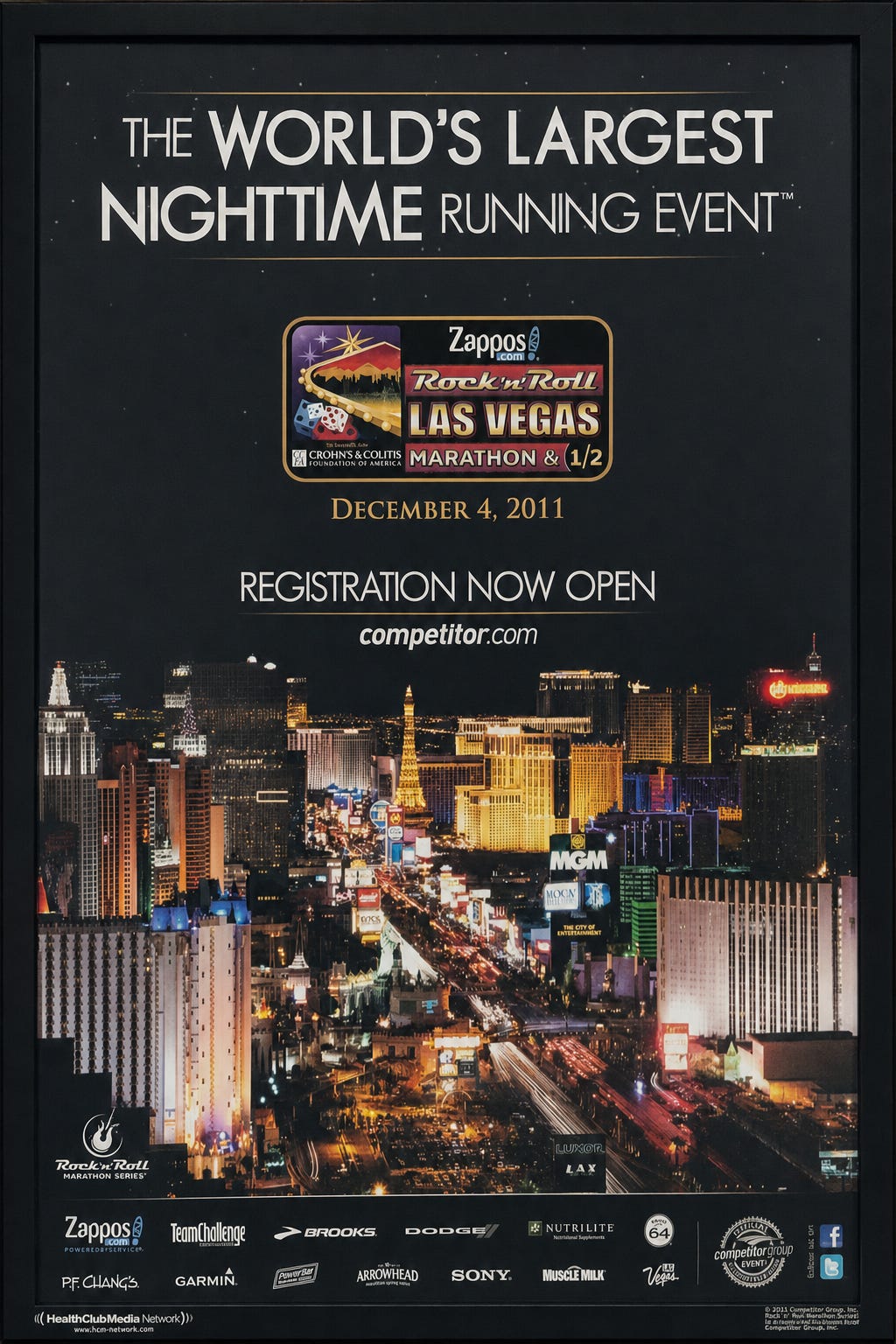
If there is a case study in how to grow without diluting the halo, it is what the team did by moving Las Vegas from a traditional morning start time to a nighttime experience and building the “Strip At Night” platform. Instead of simply increasing capacity, the product itself changed. Running under the lights on the Las Vegas Strip in prime time became its own form of social currency and a call to action.
Participants were not just doing a race. They were running the Strip At Night.
The team deserves enormous credit for turning that into something athletes instantly understood and wanted to be part of. Lucy, Dan, Maya, Megan, Stacey, and many others did a masterful job transforming “Strip At Night” into a clear call to action and a marketing platform with immediate cultural resonance. The uniqueness was the growth strategy. The experience was the marketing.
That is the critical difference. Growth can work when expansion creates new meaning. It becomes far riskier when expansion simply adds more of the same product and hopes the original aura survives.
What Happens When Supply Expands Without New Meaning
When organizers add a large amount of inventory to a scarcity-driven event without creating a new layer of meaning, three risks usually emerge.
The status premium weakens because access is no longer as exclusive.
Pricing becomes harder to sustain because consumers start evaluating the event more by its tangible features than by the privilege of getting in.
The registration ritual loses heat because the waitlist, lottery tension, and instant-sellout energy no longer carry the same FOMO.
Year one can disguise these issues. Pent-up demand gets released, loyal participants are curious, and the market often rewards novelty. But the true test is what happens in years two and three, once the newness fades. If the event no longer feels like a must-have badge, demand often normalizes faster than operators expect.
Ironman as a Cautionary Case Study
Ironman’s recent handling of the World Championship offers a strong cautionary example. In 2022, the event in Kona was held over two days with roughly 5,200 athletes, about double the traditional field, which highlighted both the scale opportunity and the logistical strain of trying to grow the championship in its historic home.
From 2023 through 2025, Ironman separated the men’s and women’s World Championships across Kona and Nice, alternating venues by gender. The move was framed around practical and principled goals: reduce operational pressure in Kona, give women a dedicated race day and venue, and preserve championship prestige while expanding opportunity.
In theory, that was a thoughtful solution. In practice, it revealed how fragile the meaning of an iconic event can be when format changes disrupt the core story. Kona was not just valuable because it was difficult to reach. It was valuable because it was the shared center of gravity for the sport: one place, one mythology, one collective annual pilgrimage.
Once that unity was broken, part of the symbolic power weakened. Athletes and observers increasingly argued that the split diluted tradition and fractured the communal feeling that had made Kona singular. The men’s and women’s races may each have retained elite sporting importance, but the championship no longer carried the same concentrated cultural energy when the experience was divided across places and years.
Just as importantly, the experiment did not deliver its hoped-for growth outcome. Ironman’s own leadership later acknowledged that the split did not produce the expected increase in women’s participation. That matters because it turns a controversial format change into an even sharper lesson: if an organizer asks the market to give up tradition, shared identity, and emotional continuity, the upside has to be both real and visible.
Instead, the market response suggested a mismatch. The format solved some operational issues, but it also weakened the very narrative architecture that made the World Championship special. That is why Ironman announced that, beginning in 2026, the World Championship would return to Kona as the exclusive location, with men and women competing for world titles on the same day.
That reversal is significant. It amounts to a recognition that iconic events derive value not only from access restrictions or field composition, but from ritual, concentration, and shared meaning. In other words, scarcity alone is not enough. The event has to feel whole.
The Strategic Lesson
The lesson for endurance properties is not that growth is bad. It is that growth has to create new value rather than simply spreading existing value thinner.
There are two smarter ways to do that:
Create deliberate tiers of exclusivity inside a broader footprint, such as heritage waves, limited-capacity premium experiences, or distinct competitive categories.
Reimagine the product so that expansion adds a new story, such as a destination strategy or a format innovation that creates fresh cultural relevance rather than just additional capacity.
Without one of those moves, an organizer risks trading long-term brand heat for short-term revenue. That is the larger issue at stake in the current debate around split days and expanded fields. The question is not whether there is enough demand to fill more slots once. The question is whether the event will still command premium identity value after the market learns that access is no longer rare.
London Changes the Stakes
This debate is no longer hypothetical. London Marathon Events has confirmed that the 2027 TCS London Marathon will become a two-day event, allowing a record 100,000 participants to run the traditional 26.2-mile course across Saturday, April 24 and Sunday, April 25, 2027.
Many in the running industry are calling it a “massive game-changer.” They are correct. A move of that scale has the potential to reshape expectations across the endurance industry and force every major organizer to rethink capacity, format, and brand value.
The open question is whether London becomes the blueprint others follow or the cautionary tale they study. If the two-day format creates fresh layers of meaning, differentiated experiences, and new forms of social currency, it could redefine what a major city marathon can be without losing its halo. But if it simply doubles the inventory, it risks falling into the same trap that iconic events often face when growth outpaces narrative design.
That is why the implications reach beyond London. With record ballot demand and a one-off two-day format now confirmed, the 2027 race becomes a live market test not only for London Marathon Events, but for the broader Abbott World Marathon Majors ecosystem.
The next few years may answer a bigger strategic question for the category: in an era of extraordinary participation demand, do the world’s most storied races want to be bigger, or more iconic?