What 90 Days of Showing Up Did to My LinkedIn (and My Ego)
I used AI to write more, and dig deeper, and caught myself leaning on it as a crutch. A candid account of 90 days, the metrics, and the honest line between tool and shortcut.
Earlier this year, I did something that, on paper, sounds almost too simple to write about: I joined a small accountability squad and committed to posting on LinkedIn twice a week for 90 days: February 1 through April 30.
No growth hacks. No paid amplification. No algorithm whispering. Just a handful of people in different time zones, a shared agreement, and a rule that we’d actually show up for each other.
Here’s what happened: the numbers, the mechanics, and the part nobody puts in the case study: how it actually felt, and what I learned about writing with AI without letting it write for me.
The setup
The idea was almost embarrassingly low-tech. A few professionals who respected each other’s work signed a one-page agreement and committed to a 90-day sprint. The terms were specific and, crucially, sustainable:
Two posts a week. No more. The cap mattered as much as the floor. The goal wasn’t to flood the feed; it was to be consistent without burning out.
Engage with each other. Each week, you committed to genuinely liking and commenting on a chunk of the group’s posts. Not essays. A real “love this” was enough.
Keep it clean. Nothing political, nothing engineered to provoke. If you wouldn’t want the group to amplify it, you didn’t post it.
Show up or step out. Ghost your commitments and you were out; no drama, but the whole thing only worked if everyone was actually in.
We set two measurable goals: grow followers by 25%, and grow profile views by 25%, measured from day one to day ninety. We checked in weekly over messaging and did a snapshot review every couple of weeks.
That was it. The entire “program” fit on a single page.
The results
I’ll give you the honest version, not the LinkedIn-flex version.
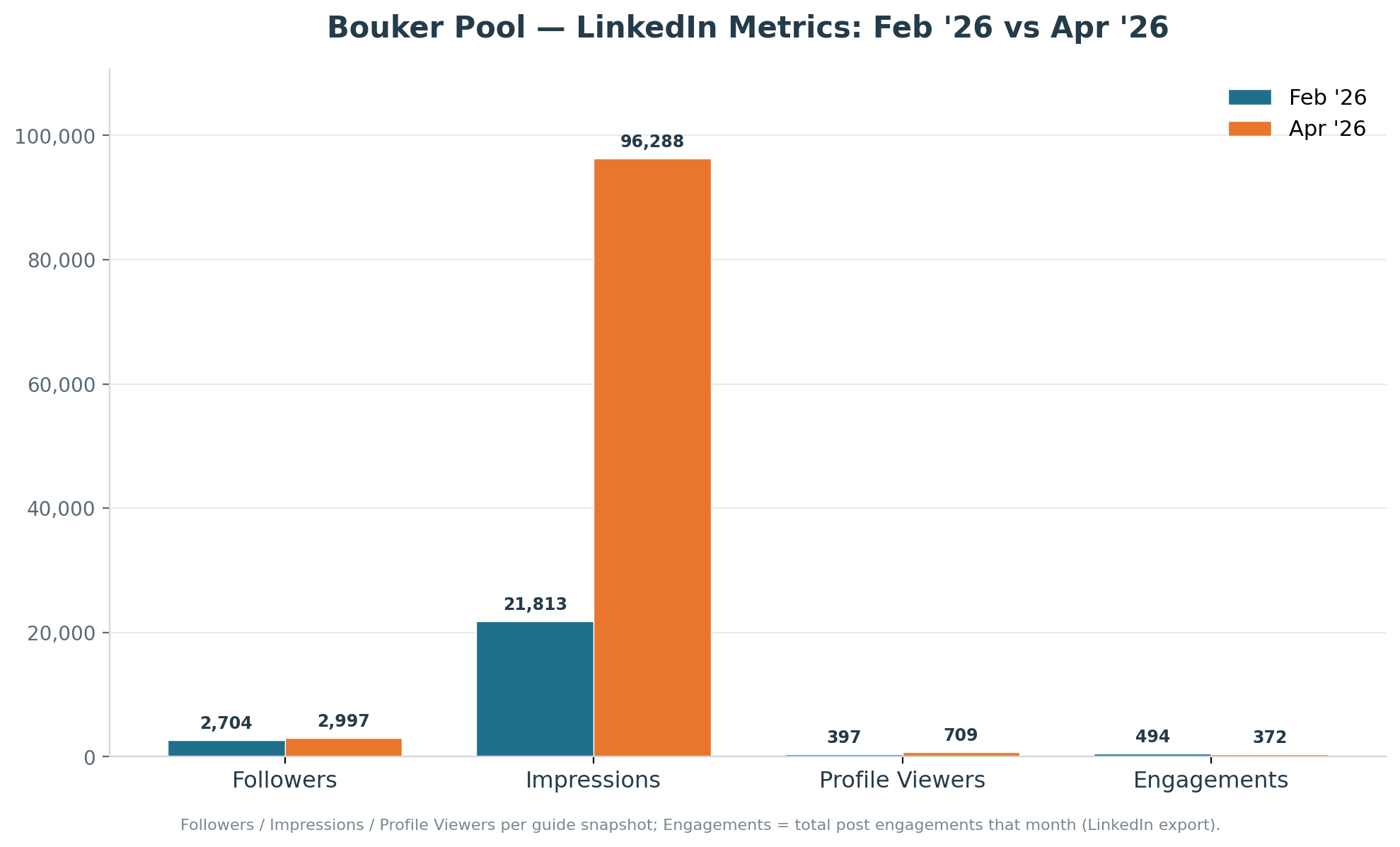
Reach exploded. This was the headline I didn’t see coming. Over the 90 days, my monthly impressions climbed from roughly 22,000 to nearly 96,000; more than a 4x jump. Total impressions across the sprint cleared 97,000, reaching over 50,000 unique people. For someone posting twice a week from a standing start, that compounding still surprises me.
Profile views blew past the goal. The target was +25%. Profile viewers nearly doubled over the period, up close to 80%. To me, this is the metric that actually matters. Impressions are vanity-adjacent; a profile view means someone got curious enough about you to click.
Followers grew, but I missed the stretch goal. I added several hundred net new followers over the sprint. Real, steady growth. But I did not hit the +25% target. I landed meaningfully short of it. And I want to sit with that for a second rather than spin it.
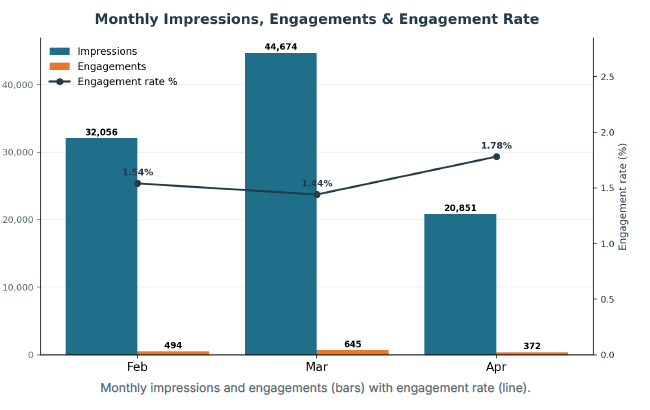
Engagement stayed real. My engagement rate hovered around 1.5% across 45 posts over the 90 days, a few breakout pieces, a lot of solid middles, and the occasional thing that landed with a thud. The posts that performed best weren’t the ones I labored over. They were the ones closest to what I actually think about all day.
What actually drove it
A few patterns held up across the whole sprint:
Consistency beat brilliance. The single biggest lever wasn’t any individual post. It was just showing up twice a week, every week. The algorithm rewards rhythm, and so do humans, people start to expect you.
The pod was the unlock. Early engagement from even a handful of committed people gives a post initial velocity, and velocity is what the feed reads as “this is worth showing to more people.” A small group that genuinely shows up for each other punches far above its size.
Niche outperformed breadth. My best-performing content was tightly in my lane, the stuff I have actual conviction about. When I drifted toward generic “thought leadership,” it sank. The numbers were unambiguous: specificity wins.
The cap protected the quality. Two posts a week sounds like a constraint. It was actually a gift. It forced me to choose, which meant fewer throwaway posts and more that I’d stand behind.
For the first couple of weeks, it felt like homework. There’s a specific flavor of dread in opening the app on a Tuesday knowing you owe the group a post and you’ve got nothing. I resented it a little. I questioned whether any of this was a good use of a serious person’s time.
Then something shifted. Somewhere in the first month, the obligation turned into a rhythm, and the rhythm turned into something I actually looked forward to. Knowing a few people would read and respond, really respond, changed how I wrote. I stopped performing for a faceless feed and started writing to specific humans I respected. The work improved because the audience became real.
The accountability cut both ways, and that’s the point. There were weeks I didn’t feel like engaging with anyone’s posts, but I’d committed, so I did, and half the time I’d learn something or reconnect with someone in the process. The reciprocity wasn’t a tax. It was the whole engine.
And the missed goal? I’ve made peace with it. Falling short of +25% followers while nearly doubling profile views taught me which number I actually care about. Followers are a lagging vanity metric. Profile views are intent. If I had to choose, I’d take the curiosity every time.
But I won’t pretend it didn’t sting a little. I’m competitive. I signed an agreement, I named a target, and I didn’t hit it. That tension, between the result I wanted and the result I got, is more useful to me than a clean win would have been. It tells me exactly what to fix next time: not the consistency (that worked) but the invitation, giving people a clearer reason to follow, not just to glance.
A note on the writing itself
Here’s the part I almost left out, and the part I now think matters most.
I’ve never considered myself a “writer.” I’ve always respected the craft and the people who truly dedicate themselves to it; those like Steve Madden, Bill Strickland, Mario Fraioli, and others. My own process has been different: capturing thoughts in notebooks, voice notes, and conversations, often while running or cycling, narrating ideas to no one at mile six. The hard part was never having the thoughts. It was taking those scattered inputs and turning them into something coherent and intentional, and then into something I’d actually put my name on. This is the first time since college that I’ve consistently engaged in longer-form writing outside of business decks and memos, where the argument has to carry itself.
And this is where I have to be honest about AI, because writing about consistency and self-improvement while quietly papering over how the words got made would be its own kind of dishonesty.
At its best, it has been a tool for clarity and depth. I’ve used AI primarily to help structure ideas, surface relevant data, and pressure-test perspectives. When I came in with one confident take, I could ask it to argue the other side, and more than once that forced me off a lazy conclusion. It pushed me beyond a single source of truth to explore multiple perspectives, engage more rigorously with the data, and better articulate my own point of view. That is genuinely how I want to use the tool: as a sparring partner that raises the floor on rigor.
At its worst, I’ve caught myself leaning on it too heavily; using it as a shortcut rather than doing the harder work of thinking. I won’t pretend otherwise. The danger isn’t that AI writes a bad sentence. It’s that it writes a perfectly fine one, and you nod, and a little bit of your own voice quietly goes missing. That tension, between using it for clarity and leaning on it as a crutch, has been part of the learning.
So the real discipline of these 90 days wasn’t the posting cadence. It was staying honest about where AI fits, while keeping the core ideas grounded in my own experience and thinking. That line between tool and shortcut is thinner than people admit, and it doesn’t hold itself. You have to choose it, sentence by sentence, especially on the days you’re tired.
The process has been both rewarding and uncomfortable, full of moments of frustration and self-doubt, as well as genuine enjoyment. It made me think harder than I have in years, not in spite of the AI, but because using it honestly demanded that I show up with something real for it to work on.
Would I do it again?
Yes. Without hesitation.
Not because of the impressions, though those were nice. Because the thing I was quietly afraid of, that I’d commit publicly, fall short, and feel foolish, happened in miniature, and it was completely survivable. I learned more from the goal I missed than the ones I cleared.
If you’re a professional who keeps meaning to “be more consistent on LinkedIn,” I’ll save you the long version: the platform isn’t the obstacle, and neither is your content. The obstacle is showing up alone. Find three or four people who’ll hold you to it and hold you back. Cap your output so it’s sustainable. Pick a lane and stay in it. Then just do it for 90 days and measure honestly.
The growth is real. But the part that lasts is what showing up consistently does to your relationship with your own work, and, in my case, to the act of writing itself. This feels like the beginning of something, not necessarily a perfectly consistent habit, but a meaningful step in how I process, develop, and share ideas going forward. I’ll keep doing the work of getting it out of my head and onto the page, using AI as a sharpener, not a substitute, and keeping the voice honestly my own.
90 days. Two posts a week. AI as a sparring partner, not a ghostwriter. Turns out the discipline was never the cadence — it was keeping the voice my own.