

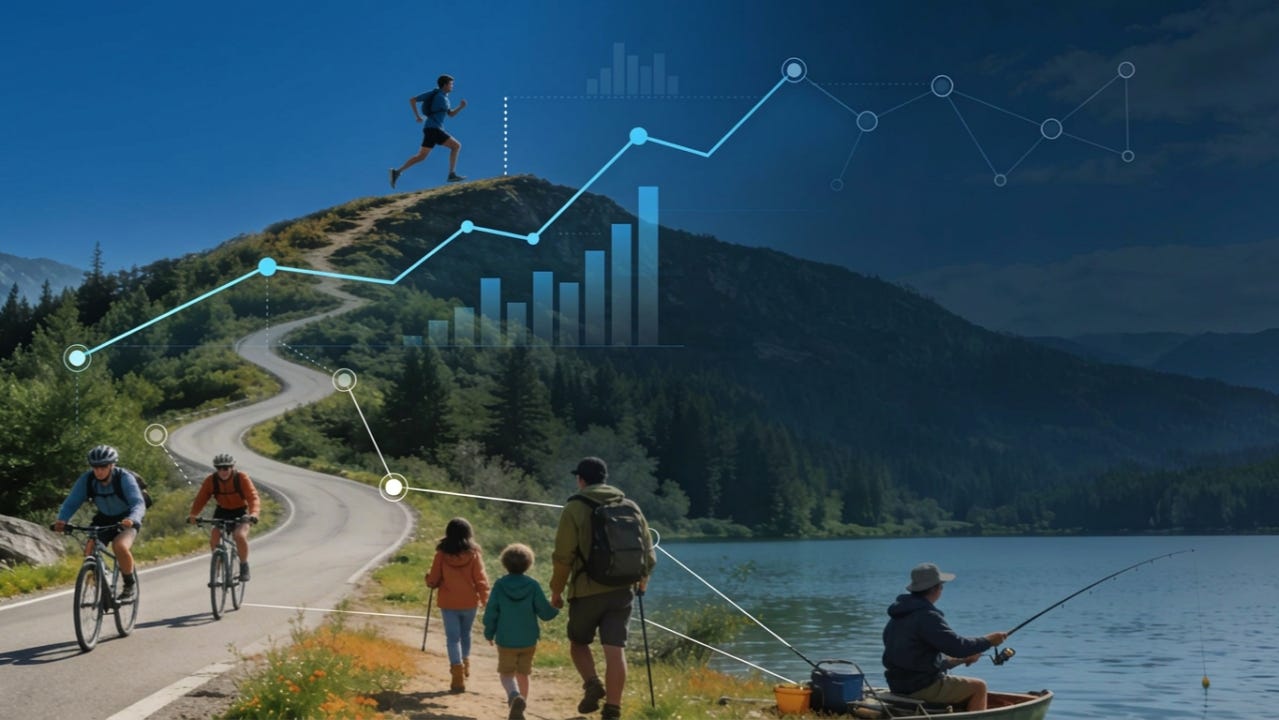
Every once in a while, an industry undergoes a structural transformation so significant that it redefines who the winners and losers will be for the next decade. The mass participation events space is in the middle of one right now, and I’ve written about that opportunity extensively. But there is an even larger, more capital‑intensive reset happening right next door: the outdoor recreation economy.
At $1.3 trillion in gross output, 5.2 million jobs, and 2.4% of national GDP, outdoor recreation is no longer a lifestyle niche; it is a pillar of the American economy. It is nearly four times the size of air transportation and more than three‑and‑a‑half times the size of motor vehicle manufacturing. Yet for all its scale, the sector remains deeply fragmented, under‑capitalized relative to its economic contribution, and ripe for the same kind of consolidation and platform‑building now reshaping endurance sports, youth athletics, and live events.
The starting gun has fired here, too.
The Macro Picture:
A $1.3 Trillion Economy Still Accelerating
The latest BEA data puts outdoor recreation’s gross output at a record $1.3 trillion in 2024, up from $1.2 trillion in 2023, with value‑added reaching $697 billion, 2.4% of U.S. GDP. Total compensation for workers in the sector has climbed to roughly $324 billion, accounting for 3.2% of all U.S. wage and salary income.
Zooming out, the trajectory is even more telling. Between 2012 and 2023, the outdoor recreation economy grew by 37%, outpacing the broader U.S. economy at 29% and beating sectors such as education and health care (26%) and finance, insurance, and real estate (33%). Outdoor recreation on federal public lands and waters alone generates an average of $351 million per day.
Growth is normalizing off the pandemic spike; 2024 real GDP growth in outdoor recreation was 2.7%, slightly under the overall economy’s 2.8% and down from 5.3% in 2023. But it is normalizing at a massive base, with long‑term demographic, cultural, and policy tailwinds that suggest the next leg is forward, not backward.
The Participation Boom:
New Faces, New Behaviors, New Opportunity
This is not just an economic story. It is a participation story, and the parallels to the mass participation events reset are striking.
Outdoor participation hit another record in 2024: 181.1 million Americans aged six and older engaged in outdoor recreation, representing 58.6% of the population. That followed a 4.1% jump in 2023 to 175.8 million participants. Virtually every signal in the participation data indicates sustained growth.
The signals are clear
Scale is unprecedented: the outdoor participant base has grown by more than 11 million over the past decade.
The demographic mix is changing fast: Black participation grew 12.8% and Hispanic participation 11.8%; for the first time, over half of American women participated in outdoor recreation, while seniors (65+) grew 7.4% and youth participation rose 5.6%.
Core participants are returning: after a decade of erosion, the most frequent users increased 5.7%, adding roughly five million high‑value participants.
Gateway activities are the funnel: hiking (63 million participants), camping, bicycling, running, and fishing lead the pack, with each of the top five activities adding around 2.1 million participants.
There is one nuance that matters for investors: while more people are going outside, the average number of outings per person has declined from 87 per year in 2012 to 62.5 in 2023. This is a broader, more casual, more diversified base, younger, more diverse, and more digitally native, making more intentional choices about which communities, brands, and experiences earn their time.
That is exactly what Melanie (Mel) Strong, GP at NEXT VENTŪRES and longtime Nike operator, described on the Second Nature Media Podcast about walking every aisle at The Running Event with her team: a room that felt both familiar (Nike, adidas, the heritage players) and entirely new, lines of people around upstarts, accessory brands, and niche footwear labels, signaling where the real energy and growth are in the ecosystem. Running and trail are diversifying, and the same pattern is visible across the broader outdoor economy.
Just as in endurance sports, casualization is not a threat. It is the opportunity. More people doing fewer things, more intentionally, increases the reward for operators who own the relationship, deliver compelling first experiences, and architect progression paths that move casual participants toward deeper engagement and higher lifetime value.
The M&A Landscape: Capital Is Moving
If participation is the demand signal, the M&A environment is where the capital thesis comes into focus.
Private equity transaction volume in outdoor recreation increased approximately 93.3% year‑over‑year in 2024, a sharp rebound from the post‑COVID digestion period. Public market valuations across active outdoor and sports products have recovered from 2022 lows, with median EV/LTM EBITDA multiples improving from around 8.3x to 12.0x. Recent sector analyses peg median outdoor/active EV/EBITDA at roughly 10.7x, with outdoor footwear projected to grow at a 10% CAGR from 2025–2029.
More than $1 trillion in PE dry powder is still searching for returns. Sponsors under pressure from LPs are drawn to outdoor because the category combines:
Durable participation and “whole person health” tailwinds.
Deep fragmentation across brands, experiences, and services.
Passion‑driven consumer loyalty that can support premium pricing.
It is no accident that health‑and‑wellness funds are leaning harder into activity, access to the outdoors, and active lifestyle businesses as part of their thesis to “make healthcare more accessible” through movement and nature. The outdoor economy is increasingly a preventive health asset class as much as a discretionary leisure category.
What Investors Want: The Premium, Disciplined Playbook
Ask three different sector bankers what “great” looks like in outdoor, and you will get roughly the same list. CLA Meridian Capital’s outdoor lifestyle M&A update and other recent market notes converge on a common premium profile.
Domestic production and resilient supply chains that reduce exposure to tariffs and logistics.
Premium positioning and pricing power serving higher‑income, less price‑sensitive consumers.
Authentic brands with real communities, not just clever logos.
Sustainable materials and methods without sacrificing performance.
Proven, repeatable sales and low churn.
Tech‑enabled products and services, with embedded software, data, and recurring revenue.
The Policy Tailwind: Washington and the States Are All In
The outdoor recreation industry has something many sectors never achieve: sustained, bipartisan policy momentum.
The EXPLORE Act, a comprehensive modernization package for recreation on public lands and waters, was passed by Congress with broad support and signed into law in early 2025. It streamlines outfitter permitting, funds infrastructure, expands long‑distance trails, and codifies programs that support access in underserved communities.
At the state level, 24 states now operate formal offices of outdoor recreation, tasked with growing participation, supporting businesses, and integrating recreation into economic strategy. Programs like EPA’s Recreation Economy for Rural Communities are investing directly in towns that want to leverage trails, rivers, and parks as engines of economic development.
Despite contributing 2.4% of GDP, outdoor recreation receives only about 0.16% of federal spending, a nearly 14x gap. Closing even a fraction of that gap would send significant incremental capital into the infrastructure that underpins the entire category. Operators who are already aligned with policy priorities: health, access, equity, rural development, climate resilience, will be best positioned to benefit.
The Structural Thesis: This Looks Like Endurance Sports, But Bigger
For anyone who has followed the mass participation thesis, the outdoor opportunity should feel familiar. The structural dynamics rhyme almost perfectly, just at a larger scale and with more asset classes in play.
The core logic is the same: a structurally reset industry, powered by secular participation gains and demographic tailwinds, with deep fragmentation that rewards operators who think in portfolios, centralize data, and invest in community and technology.
But the outdoor recreation economy adds an extra layer: physical infrastructure (campgrounds, trail systems, resort‑adjacent real estate), durable goods, health and wellness adjacencies, rural development, and policy leverage. A campground platform like Ramble is as much an infrastructure bet as it is a consumer brand bet. That opens additional paths to value creation, from REIT‑style roll‑ups and operating platforms, to climate‑resilient destination development, to health‑outcomes‑linked funding.
The Emerging Playbook: What Winning Looks Like Now
The operators and investors who will capture the most value in this reset will share several characteristics.
Portfolio thinking across the outdoor journey. They will not just sell one product or activity; they will design ladders that move people from first hike to first overnight to first big objective, with offerings at each step.
Community as the operating system. As in endurance sports, the most valuable outdoor platforms will be those that treat community, not product specs, as their primary differentiator, layering gear, experiences, and content around that community.
Digital extending the physical. The trail, campground, or summit is still the hero moment. But digital tools will knit together discovery, booking, storytelling, training, and retention, and will quietly collect the first‑party data that becomes the moat.
Data‑driven discipline. The best operators will combine gut and data: “what you need to believe” about TAM, progression, and community flywheels, then test, measure, and double down where the signal is strongest.
Health and access as design constraints, not afterthoughts. Outdoor recreation already delivers billions in avoided healthcare costs and is being used explicitly as a rural development tool. Businesses that can credibly connect their experiences to health outcomes and equitable access will unlock new funding and partnership models.
The Starting Gun (Again)
The outdoor recreation industry has not merely recovered from COVID. It has reset, with record participation, record economic output, accelerating M&A, bipartisan policy support, and a fragmentation profile that creates enormous upside for operators who can combine brand, infrastructure, data, and community.
From a capital and partnership standpoint, the opportunity is to back operators who can deliver three things simultaneously:
Predictable participation, underpinned by demographic and cultural tailwinds.
Clear partner attribution, via first‑party data, technology integration, and multi‑channel go‑to‑market.
A community flywheel that compounds engagement, retention, and lifetime value over time.
The corrals are full. The demographics are shifting. The capital is mobilizing.
The starting gun has already fired.