

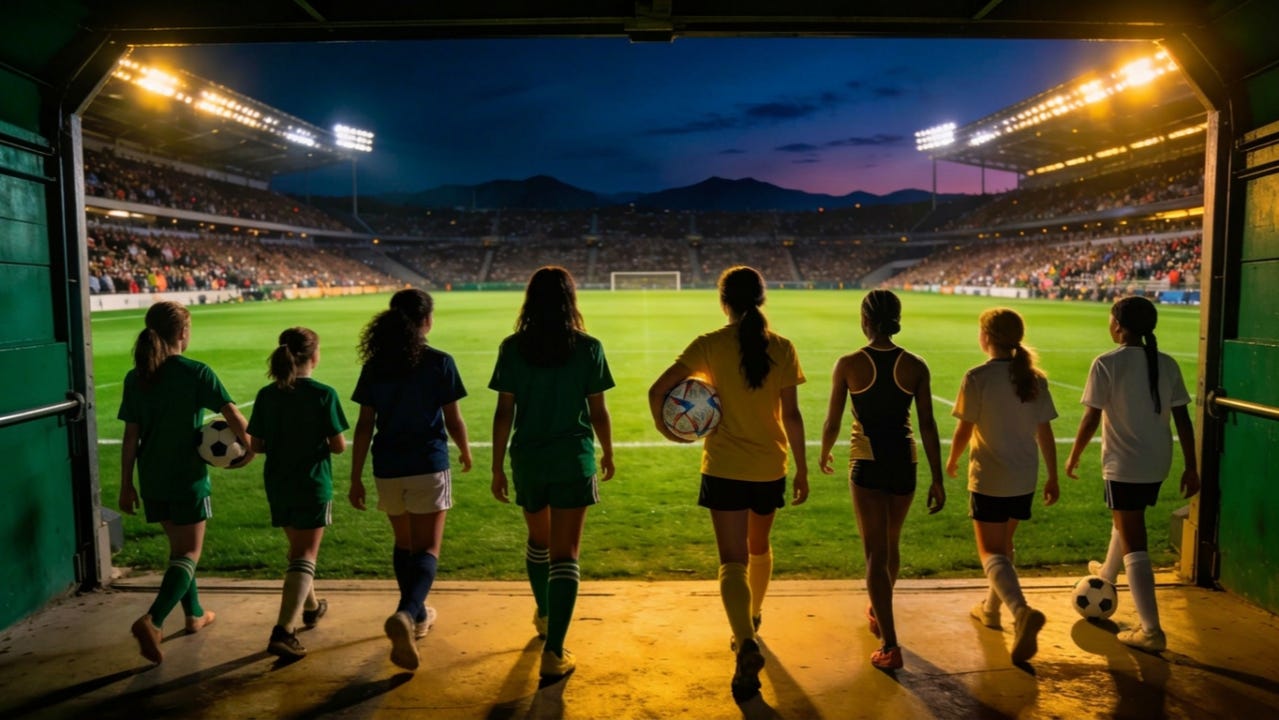
Global women’s elite sports revenue nearly doubled to about 1.9 billion dollars in 2024 and is on track to surpass 2.35 billion dollars in 2025, growing four to five times faster than men’s sports. The WNBA just landed an 11‑year, 2.2‑billion‑dollar media deal, and women’s college basketball has delivered the most‑watched basketball games in the country, men or women.
And yet, women’s sports still account for only an estimated 2–4% of global sports revenue and an even smaller share of media rights value.
That’s not a “natural ceiling.” That’s a design flaw.
The commercial flywheel is spinning: sponsorship in women’s sports is growing faster than in men’s, and the audience is younger, more diverse, and more values‑driven than almost any other segment in sports. But if we don’t fix the foundations, the science, the youth pipeline, and the collegiate floor, this boom will hit the same structural limits that held women’s sports back for decades.
This isn’t just a gender issue. It’s a governance and investment issue.
We Built the System Without the Right Science
Before you even get to access or media rights, start with this: only about 6% of sports science research has been conducted exclusively on women.
For decades, most of the training models, injury protocols, and performance assumptions used across sport were built on male bodies and then lightly adjusted for women. Female athletes were portrayed as “smaller versions of men” in the data.
The new Women’s Health, Sports & Performance Institute (WHSP) in Boston is one of the first serious attempts to close that gap. Backed by a major philanthropic commitment and tied into the 220‑million‑dollar Wu Tsai Human Performance Alliance, WHSP co‑locates clinical care, imaging, nutrition, mental health, and research specifically for female athletes.
Its mandate is simple: generate the data on women’s bodies that should have existed all along. Clara Wu Tsai’s line about the facility, “we basically need more WHSPs,” is the thesis.
If we are serious about elevating women’s sport, funding female‑specific sports science is not optional. It’s step one.
The Youth Pipeline Is Still Leaking
At the same time, girls are still falling out of sport at rates that would trigger crisis meetings if this were an elite pro league.
UNESCO reports that nearly half of girls worldwide drop out of sport during adolescence, at a rate far higher than boys. In many markets, girls’ participation lags despite interest; in the U.S., Aspen Institute Sports & Society Project Play shows structural barriers unrelated to talent or desire: fewer teams, higher costs, less free play, and fewer women on the sidelines.
Key pressure points:
Cost: Youth sports have become a pay‑to‑play industry, with families spending thousands per year on club fees, travel, and equipment, pricing out low‑ and middle‑income girls.
Role models: Girls are more likely than boys to say there aren’t enough role models in sport, and many say they would stay involved if they saw more women they could identify with.
Coaching gap: Only about a quarter of youth coaches are women, and women coaches are underpaid relative to men, which reinforces the cycle.
Burnout and overspecialization: Girls are pushed into year‑round, single‑sport pathways earlier, with less unstructured play and more overuse injuries; a perfect recipe for dropout.
On the ground, girls still practice at off‑hours, get the leftover fields and gyms, and too often get the message, implicitly and explicitly, that their sport is secondary.
You cannot build a billion‑dollar women’s sports economy on a participation base that is structurally leaking at 12, 13, 14 years old.
The Collegiate Floor Is Not Holding
Everyone likes to point to Title IX as a solved story. The growth in participation is real: since 1972, girls’ and women’s opportunities in school sports have exploded.
But the latest numbers tell a different story about where we actually are.
An updated analysis of long‑running NCAA gender equity data shows:
Women now represent roughly 55% of undergraduates but only about 43% of varsity athletes.
That participation share gap has been basically flat for a decade.
The average number of women’s teams per school has barely moved in 25+ years.
In other words: record totals, stagnant proportional equity.
Now layer in the House v. NCAA settlement and the looming revenue-sharing. The new money is flowing primarily to football and men’s basketball. Athletic departments are already signaling cuts, and early lawsuits have been filed alleging that women’s opportunities will be sacrificed in the process.
If women’s programs at the college level are weakened just as the pro side is finally scaling, you get a perfect mismatch: a booming top of the pyramid sitting on a brittle middle.
What It Will Take to Actually Elevate Girls’ and Women’s Sport
If you believe women’s sports are the most undervalued asset class in global sport, and the numbers say they are, then fixing this is not philanthropy. It’s value creation.
Five levers matter most:
Fund the science, at scale.
Guarantee equitable access at the youth level.
Defend and expand the collegiate floor.
Invest in women coaches and local role models.
Rebalance play vs. performance for girls.
The Arbitrage Is in the Girl Who Hasn’t Played Yet
Women’s sports fans are younger, more diverse, and more values‑driven than the traditional sports audience. Ninety‑plus percent of women in the C‑suite played sports; the leadership skills they cite, teamwork, resilience, and handling pressure, are exactly what every company says it wants.
The most powerful untapped asset in global sport is not a league or a media deal. It’s the girl who has the interest and the potential, but no team, no coach, no field time, no research‑backed support system designed for her.
If you’re serious about transformation, not slogans, this is where you prove it:
With budgets, not just branding.
With facilities and fellowships, not just hashtags.
With research labs and roster spots, not just press releases.
The game at the top is already changing.
Now it’s on all of us: federations, schools, clubs, investors, brands, and media to change the game for girls.