

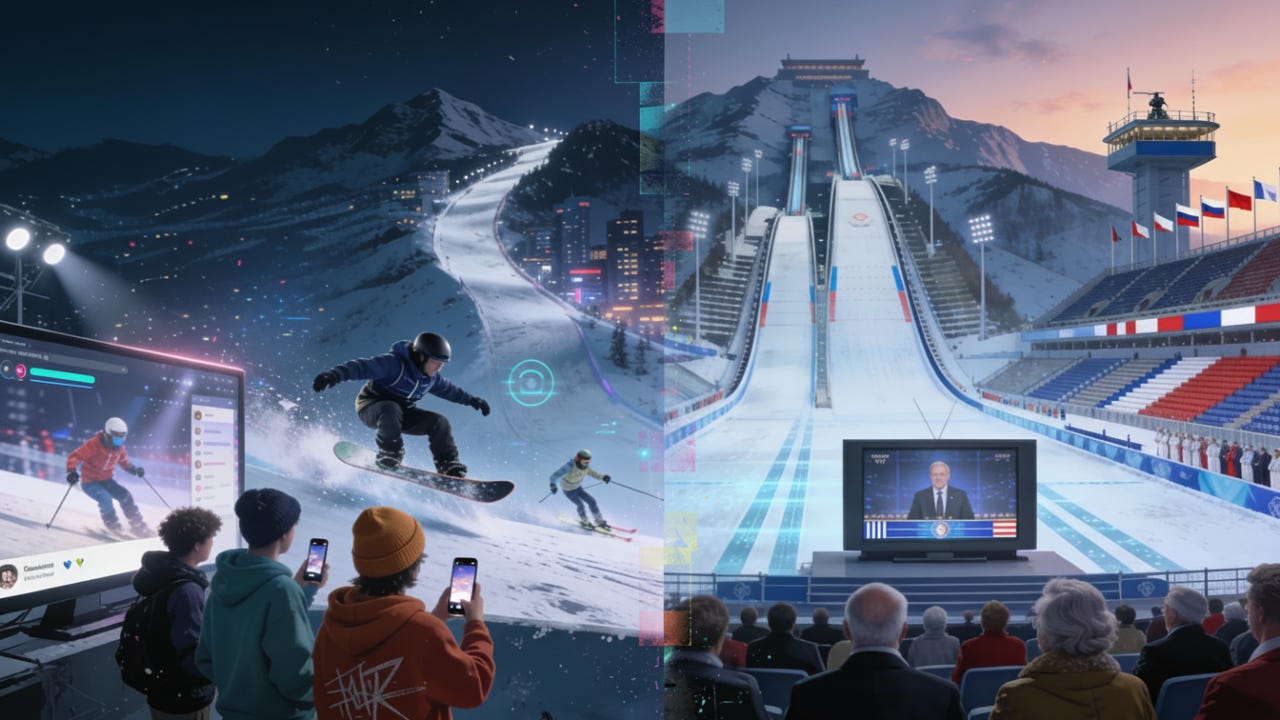
Last week in Aspen, youth viewership for the X Games (ages 2–17) jumped 102% year over year, the largest young-audience increase the event has seen in five years. Overall viewership hit 15.2 million across ESPN and ABC, up 48% from 2025. At the same time, as Milano Cortina 2026 gets underway, NBC is staring at a very different chart: Winter Games viewership has fallen from 45.6 million in Salt Lake City (2002) to 11.4 million in Beijing (2022), a 75% drop.
That’s not a blip. That’s a generational reset happening in real time.
Put side by side, X Games’ youth surge and the Olympics’ slide tell a simple story: the formats, platforms, and storytelling models that built legacy sports TV are turning off the next generation. If you’re a media company, league, or brand still betting on traditional linear playbooks, Aspen isn’t just a fun success story; it’s a playbook, a warning, and a countdown clock.
Two Futures On One Screen
On the X Games side, the numbers don’t look like “nice growth”; they look like momentum:
Youth viewership (2–17) is up 102% year over year, the highest in five years.
15.2 million total viewers across ESPN and ABC, up 48%.
Female viewership on Roku is up 233% year over year.
91% of Roku streaming households were new to X Games on that platform.
Total consumption on Roku is up 149% year over year.
220 million+ social video views during the event.
Global search interest up 120% year-over-year.
And it’s not just who’s watching, it’s who’s competing. Teenagers aren’t aspiring from their couches; they’re on the start list and on podiums. When 15- and 16-year-olds are winning medals on live TV, the audience isn’t watching “some distant pro scene," they’re watching their peers.Now look at the Winter Olympics:
Beijing 2022 averaged 11.4 million viewers in the U.S., a record low and down 42% from PyeongChang 2018.
Only about a third of 18–24-year-old sports fans watched a live sporting event in 2023; north of 70% of 55+ did.
Roughly a third of U.S. Gen Z says they don’t watch live sports on TV at all.
Winter Olympics fandom is heavily Boomer-skewed, with higher incomes and older demos – great for today’s CPMs, terrible for tomorrow’s relevance.
NBCU has already sold out Milano Cortina ad inventory and is rightly investing in cross-platform tech, AI highlights, and a better Peacock experience. But tech is table stakes. The bigger question is whether a format built on nationalism, ceremony, and a four-year drumbeat can keep up with the daily cultural rhythm Gen Z and Gen Alpha live in.
What X Games Is Getting Right
This isn’t “winter sports vs. action sports.” A lot of the disciplines are identical: snowboarding, freestyle, and pipe. The gap is in how the whole thing is told, packaged, and experienced.
Athletes first, institutions second. Younger fans don’t wake up loyal to federations or flags. They follow people. X Games leans into that: backstories, mic’d-up runs, social-native clips that sound like the athletes, not the control room. Viewers build relationships with people, not logos.
The Olympics are trying – more mics, more profiles, more social content – but the underlying structure is still national teams, formal ceremonies, and layers of protocol. It’s hard to feel intimate when everything is built for ceremony.
Short-form is the front door. Expecting a 20-year-old to sit through hours of live coverage as the primary experience is fantasy. They want clips, context, and community: highlights, behind-the-scenes moments, creator-led watch-alongs, and group chats on the second screen.
X Games is treating the event as a content engine. 220M social video views and weeks of relevance before and after the live window are exactly the right instinct. The live broadcast is one node in a much bigger ecosystem.
The Olympics are moving in that direction (YouTube creator partnerships, more platform-specific content), but the center of gravity is still a long, linear broadcast where digital is the add-on, not the product.
Built for streaming, not retrofitted Gen Z is the first cohort that streams more sports than it watches via cable. They expect “tap and watch” – no mystery blackouts, no byzantine bundles, no guessing which app the game is actually on.
X Games’ Roku-first strategy – 149% growth, 91% new households on that platform – is what happens when you design for discovery in a streaming world. You assume the viewer doesn’t know you yet and you make it stupidly easy to stumble into the event.
The Olympics still lean on the old economics: linear first, streaming as the second screen. Peacock and Xfinity integrations are better every cycle, but the business model still rewards hanging on to the bundle.
Authenticity over pageantry. Younger audiences are ruthless about what feels “for them” and what doesn’t. They gravitate toward creator voices, unscripted moments, and cultural fluency. Over-produced, over-scripted, and over-controlled content reads as inauthentic.
X Games leans into chaos in a good way: athlete POVs, social chatter, festival energy, and a tone that feels closer to a music festival than a state ceremony.
The Olympics’ strength lies in ritual and tradition, which have real emotional power. But the more the experience leans into pageantry and nationalism, the more it risks feeling like your parents’ media, not yours.
Why This Should Keep Broadcast Leaders Up At Night
This isn’t just about Aspen and the Alps. It’s about whether the next generation considers live sport part of their media consumption.
Demographics are destiny. You can’t build the future of a sports media business on audiences aging out of the 18–49 demo. If you’re not replenishing with Gen Z and Gen Alpha, you’re running on fumes.
Attention is zero-sum. You’re not competing with “other sports.” You’re competing with TikTok’s For You feed, Twitch streams, YouTube rabbit holes, and games. If your show can’t clear that bar, it loses by default.
Fragmentation is accelerating. Fans churn in and out of services based on relevance. If your content isn’t essential, it will be removed in the next credit card cycle.
The window is closing. A 75% audience drop over two decades isn’t a rounding error. It’s a structural warning. “We just need another breakout star” isn’t a strategy; it’s wishful thinking.
So What Should Media and Leagues Actually Do?
No one is suggesting that the NFL, the IOC, or major broadcasters try to copy the X Games.
There are very practical shifts to make:
Put athletes at the center. Fund storytelling around people, not properties. Let athletes own more of their narrative and give them the tools and freedom to build their own channels.
Treat short-form as a product, not marketing. Build teams and rights structures around clips, behind-the-scenes, and creator remixes. If your best moments only live inside a three-hour window, you’re leaving equity on the table.
Design experiences for streaming-native discovery. Assume the next viewer has zero context. Can they find you in two taps? Do they understand what’s happening in 10 seconds?
Build real creator ecosystems. Don’t bolt on one influencer campaign and call it a day. Bring creators into planning, rights, and formats from the start.
Choose realness over perfection. Let cameras roll on awkward, human, emotional moments. Let broadcasts breathe a little. Viewers would rather feel like they’re in the room than watching a flawless corporate reel.
Evolve your scorecard. Linear overnights are one line on the dashboard, not the dashboard. Look at social reach, search spikes, depth of streaming engagement, creator-driven lift, and sentiment. For X Games, 220M social views and triple-digit search growth matter as much as 15.2M on TV.
The Choice In Front Of Traditional Media
X Games Aspen 2026 isn’t a weird outlier. It’s a preview.
Young audiences aren’t walking away from sports. They’re walking away from formats, platforms, and narratives that don’t match how they live the rest of their media lives.
The Olympics still have scale, emotional weight, and history that the X Games will never fully replace. But if they (and everyone else) don’t rewire how they show up, structurally, not cosmetically, they risk drifting into “nostalgia event” territory: big every four years, but less and less relevant everywhere in between.
The 102% youth surge in Aspen is the future tapping traditional media on the shoulder. The only real question is whether they treat it like a warning light or a roadmap.