

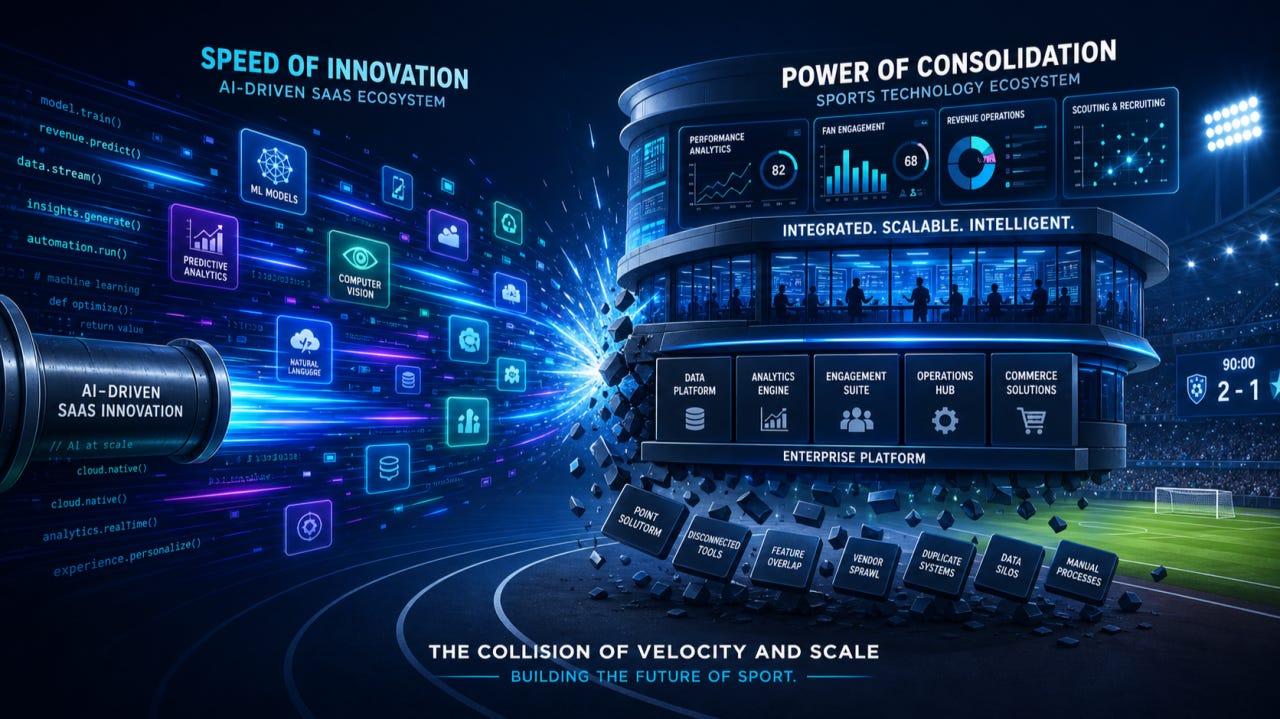
What used to take years now takes months. In some cases, weeks. Research from McKinsey & Company found that developers using AI-powered tools can complete coding tasks up to twice as fast, and a controlled experiment with GitHub Copilot showed task completion rates improving by 55.8% faster than those without AI assistance. Teams using AI tools also report 31% faster overall feature development cycles. The barrier to building has collapsed, and that changes everything.
Layer that on top of the rapid growth of sports as an investable asset class: youth sports, mass participation, data, media, performance, and you get an explosion of innovation across the ecosystem. Sports assets have compounded at roughly 13% annually for six decades, and 2025 saw total sports tech deal value hit $200 billion, the strongest year on record, across more than 1,000 transactions. Private equity alone deployed $6.33 billion globally into sports services in the first three quarters of 2025, the highest in at least eight years.
Some of it is genuinely valuable. Some of it makes you stop and think. And some of it feels like solutions desperately searching for problems.
What’s more interesting, though, is what’s happening beneath the surface; the human side of this shift.
Over the past few months, I’ve been to trade shows and on a number of calls that reflect just how disorienting this moment is, even for experienced operators and investors.
On one call, a founder, clearly successful, clearly seasoned, openly admitted something you don’t often hear out loud:
“This is a world I don’t live in. I hate this world. It’s the shittiest, grossest business I’ve ever seen. This is my last venture.”
It wasn’t performative. It was frustration. Real frustration with the velocity of change, the constant need to adapt to new tools, and the creeping sense that the ground is shifting faster than strategy can keep up.
On another call, the conversation turned to capital and market structure in sportstech:
“The space is getting squeezed. Institutional capital isn’t seeing unicorn outcomes unless companies expand beyond sports. At the same time, most of what’s out there aren’t really companies, they’re features. Put those together, and you’ve got a wave of companies that won’t get funded and will need to partner, sell, or shut down. That’s going to put pressure on pricing across the board.” - Jonathan Schecter
That observation hits at something critical, and the data backs it up.
The Numbers Behind the Feeling
Sports tech investment in 2024 was nearly a nine-year low, barely edging past 2023’s depressed numbers. And yet, even as confidence returned in 2025, with private financing in H1 2025 alone reaching a record $6.6 billion across 239 deals, the nature of the capital has fundamentally changed. Equity financing deal volume in sports tech actually declined from 34 transactions in YTD 2024 to 29 in YTD 2025, even as total equity capital deployed jumped 53.1% year-over-year to $5.7 billion.
The message is clear: investors are writing bigger checks to fewer, more proven companies. The long tail is getting cut.
This is the bifurcation point. AI has not only lowered the cost of building but also flooded the market. In 2025, AI alone accounted for nearly half of all global venture funding, while the majority of private companies in crowded SaaS verticals still face prolonged holding periods or valuation resets. In sportstech specifically, deal numbers are down even as deal value is up.
The math tells you everything: scale wins, and scale is scarce.
The “Feature vs. Company” Distinction Is Unavoidable
Teams and leagues are hitting what one industry analyst described as a “fragmentation ceiling” exhausted by the cognitive load of managing 50 disconnected APIs without the internal resources to stitch them together. The market’s response is consolidation. Companies like Hudl have made 18 acquisitions; Teamworks reached a $1 billion valuation backed by a $235 million funding round. Catapult, Genius Sports, Sony, and Sportradar have all made multiple acquisitions, with one CEO summing up the industry mindset simply:
“The leagues and teams don’t want to have fragmented systems anymore. You want to have one provider who can aggregate a lot of this stuff.”
The private equity number tells the same story. PE investments in European sports alone nearly doubled from 96 deals in 2023 to 190 deals in 2025, with firms deploying €10.6 billion, more than triple the previous year. The sports and entertainment industry has posted a 20.8% CAGR over the past three years, significantly outpacing global economic growth.
This is not a bubble. It is institutionalization.
But the capital is flowing to platforms, rights holders, and infrastructure, not to isolated point solutions. Companies that built niche tools in the hope of a strategic exit are facing a much more brutal reckoning: M&A activity in sports tech reached $156 billion in 2025 across 450 announced deals, but the bulk of that value was concentrated in mega-deals like EA ($55B) and Netflix/Warner Bros. Discovery ($82.7B). Mid-market consolidation is accelerating precisely because there are so many undercapitalized features looking for a home at any price.
The Three Realities Taking Shape
Speed is no longer a differentiator; it’s table stakes.
AI has removed many of the traditional barriers to building. McKinsey found that top-performing organizations using AI in software development achieved 16–30% improvements in productivity and time-to-market, alongside 31–45% gains in software quality. But the ability to launch quickly is now assumed by every investor and every buyer. What matters is whether what you’ve built solves a meaningful, persistent problem inside the sports ecosystem, not whether you built it fast.
The feature vs. company distinction is becoming unavoidable.
Many sportstech offerings were never full businesses. They were tools, modules, or capabilities that lived best inside a larger platform. In a tighter capital environment, those distinctions matter. A feature without distribution, defensibility, or integration pathways is now exposed on every due diligence call, and there are more of those calls than ever.
Strategic buyers are gaining leverage.
As capital tightens around smaller players, established organizations, leagues, platforms, event operators, and governing bodies are operating from an increasingly advantaged position in buy/build/partner analysis. When early-stage companies can’t raise, they don’t just disappear; they become acquisition or partnership opportunities at compressed valuations. The M&A market in sportstech is not evidence of overall industry health. For many, it’s a fire sale dressed in a press release.
Where This Leaves Founders and Operators
For founders, especially those coming into sports from the outside, this is a brutal adjustment. Sports is not a typical SaaS vertical. It’s fragmented, relationship-driven, operationally complex, and often resistant to change unless the value proposition is undeniable. Add AI-driven acceleration, and you get a paradox: it’s easier than ever to build something, and harder than ever to build something that matters.
For operators inside the industry, there’s a different kind of pressure. You’re being pitched constantly. New tools, new platforms, new “solutions,” many of which overlap, few of which integrate cleanly, and some of which create more complexity than they remove. The global sports technology market is projected to grow from $44.9 billion in 2026 to $121.6 billion by 2033, and the noise will get louder before it gets quieter.
Increasingly, operators are being asked to make decisions not just about adoption, but about architecture: What do we own? What do we partner for? What do we ignore?
The Shift That’s Coming
The next phase of sportstech will not be defined by how many companies get created. It will be defined by how many actually get absorbed into platforms, into workflows, into ecosystems that already have distribution and trust. Consolidators are now looking for platforms that can aggregate capabilities, not add-ons that require a dedicated IT resource to maintain.
The uncomfortable truth is that we are moving from a phase of expansion to a phase of filtration.
AI made it easier to enter. The market is making it harder to survive.
And not everyone who got in during the rush is going to make it through to the other side.
Data sources: Drake Star Sports Tech Report 2025, SportsTechX Global VC Report 2025, Capstone Partners Sports Technology M&A Update, S&P Global Market Intelligence, Apollo Global Insights, McKinsey & Company, GitHub/Microsoft Research, Sports Business Journal, Deloitte Sports Investment Outlook.