

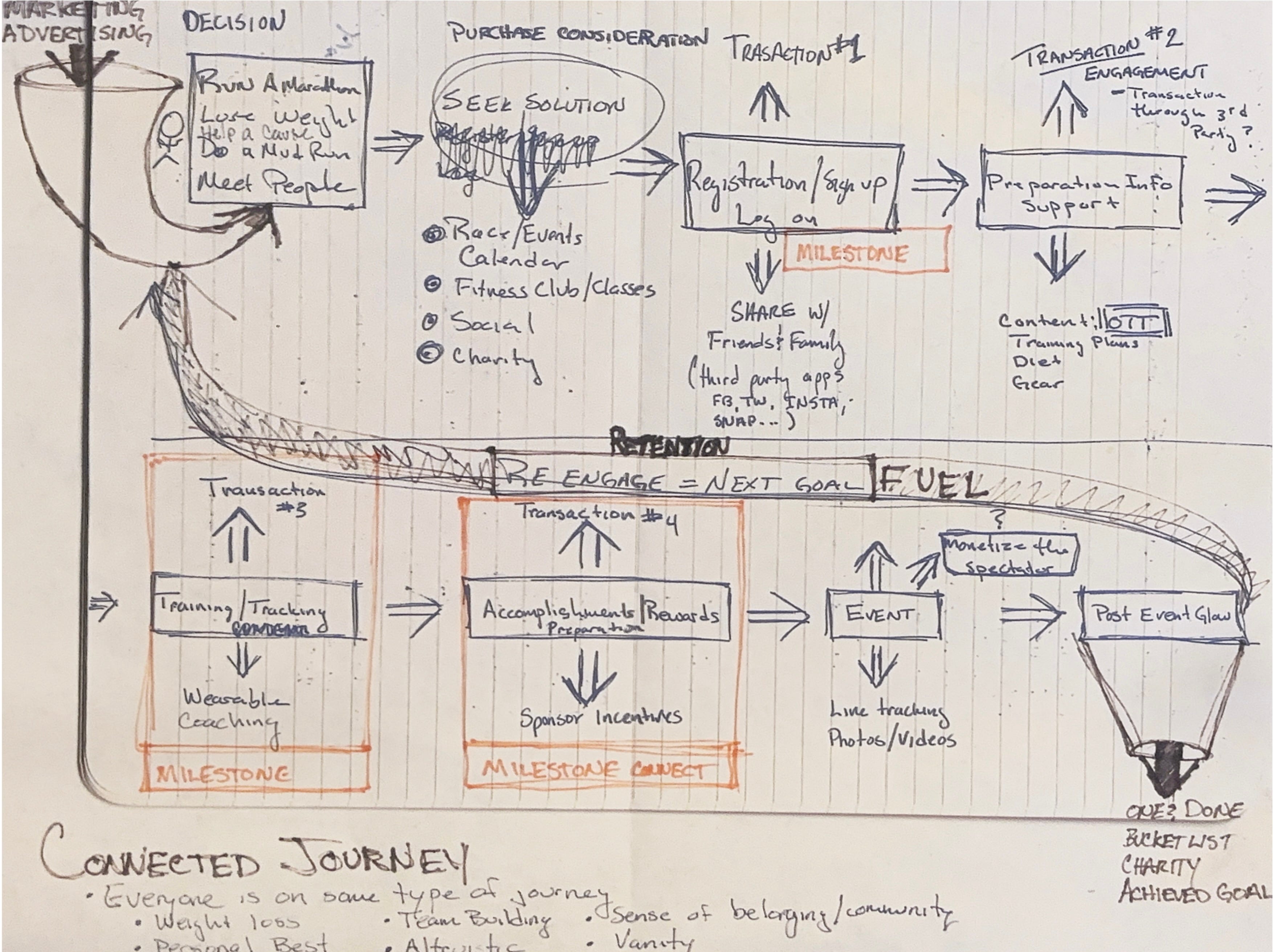
I drew this a long time ago.
It was the Competitor Group (CGI) era. Rock ‘n’ Roll was the biggest marathon series in the world; Competitor magazine was still landing in mailboxes and free at specialty retail stores; Triathlete, Inside Triathlon, and VeloNews were on the newsstand; and every strategy conversation in the building came back to the same question: how do we turn a race entry into a relationship?
We were, at the time, very good at the top of the funnel. We knew how to buy runners into the start line. What we could not quite figure out, and what the whole industry could not quite figure out, was what to do with them once they said yes, and how to bring them back after they crossed the finish line.
So I started doodling and sketching what I saw as the connected runner consumer journey.
Decision → Seek a solution → Register → Preparation →
Training → Milestones → Sponsor incentives → Event →
Post-event glow → Re-engage to the next goal.
A single connected loop, with transactions marked wherever the runner was already reaching for a wallet, and a scribbled note at the bottom that has aged better than almost anything else on the page: everyone is on some type of journey.
For years, this map was directionally right and operationally out of reach. The industry knew the journey existed. It just did not know how to price it, staff it, or own it.
The 2026 RunSignup midyear report is the first time I have seen clean, industry-scale evidence that this is finally changing.
The Number That Matters Is Not the Participation Number
Almost every trade write-up of the RunSignup data leads with and focuses on the same line: races grew 5.9% per event in the first half of 2026, on top of 5% in 2025. Large events with more than 5,000 participants grew 8.2%. Race churn is running below pre-pandemic norms. Running, as an industry cliché goes, is back.
All true, not surprising, but not the most interesting or relevant data.
The most interesting number, and the one that made me stop and think, is that per-race revenue grew 9.9%, nearly two full points faster than participation (RunSignup). Revenue outpacing bodies is not a headline about a running boom in progress. It is a headline about a change in the business model. Something other than “one more runner in the start corral” is finally growing the bottom line.
Look at what else moved in the same report:
5Ks now average 1.3 price increases per race, up 30% year over year. Marathons average 2.5, up 13.6%. Even 10Ks and half marathons are seeing significant increases (RunSignup).
The average marathon price range moved from $84.01 to $111.22 in 2025 to $89.16 to $120.19 in 2026 (RunSignup). The “same race, same product, one fee” model is quietly dying.
Registrations 120+ days out jumped to 16.4%, up 84.2% year over year. Race-week registrations fell 26.6% to 17.4% (RunSignup). Marathons are now 55.4% pre-booked more than four months in advance.
63% of transactions are on mobile. And get out your iPhone: 31.9% of May payments were made via Apple Pay (RunSignup).
Read down the list and the story is very clear. Runners are committing earlier, on the device they carry through every stage of preparation, at prices that vary meaningfully across a tiered ladder. Events are finally being paid for the journey, not just for the bib.
The Top-of-Funnel Trap
I think back to understand why this matters, and I remember what we were actually doing at CGI, and what almost every large event company was doing at the same time.
We were spending an enormous share of our marketing energy at the very top of the sketch, the “marketing / advertising / decision” cone in the upper-left corner. National magazine media buys. Search. Direct mail. Local media. Ambassadors. Registration promos to fill the next race in the series. That work was measurable, defensible in a budget meeting, and immediately connected to a registration transaction.
Everything else on the page was, in practice, someone else’s business.
Training plans lived on third-party sites and in coaches’ inboxes. Training gear was at the specialty run retailer. Photos were from a separate vendor, with its own logo on the picture or as a watermark. Charity dollars flowed through Crowdrise, Charity Miles, and dozens of platform partners. Travel and lodging were handled by hotels and OTAs. Nutrition was at a booth at the expo. The “post-event glow” was part of an emerging trend on social media, mostly in blogs and online reviews. Re-engagement belonged, mostly, to whichever race the runner heard about next from a friend.
The event owned the transaction. Everyone else owned the journey.
This was not a moral failing; it was the incentive structure that drove us to fill corrals and drive EBITDA. Filling the top of the funnel was legible and rewarded. Serving the converted runner, the person who had already said yes, was diffuse, cross-functional, and hard to attribute. So the industry did what industries do when the metrics are misaligned with the strategy. It overinvested in acquisition and underinvested in the customers it already had in the database.
The runner, meanwhile, kept living the whole journey. She just did it across a dozen apps and vendors, none of whom were the event she was training for.
Ahead of Our Time
The group at CGI was keenly aware of the trends, the opportunity, and the pressure. To the chagrin of private equity owners who wanted to squeeze the most out of what we already had, we tried to shift the trend and reinvent the model from within.
We took a strategic stake in MapMyFitness, joining Austin Ventures and Milestone Venture Partners in the company’s $9 million Series B in June 2012, to give runners a GPS and training-tracking home connected to the events they were training for. We built a co-branded runner-travel platform with Travelocity, offering race-specific hotel blocks, bundled air and lodging, and itineraries built around early race-day starts for the Rock ‘n’ Roll Marathon cities, because we knew a destination marathon was a trip before it was a race. We launched Gear Buzz, a flash-sale platform and short-form gear-review video segment pushed through Triathlete, Inside Triathlon, VeloNews, and Competitor magazine, with brands including Brooks and The Sports Authority, because a runner training for a half marathon was going to buy shoes, and we did not see why those dollars should leave the ecosystem. We ran an entire charity department that worked hand in hand with cause partners to build real programming, not just a fundraising minimum. We leveraged our own media to launch SportsCenter-style online segments: RunCenter, TriCenter, and VeloCenter. We understood that the athlete’s attention between races was as valuable as the race itself.
It was an incredible group of people reinventing an industry, redefining a business, and bringing outside business practices into what had, until very recently, been a mom-and-pop trade.
Some of those bets were early. Some were the right idea at the wrong altitude of capital, technology, or organizational patience. What they all had in common was an accurate read of the map. The runner’s journey was a business, not a marketing funnel, and the event company that owned it would compound value in ways the pure registration model never could.
The industry, and its owners, were not quite ready to hear that yet.
What the 2026 Data Actually Shows
A decade later, reframe the RunSignup numbers using the same journey map, and they no longer look like a pricing story. They start to resemble the ownership story we were trying to write.
Revenue growth outpacing participation is what happens when the converted runner is finally asked to spend on more than the entry fee: merchandise, hospitality, deferrals, insurance, add-ons, premium experiences, photos, team fees. The gap between 9.9% and 5.9% is where the middle of the funnel is finally showing up on the P&L.
More price steps per race is what happens when organizers stop treating registration as a single transaction and start treating it as a designed pricing ladder. It is not a punishment for late buyers. It is a recognition that the early buyer and the late buyer are different customers with different jobs to be done.
Earlier registration is the most important structural shift of all. When a marathoner books more than four months out, the organizer inherits a long, high-intent engagement window that used to belong entirely to third parties. That is the exact stretch of the sketch, from Registration through Preparation, Training, and Milestones, where the industry historically had no product. Now it has time, permission, and a mobile checkout waiting.
Large events pulling ahead is what “sense of belonging / community” from the bottom of the napkin looks like when it hits the top line. Scale, brand, and identity are once again worth paying more for. Runners are not buying a course. They are buying a place to belong.
Mobile and Apple Pay are the connective tissue. The connected journey was always going to require a device the runner carried through every stage. Now she does, and she pays with a glance.
None of this is being announced. It is happening inside the pricing pages and product roadmaps of every large event company in the country, and the data has finally caught up.
What Is Still Missing
Staring at the sketch ten-plus years later, I see that the industry is finally monetizing about half of it. The other half still has holes.
Preparation and training are still overwhelmingly owned by third parties: Strava, TrainingPeaks, Runna, coaches, YouTube. Events have the intent data and the goal date. Very few have a training product runners actually use.
Sponsor activation at milestones, the “sponsor incentives” box on the sketch, still consists mostly of banner ads and expo tables. Useful, contextual, journey-aware sponsor product is largely unbuilt.
The spectator is still, for most events, a free user. Live tracking exists. A spectator product does not.
Post-event glow and re-engagement is the highest-intent moment in the entire calendar year, and most events waste it with a “save the date” email and a discount code.
The handoff back to the next goal, the loop from Post-Event Glow back to Decision, is the weakest link in almost every portfolio. Retention still leaks to the next shiny race and the next third-party platform.
Each of those is a business, not a feature. Each is a place where an organizer who understands the journey can build durable margin and, more importantly, a durable relationship.
The Standard the Sketch Sets
There is a version of this shift that is just yield management with better branding: squeeze the procrastinator, charge more for the same t-shirt, and call it a tiered experience. If that is where the industry lands, the runner will notice, and eventually so will the churn number.
The sketch, for all its scribbles and dated thoughts, still sets a higher standard. Everyone is on some type of journey. Weight loss. Personal best. Team building. Altruism. Vanity. Belonging. The job of an event company, and the actual product, is to help the runner complete their journey, not to extract from it.
The 2026 data shows the industry now has permission and the tools to build for the whole map. Earlier commitment, mobile-native checkout, tiered pricing, higher revenue per runner, healthier large events, low churn. That is the enabling environment we would have paid real money for at Competitor. It is also, arguably, what let CGI sell to Calera Capital for close to $250 million in December 2012, on the back of a five-year revenue CAGR of 26% and an adjusted EBITDA CAGR of 39%, even though the connected journey we were sketching would take another decade, two more owners, and a mobile checkout to arrive at scale.
The question for the next five years is whether the industry uses this new environment to comfort the afflicted, the runner who has already said yes and is waiting for us to show up for the rest of her journey, or whether we go back to afflicting the comfortable by buying strangers into the top of a funnel we still do not own.
The sketch, drawn a decade too early, still points the way.