
The most important shift in sports media is not that athletes are posting more content. It is that some are building businesses around the attention they have already earned.
Brands have spent years trying to make campaigns feel personal by hiring influencers, borrowing their voices, and placing a product in a familiar-looking feed. Sometimes it works. But audiences can also recognize when a supposedly candid moment exists because a creative brief required it. In a 2025 survey by BBB National Programs, only 5% of respondents said they trusted influencer content completely, and 70% felt deceived upon discovering an undisclosed partnership. The lesson is not that paid partnerships are inherently untrustworthy. It is that trust is difficult to manufacture and easy to spend.
Athletes begin from a different place. People have watched them compete, improve, lose, recover, and make choices under pressure. Their public story was already underway before a brand stepped in to sponsor it.
That does not make every athlete authentic, or every endorsement convincing. It does give athletes an advantage that a campaign cannot create from scratch. The opportunity now is to turn that earned attention into something they control: a body of work, a direct relationship with their audience, and, in some cases, a company.
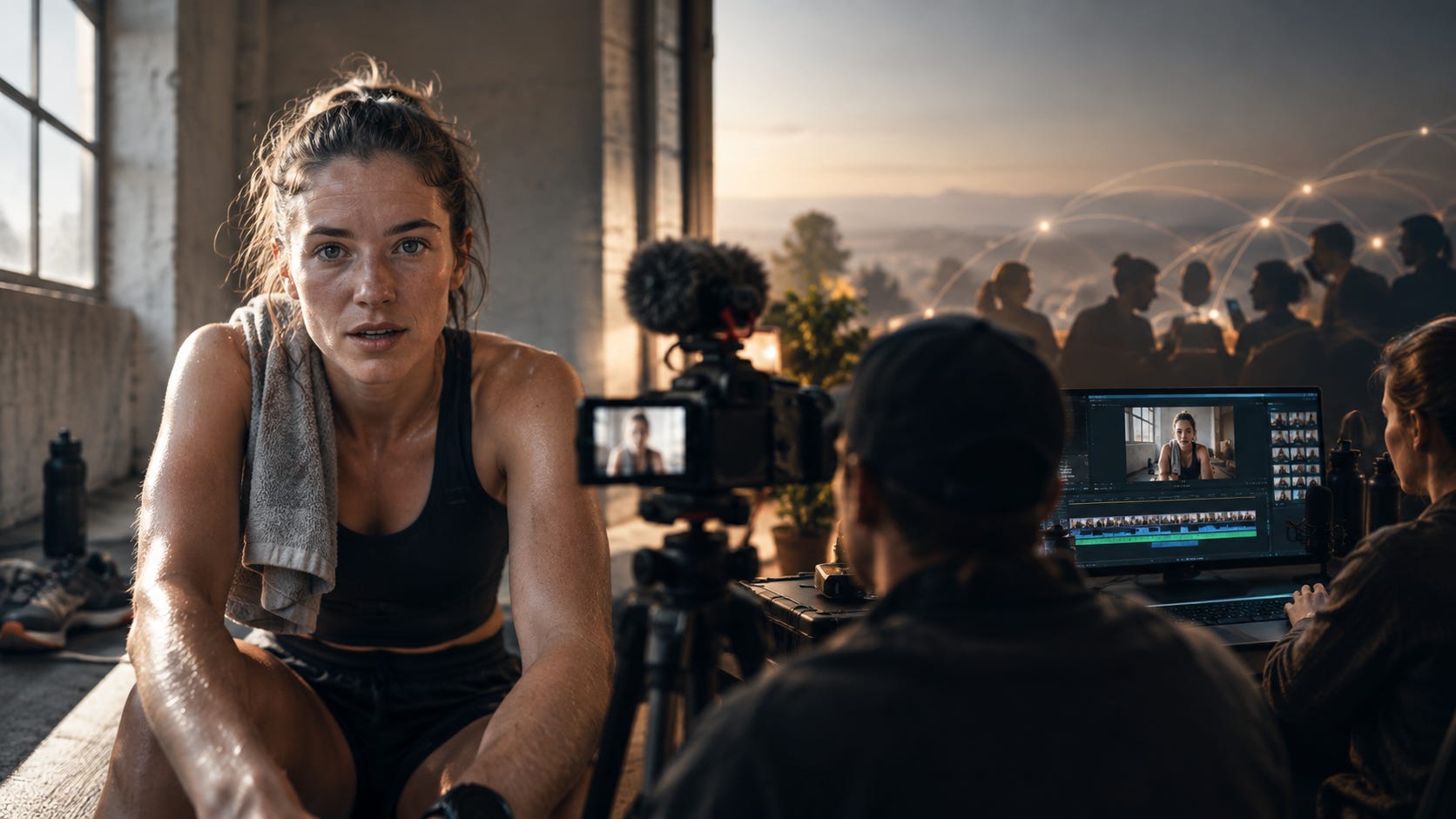
The athlete is no longer just the subject of someone else’s story. Increasingly, the athlete is the studio.
From talent to owner
For decades, an athlete’s commercial life was largely organized by other people. Leagues and teams controlled access. Broadcasters determined which stories reached a mass audience. Sponsors decided how the athlete appeared in campaigns. The athlete was valuable talent inside systems built and owned elsewhere.
That model has changed. An athlete can announce news directly, produce a series, host a podcast, develop a documentary, build a consumer business, or introduce fans to a part of their life that never appears in a game broadcast. Distribution is still hard, and none of those ventures is guaranteed to make money. But an athlete no longer needs a network slot or a sponsor’s permission to begin.
Coco Gauff is a useful example of how far beyond endorsement this can go. She launched iROC Media Group in 2025 and partnered with Religion of Sports on original projects. Its first releases included Tennis Channel short documentaries about fashion in tennis and Zina Garrison. Gauff described the difference plainly: “I don’t want to just promote a brand or a product. I really want to be a part of it.
Gauff is not merely extending her visibility into media. She is making decisions about what gets made, who helps make it, and what kind of company could exist beyond her playing career. That is a different position from being the face of a campaign.
Naomi Osaka has also treated business, culture, and media as connected parts of her public life rather than a series of unrelated endorsements. The larger point is not that every athlete should start a production company. It is that athletes increasingly have the ability to choose whether their value ends at their appearance in someone else’s work.
The harder test comes later. Can the business make something people want when its founder is not on screen?
Peyton Manning’s Omaha Productions shows why that question matters. Peyton and Eli Manning appeared in more than 70% of the company’s early projects; they now appear in roughly a quarter of them. Omaha has expanded its slate and its commercial production work, with branded content and campaigns accounting for about a quarter of revenue. Manning’s reputation helped open the door. A company capable of developing and producing work beyond his appearances is what gives the business a chance to last.
Trust is not a campaign
The influencer industry has become highly skilled at converting attention into action. It knows how to identify what an audience wants, offer useful content, and point people to where to go next. There is plenty for sports businesses to learn from that discipline.
But there is a line between understanding an audience and manufacturing a relationship with it.
An athlete does not need to invent a struggle to be relatable. The work is already there: the training no one televised, the injury that changed a season, the teammate who deserves attention, the sport that is difficult to find on TV. The best athlete-led media gives people access to a real point of view. The weakest athlete campaigns take those same ingredients, script them, and ask fans to mistake the result for spontaneity.
Brands should ask a more demanding question than whether an athlete can deliver impressions: Would this still be worth watching, reading, or attending if our logo were removed?
If the answer is no, the brand may be renting credibility for a moment. If the answer is yes, it has the potential to support something that both the athlete and the audience value. That might mean financing a recurring series, helping an athlete document a season, building a clinic or event around their expertise, or backing a media property in which the athlete has real creative authority.
It also means accepting that the athlete’s voice cannot always be made to sound like brand copy. CreatorIQ’s 2026 survey found that 53% of creators with at least 500,000 followers felt tension between the content their audiences wanted and the content brands wanted them to make. Athletes face that same tension. A partner that removes the voice people came for is weakening the asset it hoped to use.
A following is not a business
The tools to build direct media are more accessible than they used to be. YouTube, podcasting, newsletters, subscriptions, commerce platforms, and community products let an athlete and a small team do work that once required a much larger institution.
But publishing directly is not the same as owning the relationship.
A clip can reach millions of people without giving the athlete a reliable way to reach them again. A large following can disappear from view when a platform changes how it distributes posts. A successful sponsorship can pay well without leaving behind any lasting intellectual property or customer connections.
So the business question is not simply, “How many followers does this athlete have?” It is: Do people come back? Is there a format they recognize? Can the athlete reach that audience across channels? What rights do they retain? Is the work sustainable alongside the demands of competition?
The economics deserve some humility. In a 2026 survey of 5,095 creators across 100 countries, 67% reported earning less than $10,000 from creator work in the prior year. The tools have lowered the barrier to making media; they have not made a durable media business easy to build.
This is where an operating team matters. Someone still has to develop ideas, clear rights, produce work, manage distribution, sell partnerships, and protect the athlete’s time. Gauff retains creative control at iROC, but she works with Religion of Sports on the production capabilities her tennis schedule cannot accommodate. The lesson is not that the athlete must do everything. It is that support should increase the athlete’s capacity without taking away their say in what gets made.
Women athletes show the stakes
For women athletes, direct media can do more than broaden a sponsorship portfolio. It can make it easier to discover an athlete in sports that have not always offered consistent coverage or comparable earning opportunities. It can bring fans to a team or league through an interest that has little to do with a box score.
PWHL player Sarah Nurse has said that some fans first found the league through her beauty content on TikTok and Instagram. That is not a distraction from hockey. It is an entry point. A person follows Nurse, becomes interested in her work, and discovers the sport through her.
TOGETHXR’s Snap the Gap program offers athletes production support and coaching to help them develop those connections. In one cohort, Michelle Alozie’s Snapchat following grew from 127,000 to 204,000 over three months. The cohort produced millions of Story and Spotlight views. Those are meaningful discovery numbers, though the program did not provide revenue figures to Digiday. The longer-term question is whether that attention translates into income, retained audiences, and work that athletes can sustain.
“Become a creator” can easily become one more unpaid job for an athlete. A stronger model gives athletes useful support, fair commercial terms, and ownership of the value their work creates. It also gives leagues and teams another way to grow. Nurse’s audience does not have to compete with the PWHL’s audience. One can lead people to the other.
The larger media lesson
Sports makes this shift unusually visible, but it does not stop at sports.
The old media question was, “What’s on?” A network, publisher, or schedule organized the audience’s attention. Increasingly, the question is, “Who do I want to hear from?” People follow a voice across video, audio, writing, live appearances, and communities. They do not always care which institution first gave that person a platform.
That does not make institutions irrelevant. Leagues, teams, brands, networks, and production companies still bring capital, reach, access, and expertise. But they no longer have a monopoly on the relationship between talent and audience.
The best ones will stop treating an athlete’s independent audience as a threat to control, or merely as inventory to sell. They will help athletes do better work, protect their voice, and share in the upside on terms that recognize each partner's contribution.
Athletes, in turn, should be careful not to confuse visibility with ownership. A deal can be lucrative and still leave them with no rights, no audience connection, and nothing that survives the campaign. The point is not to reject partners. It is to choose partners who help build something worth keeping.
Brands cannot manufacture the history that makes people care about an athlete. They can recognize it. They can respect it. And, if they are willing to give up some control, they can help turn it into work that lasts.
That is the real promise of the athlete as studio: not another kind of influencer campaign, but a business built around a person whose story was compelling long before anyone tried to market it.