

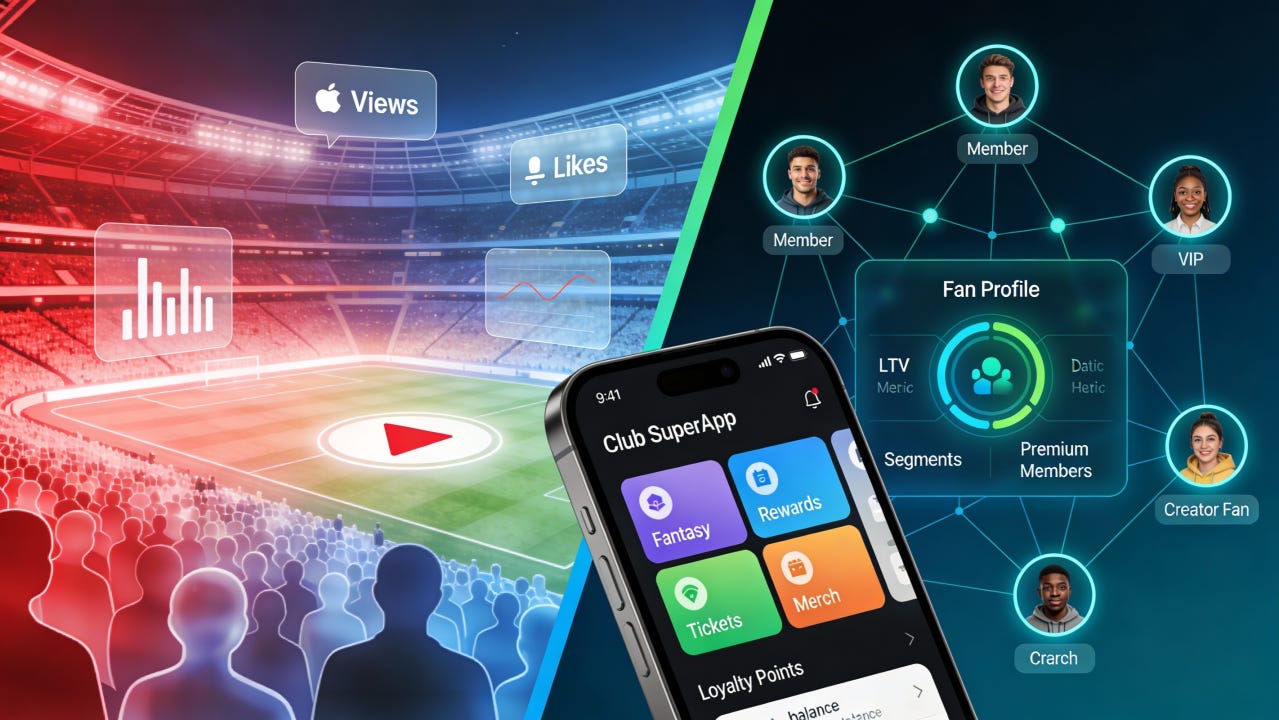
The relationship between fans and sports hasn’t just changed; it has fundamentally inverted. Fans no longer want to be passive consumers. They demand to participate, personalize, and own a piece of the action.
We are seeing a generation raised on interaction that expects digital sports experiences to match the dynamic engagement they find in every other part of their lives. High-income fans, those households earning $300k+, are willing to pay significant premiums for access, status, and personalization. YouTube’s Sports Plan will capture this attention at an unprecedented scale.
But here is the hard truth for every league and team executive: If you do not build the parallel infrastructure to convert that attention into owned relationships, you are building your house on rented land.
Without a strategy to own your data, you will remain dependent on algorithmic goodwill, unable to prove value to sponsors or understand the fans you actually have. The winning formula for 2026 is now clear, validated by real-world deployments across European football clubs, basketball teams, and national federations.
YouTube and other social media for Reach. SuperApp for Relationship. CDP for Intelligence.
The Platform Reality: The Rental Trap
For the second consecutive year, IMG‘s Platform Power Rankings put YouTube at #1. It is the world’s largest podcast platform and the dominant player in connected TV. It is the single most crucial third-party distribution platform.
But here is what Youtube Channel, and every other platform, cannot deliver: Ownership.
When a fan watches a highlight on YouTube, the platform captures the signal. The algorithm learns from it. The platform monetizes it. You, the rights holder, see a view count. This structural asymmetry has persisted for a decade.
The data speaks: 70% of Gen Z fans say they want to be “an active part of the game,” not just watch it. Yet most rights holders still measure success by reach - followers, views, impressions. These are vanity metrics. They tell you how many eyeballs you reached. They do not tell you who those eyeballs belong to, what they value, or whether they will ever spend a dollar with you.
Sponsors are asking more complex questions. 78% of sponsors now demand measurable fan interaction, not just impressions. They want to know: Did fans who saw our activation actually engage? Did that engagement drive behavior change? What is the ROI?
On YouTube, you cannot answer these questions. The platform does not provide you with that visibility.
Sports organizations have a choice: repeat the platform dependency pattern or break it.
The Architecture of Ownership: Three Layers, One System
The model that is winning, validated by European clubs like Vitória SC, FCI Levadia, FC Famalicão, and Rīgas Zeļļi, treats three components as a unified ecosystem:
The Discovery Engine (YouTube): Use Shorts and Reels for algorithmic reach, but guide fans toward long-form storytelling that builds emotional connection. As IMG notes: “More is more.” Volume and quality are both required. YouTube dominates because it owns the full funnel - search, recommendation, long-form, live, and community. Your job is to own what happens next.
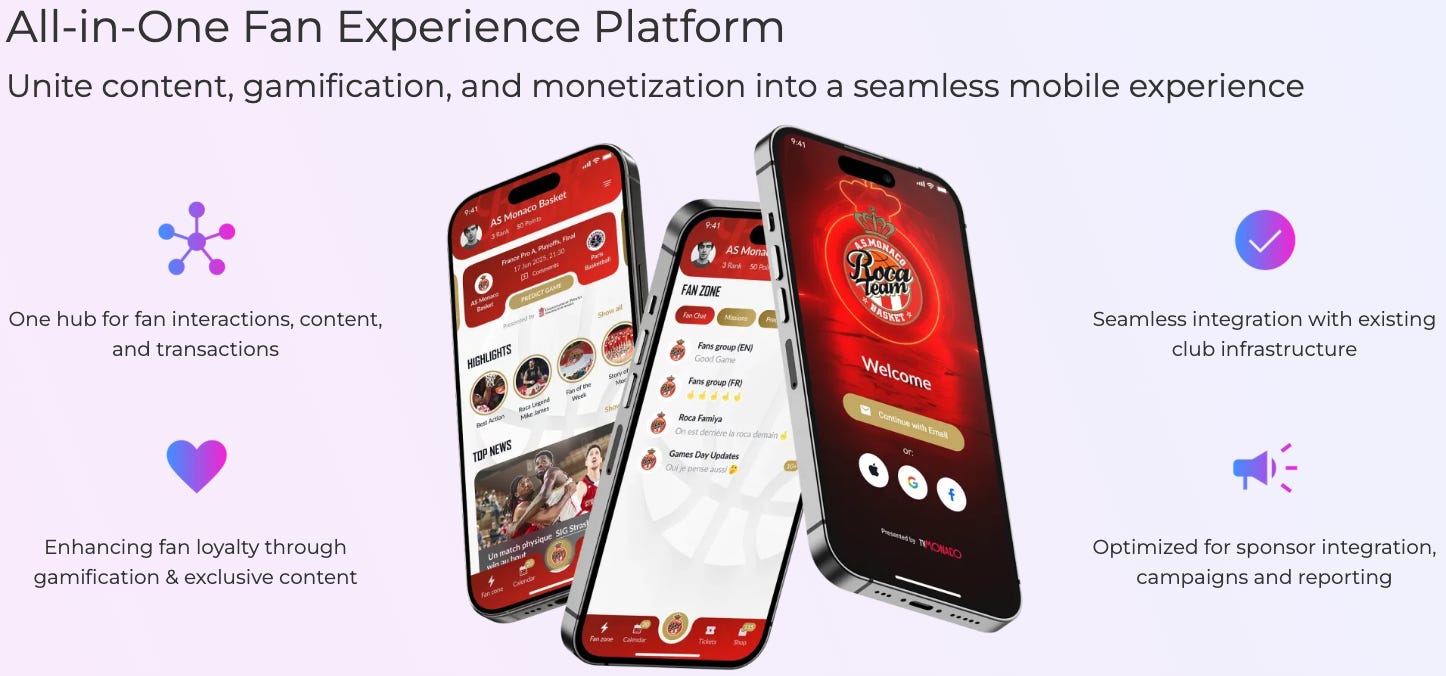
The Operating System (SuperApp): This is not a competitor to YouTube or other social media platforms. It is a companion, a white-label, controlled environment where verified identity meets immersive experience. This is where you bundle fantasy, gamification, rewards, ticketing, and merchandise into a single hub. When a fan discovers you, they click through to the SuperApp. This is where the relationship deepens.
The SuperApp is the operating system for engagement. Blocksport’s deployments show what this looks like in practice: fan missions (task-based rewards), achievements (recognition systems), points and redemption (loyalty currency), voting (community decision-making), exclusive content, social walls (community interaction), and digital wallets (cashless transactions).
The Data Spine (CDP): This is the game-changer. A Consumer Data Platform unifies signals from every touchpoint - YouTube subscriptions, social follows, ticketing history, merchandise purchases, email engagement, and in-venue activity - into a persistent fan profile. It turns behavioral signals into actionable intelligence.
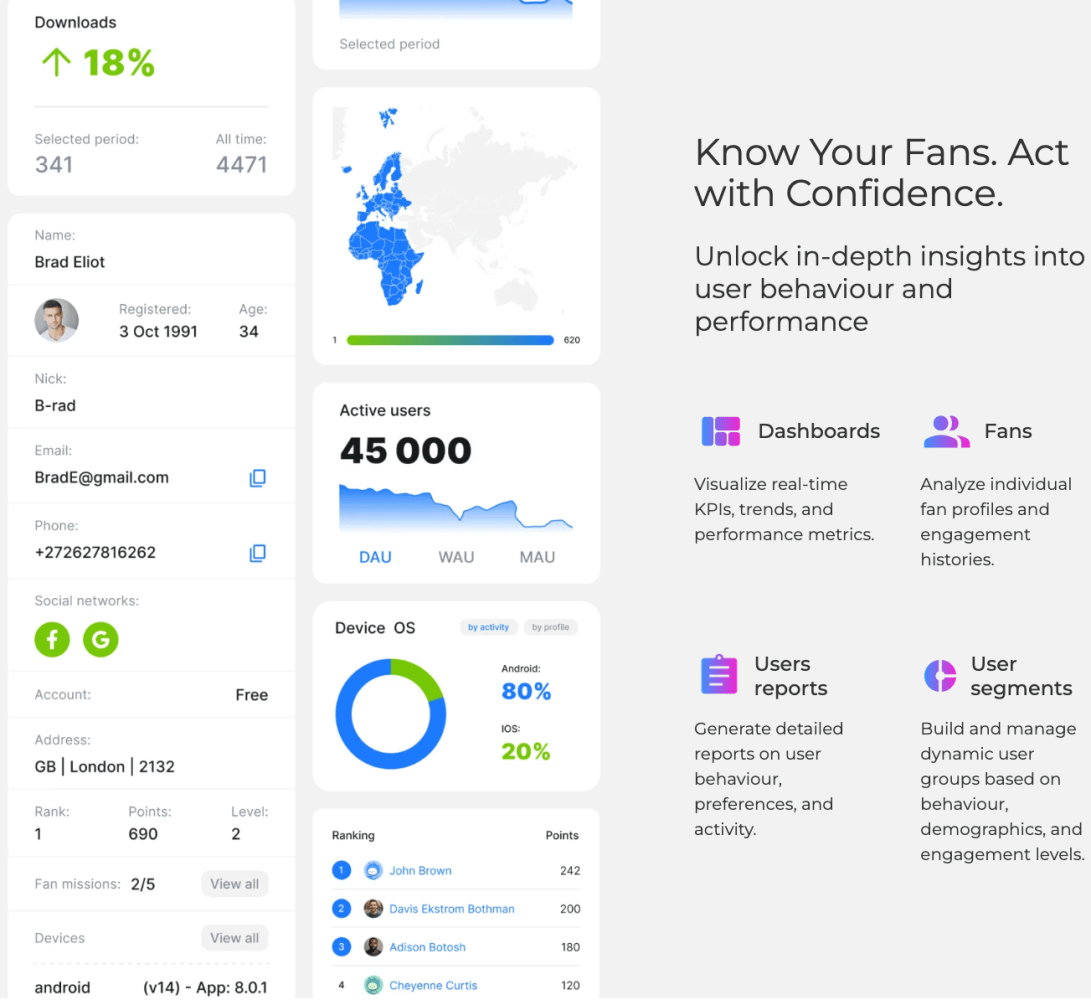
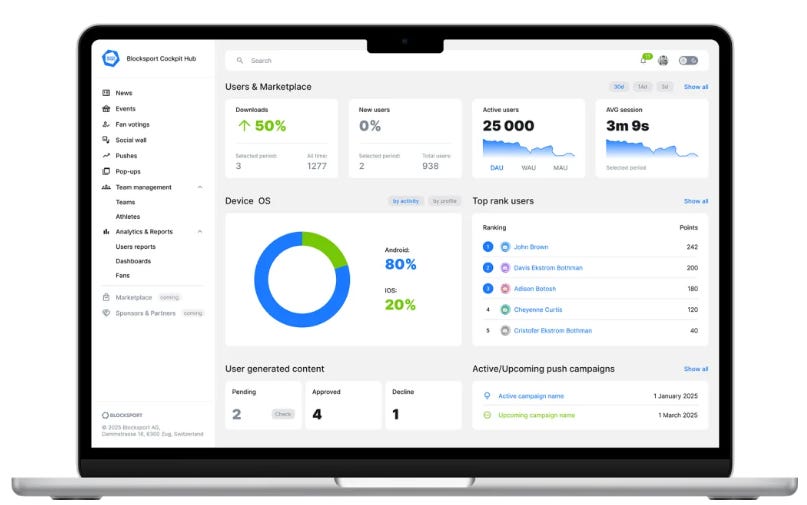
Blocksport’s CDP provides real-time dashboards, fan profile analysis, dynamic segmentation, sponsor campaign tracking, and AI-powered insights. When a fan interacts with your SuperApp, that signal flows into the CDP. The CDP learns. The next experience is more personalized. Engagement increases. Revenue follows.
The Proof: It’s Not Just Theory
This isn’t a future state. It is happening now. Blocksport’s deployments across European football clubs are proving the economics of this model:
Data Quality:
100% verified emails
70% opt-in rates for data sharing
70% share phone numbers
50% share home addresses
Engagement Depth:
4 minutes average session duration
90% gamification engagement
40% weekly active users
5.2 screens per session
Monetization Reality:
€72,300+ spent through cashless solutions
$137,000+ in membership revenue (in-app)
65,000+ app downloads
+35% monthly active users
+70% month-on-month growth
35% increase in sponsor campaign CTRs because targeting is actual, not aspirational
Vitória SC launched its SuperApp in August 2025. The platform became the central hub for fan interaction, exclusive content, gamification, loyalty rewards, and sponsorship activations. The integrated CDP allowed them to prove sponsor ROI and segment fans for hyper-targeted offers.
FCI Levadia deployed a similar strategy. Deeper fan data visibility. More personalized communications. Measurable increases in merchandise sales and ticket conversions.
FC Astana introduced Web3 capabilities alongside the SuperApp, offering fans blockchain-based memberships and fan wallets.
The pattern is consistent: European clubs are moving faster because they have to. Volatility drives innovation. Without the safety net of massive domestic media deals, they must own their direct-to-consumer revenue.
The U.S. Reality (And Why It’s Changing)
In the U.S., we often treat digital as an optimization layer on top of a healthy business. That is a mistake. The convergence is coming.
U.S. teams operate with more financial cushion: closed leagues, revenue sharing, stable media rights. This structural safety has allowed digital strategy to evolve slowly, focusing on personalization and yield management rather than survival.
But premium fans are reshaping this. High-income fans earning $300k+ spend 60% more time with leagues when they engage digitally, and they are willing to pay significant premiums for personalized, exclusive experiences. 50% want loyalty programs that deliver free tickets. 39% want future discounts. 28% want early ticket access.
These fans expect frictionless technology: 53% want improved food and beverage ordering through apps, 44% want tap-to-pay payments, and 45% believe smart parking could improve arrival times. But they also demand authenticity. When tech is integrated into the fan experience naturally, not as an add-on, engagement soars.
The organizations that thrive in 2026 will be the ones that use platforms for reach but refuse to let platforms own the relationship. European clubs have already made this choice. The question for U.S. teams is: when will you?
The Strategic Imperative: Gamification as a Growth Engine (And the Ethics of Engagement)
Gamification is not a toy. It is a growth engine. But before we celebrate its power, we need to understand what we are actually building.
Adam Alter‘s research in Irresistible: The Rise of Addictive Technology and the Business of Keeping Us Hooked reveals a critical truth: technology companies and marketers have teams of engineers and researchers devoted to keeping us engaged. They know how to push our buttons. They know how to coax us into using their products for hours, days, and weeks on end. The architecture is intentional. The addiction is by design. Gamification operates on the same psychological principles—every point earned, every achievement unlocked, every leaderboard position climbed triggers dopamine release. The engagement is engineered to be irresistible.
Every prediction, every vote, every fantasy lineup set is a signal that tells you who your fan is and what they value, but it is also a behavioral hook designed to keep them coming back.
The numbers validate the engagement power: Fans who engage with gamification spend 60% more time with their league and interact 56% more on social media. Sponsor visibility increases by 30% because advertising surfaces become part of an interactive experience rather than passive overlays. Blocksport’s data shows 90% gamification engagement, with fans averaging 5.2 screens per session and 4 minutes per visit. This is not casual browsing. This is repeated, intentional engagement—the kind of behavioral signal that a CDP thrives on.
The ROI loop is straightforward: Engagement generates data. Data enables segmentation. Segmentation drives targeted campaigns. Campaigns convert casual fans to paying customers (ticket buyers, merchandise purchasers, premium members, sponsor engagers). Conversion proves value to sponsors. Sponsor investment funds, better content, better gamification, better experiences. More engagement. More data. More revenue. F-liiga (Finnish Floorball) implemented a fantasy league. Within three weeks: 2,550 registrations, 120,000+ pageviews per month, 33% higher engagement on social media, 91% recommendation rate, 28% increase in sponsor visibility, all with no additional staffing overhead. That power is real and undeniable.
But here is the critical question: How do you harness this power ethically? Alter argues that we must understand the design before we can resist it. Sports organizations that deploy SuperApps and gamification have a responsibility to be transparent about the mechanisms they use to drive engagement. The fan missions, the points, the leaderboards, the exclusive rewards, these are not neutral features. They are behavioral architecture, designed with intention.
This does not mean you should abandon gamification. It means you should deploy it with intent and integrity. Ethical gamification in sports looks like transparency about rewards (making it clear why fans earn points and what motivates the system), escape valves that allow engagement without the addiction mechanics, intentional design that drives behaviors genuinely valuable to community (supporting content, attending events, connecting with peers), data respect that uses behavioral signals for personalization rather than exploitation, and purpose beyond engagement where the end goal is building genuine community, not maximizing screen time.
Blocksport’s most successful deployments achieve this balance. They use gamification to drive engagement in service of a larger goal: transforming casual viewers into invested community members. The leaderboards matter because they create healthy competition. The missions matter because they encourage fans to explore content they might not have otherwise encountered. The points matter because they unlock genuine rewards—tickets, exclusive content, recognition. The system works because it creates real value while leveraging behavioral design.
The paradox is this: The most profitable version of gamification is also the most ethical, because fans who feel respected and understood stay longer, spend more, and advocate more enthusiastically than those who feel manipulated. When you use behavioral science to serve fans rather than exploit them, you build trust. And trust is the most valuable asset in sports.
The Convergence: Europe Leading, U.S. Following
Why are European clubs moving faster?
Structural necessity. Relegation risk. Inconsistent TV rights. Global fanbases. No domestic revenue safety net. For European clubs, digital ownership isn’t a growth lever, it is a survival strategy.
For U.S. teams, it is increasingly a competitive advantage. As premium fans’ expectations rise, as sponsors demand proof of engagement, as data becomes the currency of personalization and monetization, organizations that own their data will outpace those that don’t.
Stats Perform‘s 2026 research shows that 81% of sports media executives have expanded AI use in the past year to improve efficiency and cut costs, with early adopters seeing benefits in content commercialization. The executives leading this shift are treating data as infrastructure, not an afterthought.
High-income fans are already demonstrating what they want: experiences that feel personal, exclusive, and earned. They want to feel like insiders, not customers. They want recognition. They want status. And they are willing to pay for it when the technology and experience deliver authenticity.
The convergence is not coming in five years. It is coming in 2026.
What Ownership Actually Looks Like
Let’s paint a concrete picture. A European football club launches a YouTube strategy with creator partnerships, long-form storytelling, and consistent short-form content. Each video ends with a clear CTA: “Download our official app to unlock exclusive rewards, predict matchday outcomes, and compete for VIP experiences.”
Fans install the Blocksport-powered SuperApp. They create a verified identity. The CDP recognizes their YouTube subscription, social follows, and any prior purchase history.
In the app, they encounter fantasy management, fan missions (earn points for watching content, sharing on social, attending matches), a digital wallet for cashless spending, exclusive behind-the-scenes content, and sponsor-branded challenges.
Every interaction flows into the CDP: which players they favor, how frequently they log in, which content they engage with, whether they spend money, and whether they attend matches.
After three weeks: 50,000 registrations, 70% weekly active users, 120,000 fantasy lineups submitted, rich behavioral profiles on each fan.
The CDP segments them: “YouTube superfans” (subscribed, regular viewers), “Fantasy enthusiasts” (high game engagement), “Social players” (group challenges, sharing), “Premium spenders” (in-app purchases), “High-income hospitality prospects” (behavior patterns matching premium fan profiles).
The club runs personalized campaigns:
To YouTube superfans: “Subscribe to our creator partners and earn 50 points.”
To fantasy enthusiasts: “This week’s challenge offers 3x points. Beat the leaderboard for VIP tickets.”
To hospitality prospects: “Experience premium matchday with player meet-and-greet. Packages from €500.”
To premium spenders: “VIP members get early access to limited-edition digital collectibles.”
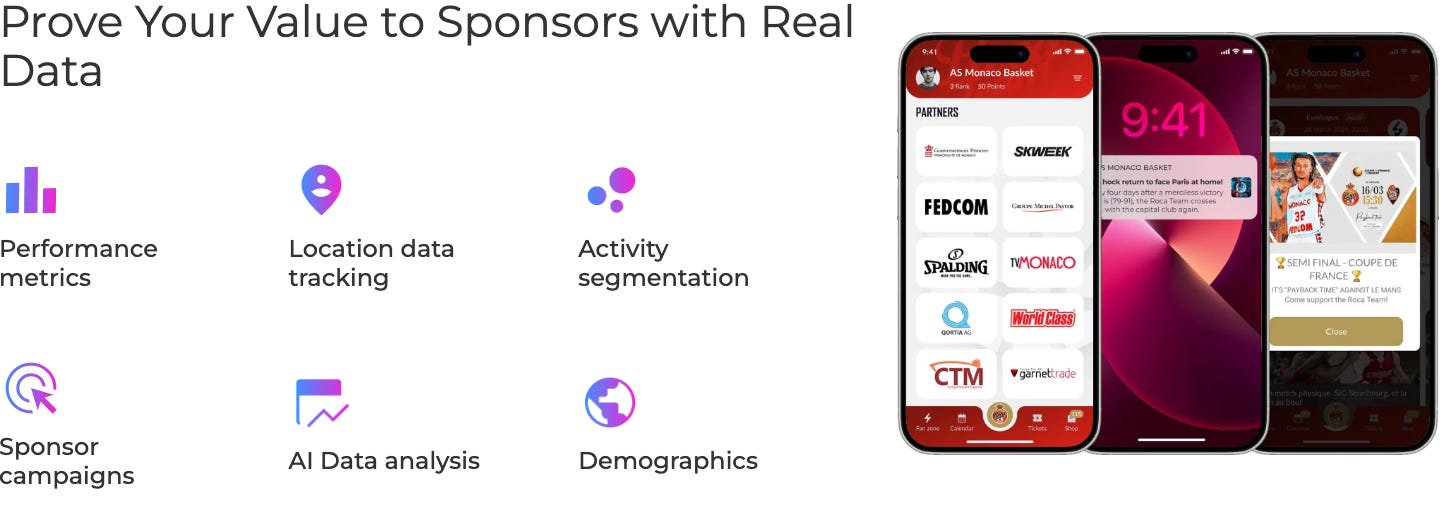
Sponsors are integrated authentically: branded missions, prediction challenges, and product integrations. The club measures everything: conversion rates, sponsor CTR, revenue attribution, and data quality.
After one season: verified identities for 65,000+ fans, proof that sponsor campaigns drove measurable engagement, direct revenue exceeding $200K independent of broadcast, a data asset informing content, pricing, and hospitality strategy.
This is ownership, not of platforms (that game is lost), but of identity, data, and direct relationship.
The Takeaway
The future of sports media belongs to organizations that own their fans, not the platforms that rent their attention.
YouTube and other social media platforms will remain the dominant discovery engines. That is not changing. What is changing is that sophisticated rights holders are building parallel architectures, SuperApps backed by CDPs, that convert fleeting platform attention into owned relationships, first-party data, and sustainable revenue.
The technology exists. BLOCKSPORT, PickYourSquad, StellarAlgo, and others have proven it at scale. The premium fans are ready to pay. The playbook is proven.
The only remaining question is whether your organization is ready to move from platform dependency to data ownership.