

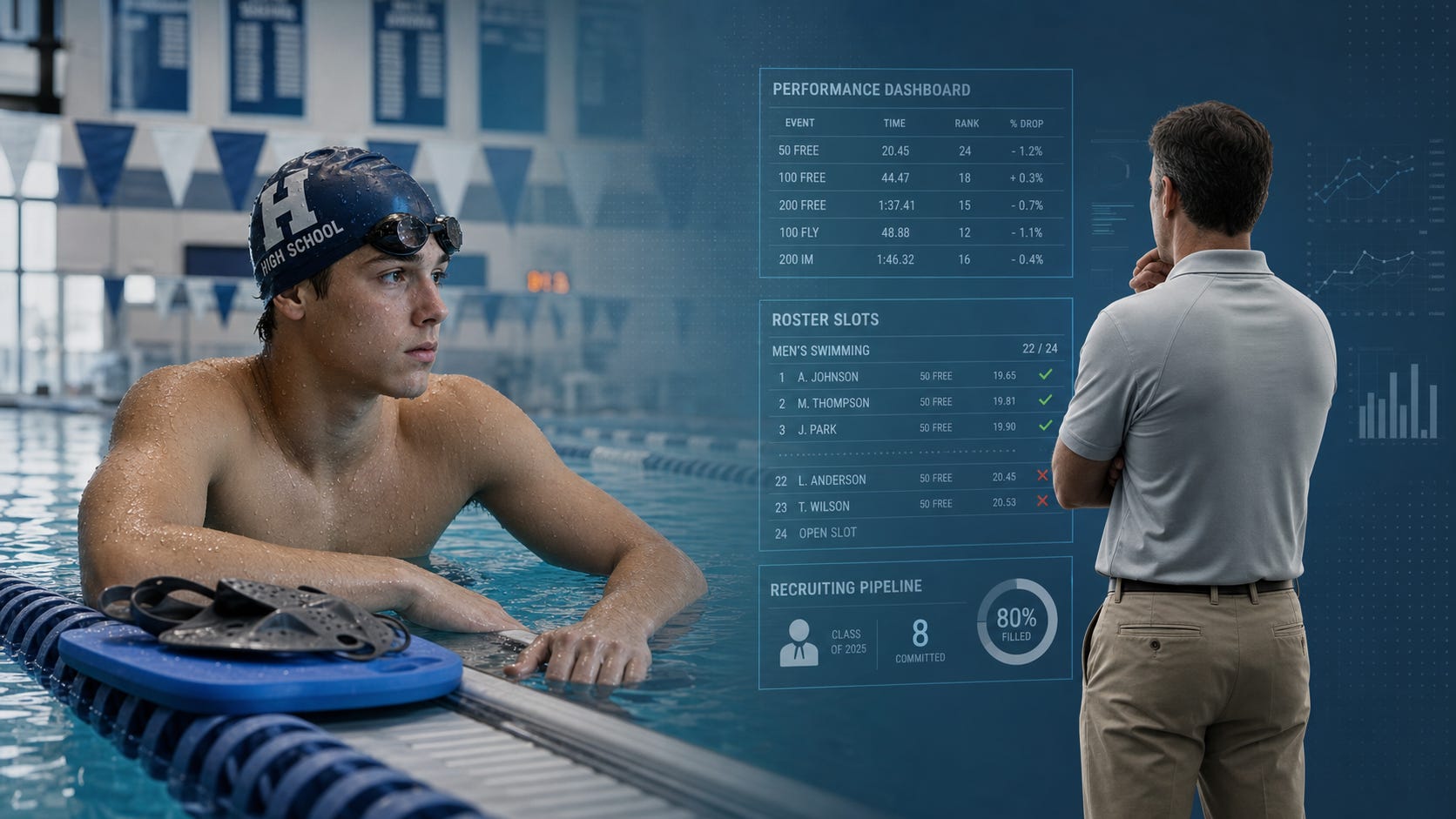
Over the last year, going through the recruiting process with my son, I’ve had a front-row seat to a shift I’ve suspected for a while, and it has now become very real.
In too many college programs, “player development” has quietly been replaced by roster management, and the difference between those two things is not small.
Publicly, coaches still say the right things:
They praise multisport athletes. They talk about leadership, resilience, long-term upside, and building the whole person. They warn against early specialization and position themselves as mentors shaping young people for life beyond sport.
That public message also aligns with what sports medicine and athlete-development experts have been saying for years: delayed specialization and broader sport sampling are generally healthier for young athletes and are associated with lower risk of overuse injuries and less burnout.
Privately, though, many recruiting conversations tell a very different story. Behind closed doors, the message often becomes much simpler and much colder: are you specialized enough, polished enough, physically mature enough, and immediately useful enough to help win now? If not, many coaching staffs move on.
As a sports business professional and a dad who has actively encouraged my son to stay the course as a four-year three-sport high school varsity athlete and leader, I find that disconnect hard to stomach. It is even harder when you see it register on my son’s face and in his voice, and realize he is silently asking the question so many kids (and their parents) must be asking now: “Why didn’t I just specialize?”
The cruel irony is that the very path that I have stayed unapologetically and resolute in, and following along with health experts and development frameworks that recommend delayed specialization, diversified movement, broader athleticism, can still be treated as a recruiting disadvantage in the wrong room.
The Public Message & The Private Market
This is what makes the current environment so frustrating for many families. The public-facing story and the private decision-making criteria are no longer aligned.
Consensus recommendations from groups such as the American Orthopedic Society for Sports Medicine (AOSSM) and National Athletic Trainers Association (NATA) explicitly support delaying specialization, participating in a variety of sports, and limiting year-round single-sport exposure because specialization is associated with overuse injury and burnout. Reviews of the literature continue to reach the same conclusion: diversification is protective, while intensive specialization carries meaningful physical and psychological costs.
Yet once recruiting decisions get real, many college coaches narrow their lens to a tiny set of immediate performance signals. The broader athletic profile, leadership background, and developmental runway that are praised in public can become secondary the second a stopwatch, ranking list, or position-specific needs takes over.
That does not mean every coach is being dishonest. It means the incentive structure has changed. A philosophy of development may still be sincere, but sincerity gets sidelined when roster spots, budgets, retention, and wins are all under pressure simultaneously.
Why Coaches Have Changed
The coaching profession has not changed because every coach suddenly stopped caring about teaching. It has changed because the job has changed. The portal and NIL era has turned college sports into a far more fluid, transactional labor market, and coaches are increasingly forced to act like general managers, cap managers, and personnel directors all at once.
The transfer portal has created a marketplace of known quantities. A staff can evaluate a 20-year-old with college film, proven production, and a more mature body, then compare that athlete against a 17-year-old who may have tremendous upside but still needs time and coaching. In an environment built around urgency, the known quantity often wins.
NIL adds another layer. Once money, donor expectations, and competitive resource gaps intensify, the tolerance for developmental uncertainty shrinks further. A miss on a high school recruit is no longer just a missed evaluation; it can also feel like a wasted roster asset in a system that increasingly rewards immediate output.
And now there is another competitive lever available to programs that want to win right away: the international recruiting market. In a growing number of NCAA sports, especially in Olympic and individual sports, coaches are looking globally for older, more fully developed, and highly specialized athletes who can step in and score immediately. International athletes now make up a meaningful share of Division I participation overall, and in some sports they represent an even larger competitive force; in men’s NCAA swimming, top programs have drawn an outsized share of championship points from athletes developed outside the United States.
To be clear, this is not an argument against international athletes. They are talented, deserving, and often come from outstanding development systems. It is, however, another example of how the incentives now favor finished products over developmental bets. If a coach can add a proven transfer, a more mature international athlete, or a highly specialized recruit who is already close to scoring level, the appetite for taking a broad-based, late-blooming high school athlete and developing him over time naturally shrinks.
Even outside revenue sports, this logic spreads. Coaches are judged on results, roster stability, retention, and their ability to put competitive lineups on the field, court, track, or in the pool quickly. That pushes them toward athletes who require less imagination and less runway. It also helps explain why so many families now experience recruiting as a process driven less by projection and development and more by risk minimization.
The Timeline Problem
There is another part of this that is not talked about enough:
Student-athletes are being judged heavily in their junior years, before they have completed critical summer competition and before they have had a full senior year to mature physically, mentally, and emotionally.
Recruiting timelines and outreach windows in many sports now become meaningful by the end of sophomore year or during junior year, which means some of the biggest evaluations occur before an athlete’s development is nearly finished.
That matters because so much real growth happens late:
Strength catches up.
Confidence catches up.
Bodies change.
Competitive maturity changes.
Senior-year performance can look very different from junior-year performance, especially for multisport athletes and later bloomers who may not have spent every month of the year building one sport-specific stat sheet.
But the process keeps moving younger. The pressure to identify, rank, contact, and secure athletes earlier means that later-developing kids can be left fighting for fewer spots just as they are beginning to make their biggest jumps. They are often competing against peers who may already have one or two more full years of high school development built into the way they were evaluated, marketed, and slotted. That dynamic can heavily favor early physical bloomers and early specializers, while leaving high-ceiling late developers trying to prove themselves on a compressed timeline.
In other words, the system is not just biased toward specialization. It is also biased toward early visibility. And when early visibility is mistaken for long-term superiority, many future contributors and leaders are screened out before they can fully become who they are.
What Families Experience
For families, the translation is painful but clear.
You hear:
“We love multisport athletes.”
“We care about the whole person.”
“Leadership matters.”
“Specialization too early can be harmful.”
Then, in the actual recruiting meeting, the subtext becomes:
You may be a terrific young man, but are you ready right now?
You may have leadership and range, but are you sport-specific enough?
You may have upside, but are you developed enough to help immediately?
That gap between what is said in public and what is rewarded in private is where trust starts to erode.
And for teenagers, it can be brutal. A 17-year-old who has done exactly what adults said was healthy and valuable can suddenly be made to feel as though he misplayed the whole thing. That emotional collision is not theoretical. It is real, and it happens in recruiting conversations every day.
The Moment It Crystallized
One recent conversation brought all of this into focus for me.
Recently, a coach looked my son in the eye and said, in so many words, that being a three-sport varsity athlete for all four years of high school might help him get into the school, but he was not fast enough to be recruited for the team.
That moment landed hard not simply because of the evaluation itself, but because of the contrast. This is the kind of coach who, like many others in college athletics, I have listened to on podcasts and read interviews with who has publicly emphasized leadership, whole-person development, and building future leaders rather than simply chasing athletic output. Yet in the private meeting, the full-athlete narrative disappeared the second the program-specific performance threshold took over.
Publicly, the philosophy sounded expansive. Privately, the filter was singular.
That is the disconnect in one sentence. The same qualities that institutions often celebrate in admissions language and development rhetoric promoting leadership, breadth, resilience, and long-term potential take a back seat when a coach is filling a performance slot on a roster. The athlete is viewed and judged more narrowly than the person. The metric overtakes the mission.
I’m not blind to the fact, and to be fair, I am fully aware that elite programs do have real standards. In swimming and many other sports, there are hard performance thresholds because coaches are trying to score points, win meets, and remain competitive against peer institutions and conference rivals. But that is also exactly why the broader recruiting messaging matters so much.
If the real standard is “help us now, or you are not for us,” then families deserve radical honesty, not generalized praise for multisport development that does not survive first contact with a roster decision.
The Death of Player Development
When people talk about the death of player development, this is what they mean.
They do not mean coaching has vanished. They mean that the system increasingly rewards acquisition over cultivation. They mean fewer coaching staffs are willing or able to take a raw but compelling prospect and spend two or three years turning upside into production. They mean the market now prioritizes ready-made contributors over diamonds in the rough.
This shift shows up in several ways:
Fewer true developmental bets coming out of high school.
Greater preference for specialized athletes with cleaner, earlier sport-specific stat sheets.
Increased reliance on transfers who have already been “finished” somewhere else.
Less patience for freshman growth curves and more pressure for immediate return.
There are still programs and coaches who believe deeply in development. Some have to out-develop because they cannot outspend or outbid. Some still see their real edge in teaching, culture, and long-term investment. But the gravitational pull of the system is moving in the other direction. Transaction is replacing transformation.
What This Means for My Son
So what does this mean for my son and my family?
It means trying to help a 17-year-old process a recruiting world that says one thing on podcasts, in marketing materials, in recruiting emails, and on stage, and another thing in the room face-to-face. It means seeing and hearing the disappointment after a meeting and understanding that he is trying to reconcile his lived experience with everything he was told to value. It means hearing the unspoken question in his eyes:
Did I do this wrong by not specializing?
My answer to him is no.
I tell him to use it as fuel. I tell him to keep chasing his dreams and build toward faster. I tell him someday some of these coaches will see him beat their top recruits. I tell him this is not the end of the road; this is only a hurdle to jump. I tell him we are not going to chase every program that only sees him as a transactional roster piece. We are going to prove to this coach and talk to other coaches and programs who see what he actually is: a four-year high school three-sport varsity athlete, a leader, a competitor, a young man with range, resilience, and room to grow.
That is the line in the sand for us.
We are not looking for a coach who values leadership only in podcasts, emails, and marketing materials but abandons it when lineup decisions begin. We are looking for the coach who believes a broad athletic background is not an inconvenience but an asset. We are looking for an environment where upside is cultivated rather than discarded because it requires patience.
My son may still be admitted to some of these schools. He may still be a walk-on to some of these teams, for these same coaches. He may still become a great teammate and contributor if that path opens. Shit, he may develop into something greater, like an All-American or, dare I say it, an Olympian (one can dream). And if it does, he will throw himself into that opportunity the way he always has.
But that is not our only goal.
We are committed to finding a school where he can achieve more than being a great athlete. We are looking for a place where he can develop into a great leader in society. We are not here because we believe college athletics is a guaranteed runway to the Olympics, professional sport, or some financial windfall. We are here because we believe athletics can be a vehicle for becoming a leader and a teammate, a leader and teammate on the field, a leader and teammate in the classroom, and eventually a better person in the business world and in life.
That can be hard for a teenager to hear. At 17, all he wants is the chance to compete at the highest level, especially for programs he admires and coaches for whom he has the utmost respect.
So yes, there is a pit in my stomach sometimes. Yes, there is sadness in my son’s eyes and voice after certain conversations. But we move on. To become better. To the next practice. To the next race. To the next opportunity.
And we will come out stronger on the other side - We have a few sayings in our family:
Make It Happen
Tough To Beat Pool
Win The Day, One At A Time
Because somewhere in this process there are still coaches who believe their job is not just to manage a roster but to build people. There are still schools that understand athletics as a crucible for character, leadership, and long-term development. There are still places where being a four-year tri-varsity high school athlete and a broad-based competitor is seen as a marker of substance, not a mark against you.
That is where we are headed.
The Road Forward
The challenge for families in similar situations is not just finding a program. It is finding an honest one. The challenge for coaches is not just winning. It is about deciding whether they still want to be in the development business or are comfortable becoming full-time asset managers in team-issued gear. And the challenge for the rest of the sports ecosystem is deciding whether it truly believes what it says about multisport participation, whole-person growth, and long-term athlete development.
Until those things align, more families will keep discovering the same hard truth:
The public message celebrates the whole athlete, but too often the private market rewards only the finished product.