

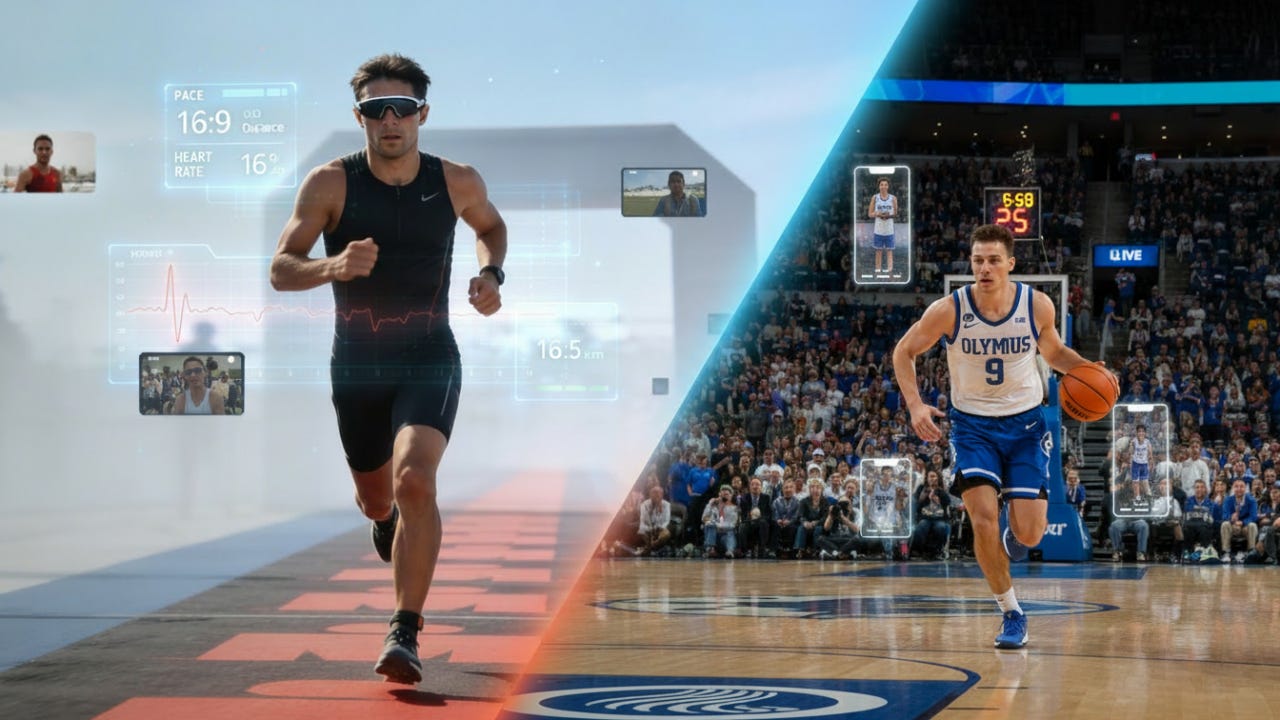
The IRONMAN Group‘s 2026 rule update banning all on-course photo and video capture, including smart glasses like the Oakley Meta HSTN, GoPros, and smartphone cameras, represents a significant countertrend in an industry otherwise sprinting toward fan engagement, athlete-generated content, and data-rich media experiences. While framed as a safety and competition-integrity measure, the decision disconnects Ironman from the broader sports industry’s trajectory, which prizes user-generated content as a driver of brand growth, sponsorship value, and community engagement. The rule, effective March 2, 2026, carries a disqualification penalty.
What the Rule Actually Says
Section 4.04 of Ironman’s updated 2026 Global Competition Rules now reads:
“Using any device (e.g., including without limitation, cameras, phone cameras, video cameras, glasses, etc.) to capture photographs, video, or other visual images during the Race is prohibited… Athletes using any device in this manner will be disqualified.”
The rule closes the door on helmet- or bike-mounted cameras, smartphone selfies, mid-race livestreams, and, most notably, emerging wearable tech such as the Oakley Meta HSTN smart glasses, launched in June 2025. Phones remain permitted for GPS tracking, live location sharing, and use as a securely mounted bike computer, but any active recording or social media use results in disqualification.
The Catalyst: Oakley Meta Glasses and the Wearable Content Revolution
The timing of this rule is not coincidental. The Oakley Meta HSTN glasses, purpose-built for athletes and virtually indistinguishable from standard sunglasses, have surged in popularity among endurance athletes, creators, and influencers since their release. They record like a GoPro without the bulk, enabling hands-free POV content that is rapidly becoming some of the most compelling storytelling in endurance sport. The rule’s explicit inclusion of “glasses” in its list of prohibited devices appears to be a direct response to this technology’s growing adoption.
Several professional triathletes pushed back. Joe Skipper wrote on Instagram: “It’s such a shame that these are banned. I don’t understand what the negative is with using these”. Instagram commenters noted the missed opportunity: “Imagine being able to sync to the racers’ Meta glasses where Ironman could go to racers’ POV during the race for media coverage”.
Ironman’s Stated Rationale
Ironman frames the change around three pillars:
Safety: Recording devices can create distractions, compromise bike handling, or interfere with other competitors in crowded race environments.
Fairness: Devices with audio capabilities (such as Meta glasses) could, in theory, provide external coaching or pacing information, creating an uneven playing field.
Race integrity: The organization’s official broadcast crew and accredited media already capture race-day action.
A Triathlon Today poll found that 80% of respondents supported the ban, with only 10% opposing it. However, that sample likely skews toward competitive-focused athletes rather than the broader age-group community that treats an Ironman as a bucket-list personal milestone.
The Sponsor Dimension: ROKA vs. Oakley
There is a commercial layer to this story that Ironman has not addressed publicly. ROKA has been Ironman’s Official Technical Eyewear and Official Performance Eyewear Partner since 2022, building on a swimwear relationship that dates back to 2014. The partnership was expanded globally in 2018 and extended through at least 2024, with Roka’s eyewear and sunglasses sold at every Ironman and 70.3 event worldwide. As of early 2026, Ironman’s own website still lists Roka as the “Official Swimwear & Technical Eyewear Partner” of the IRONMAN Pro Series, and Roka is prominently featured in Ironman’s official “Get the Gear” athlete resources.
The device most visibly targeted by the new rule, and the one named in nearly every headline, is the Oakley Meta HSTN, released in June 2025 as a purpose-built athlete smart glass with 3K video, Strava and Garmin integration, a Meta AI fitness agent, and IP67 waterproofing. Oakley is not just any competitor to Roka; it is a direct rival in premium performance eyewear, and one with vastly greater brand recognition and parent company resources (EssilorLuxottica , which also owns Ray-Ban and Prada).
Roka makes no smart glasses. It has no camera-enabled product. It competes on lens optics, weight, grip technology, and triathlon-specific design. The Oakley Meta HSTN threatens to pull athletes away from Roka’s eyewear ecosystem by offering something Roka fundamentally cannot: an integrated content-capture and AI-assisted performance platform that athletes are organically choosing to race in.
By banning the category of device that only Oakley (and emerging competitors like Rokid Corporation Ltd ) manufactures, Ironman effectively neutralizes the single biggest product-level threat to its official eyewear partner’s market position within the triathlon ecosystem. Athletes who might have switched to Oakley Meta glasses for racing can no longer use them on course, and the habit-forming effect of training and racing in the same eyewear tilts back toward Roka.
Ironman has not acknowledged this dimension publicly, and there is no smoking-gun evidence that Roka lobbied for the rule change. But the commercial incentive alignment is unmistakable: the ban protects Roka’s exclusive position while eliminating a product that is gaining organic traction among the exact audience Roka pays to access. In the sports business, when a governing body passes a rule that disproportionately benefits its paying sponsor over a non-sponsor competitor, the optics alone warrant scrutiny, regardless of the stated safety rationale.
Why This Runs Counter to the Sports Industry
The Content Economy Is the Growth Engine
The broader sports industry is moving decisively in the opposite direction. Deloitte’s 2026 Global Sports Industry Outlook describes an era where organizations are building “cross-industry platforms that combine sports, media rights, content studios, video games, fan data, real estate, and more to drive commercial value”. Global ownership groups are evolving beyond sports into media companies, where year-round engagement and diversified content revenue streams are central strategies.
Athletes alone now generate 26% of total brand sponsorship value on social media, outperforming other sponsorship channels. The Professional Triathletes Organisation(PTO), Ironman’s direct competitor in long-distance triathlon, has adopted the exact opposite approach, appointing Socialie to power athlete content creation and distribution across its social ecosystem, explicitly aiming to “make Professional Triathletes household names”.
Data + Media Convergence Is the Future
PTO’s CEO Sam Renouf captured the industry direction perfectly: “If you strip away all of the data from Formula 1, you’ve got a two-hour show of cars going around so fast that you don’t know what’s going on. But if you layer in data and real-time metrics, either audio or graphical, you can actually get engaged in the race”. PTO has been “physically turning athletes into a data model,” integrating live telemetry, heart rate monitors, split times, and positioning data to create compelling broadcast content.
Ironman’s ban moves in the opposite direction, removing a data-rich, athlete-perspective content layer at exactly the moment the technology exists to make it seamless.
User-Generated Content Drives Participation Growth
Running’s creator economy illustrates the flywheel that Ironman is disrupting. Creator content in running generates 25 times higher engagement per video than brand content, with 39% of creator video titles directly referencing races. No Abbott World Marathon Majors event has implemented recording restrictions comparable to Ironman’s, and race directors understand why: “athlete-generated content fills their social feeds, brings in first-timers who want to see what the experience is really like, and extends the life of the event well beyond race weekend”.
PwC’s analysis of digital fan engagement in 2026 emphasizes that fans now “curate their own experiences, engage across devices,” and that personalization and experience design are increasingly important to customer loyalty. Companies focused on customer experience expanded revenue at 1.7 times the pace of their peers.
The Emotional Layer for Age-Groupers
For many age-group athletes, entering, training for, and crossing the finish line of an Ironman represents a once-in-a-lifetime personal achievement. The ability to capture moments along the way, however imperfect, is part of the emotional payoff of months of training, sacrifice, and registration fees that often exceed $700. The brand’s cultural cachet, including the famous M-dot tattoo tradition, is built on personal storytelling and accomplishment sharing. Ironman is simultaneously the sport with perhaps the most emotionally invested amateur participants and the one now telling them their story can only be told through official channels.
The Matt Choi Problem vs. The Blanket Ban
Ironman’s safety argument has legitimate roots in real incidents. The most notable was Matt Choi’s disqualification from the 2024 NYC Marathon for running with an e-bike film crew that blocked other runners at water stations. Marathon Investigation documented a pattern of similar behavior across multiple events.
But the key insight from that incident is that existing rules, properly enforced, were already sufficient to disqualify bad actors. New York Road Runners (NYRR) did not need a blanket recording ban to address the problem. A more surgical approach, prohibiting external camera crews, motorized equipment on course, filming near aid stations, and setting explicit rules for smart glasses, targets the behavior causing problems without penalizing the age-grouper filming their finish line moment.
The Wearable Tech Question
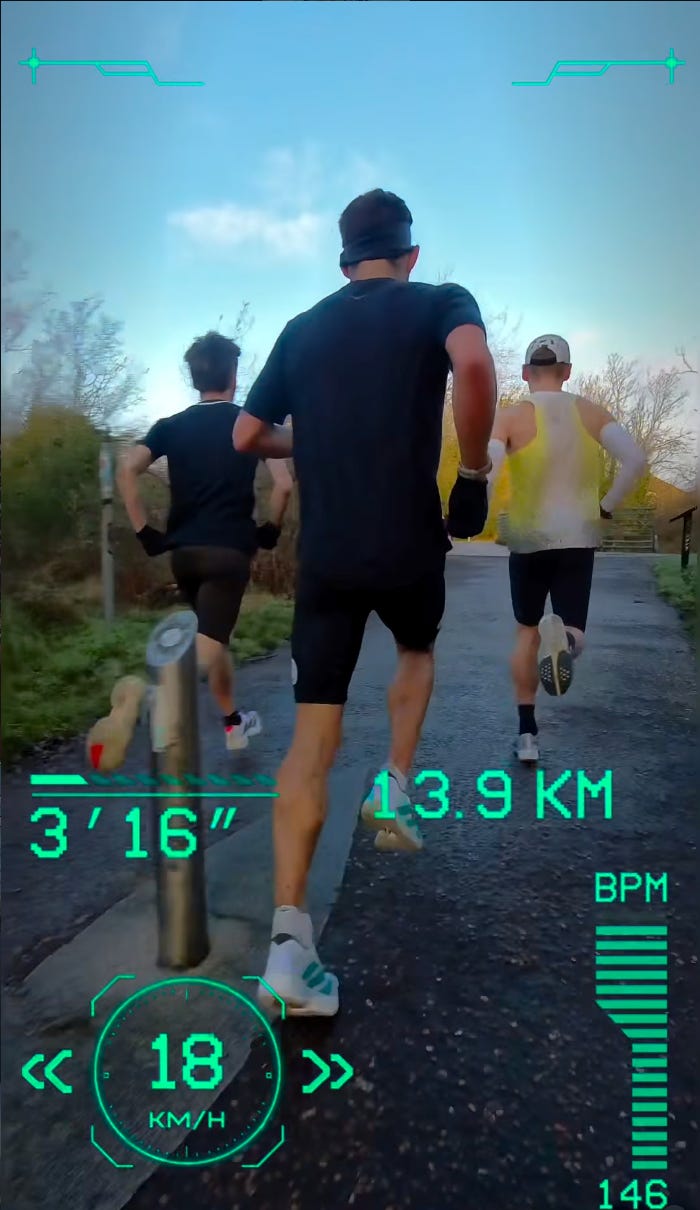
“What’s next, no use of wearable tech that blends performance data with media content?”
Me being snarky actually highlights the core tension. The Oakley Meta glasses represent the first generation of tech that seamlessly merges performance eyewear with content capture. Future iterations will likely integrate real-time performance data overlays, biometric monitoring, and AI-assisted coaching directly into the athlete’s field of vision.
The sports industry trend is toward more data integration, not less. Deloitte’s outlook highlights AI being used to “bring fans closer to the sports and teams they love” through “real-time analytics in live broadcasts, personalized and AI-generated highlight reels”. PTO is already demonstrating this with live athlete telemetry during broadcasts, showing heart rate percentages during critical race moments to create viewer engagement.
Ironman’s rule, as written, would ban any future device that captures visual data, even if the primary purpose is performance monitoring. This creates a regulatory framework that may need to be repeatedly rewritten as wearable technology evolves, a game of whack-a-mole against innovation.
The Media Rights Angle
A less-discussed dimension is Ironman’s media rights posture. The organization explicitly states that “race-day coverage is already the job of its official broadcast crew and accredited media”. Ironman’s media rights page requires formal licensing for any use of event intellectual property, and all media rights are tightly controlled.
Ironman is owned by Advance, a private media company that also owns Condé Nast. It’s 2024 broadcast partnership with DAZN puts IRONMAN Pro Series content on DAZN’s free tier across 195+ territories. There is an argument that Ironman views athlete-generated content as competitive to, rather than complementary to, its controlled broadcast product. This would explain why the organization frames official media as the sole legitimate channel for race-day documentation.
Contrast this with how PTO leverages IMG for media rights distribution while simultaneously encouraging athlete content creation as an amplification layer. PTO achieved a global live TV and streaming audience of 24.6 million for its 2024 races, in part by making athletes active participants in content distribution.
Strategic Implications
The ban may deliver short-term order on course, but risks long-term brand erosion:
Reduced organic reach: Every age-grouper who posts race-day content is free marketing for Ironman’s brand, reaching audiences that official media never touches.
Competitive disadvantage: As PTO and other organizations lean into athlete-driven content, Ironman creates a participation experience that feels more restrictive.
Innovation resistance: By banning the hardware category rather than regulating behavior, Ironman positions itself against the wearable technology sector, one of its natural commercial partners.
Diluted emotional connection: The Ironman brand is built on personal transformation stories. Removing athletes’ ability to document their own journey undermines the very narrative that drives $700+ registrations and M-dot tattoos.
The Counter-Model: Creator Sports Network and the Mountain West Conference
While Ironman locks down athlete-generated content, the rest of sports media is sprinting in the opposite direction, and the most compelling proof point just happened in D-1 basketball.
In early 2026, the Mountain West Conference made a deliberate institutional decision to route live game broadcasts through athlete-owned social channels. Five University of Nevada-Las Vegas men’s basketball players streamed a live game on their personal channels while actively playing in it. Three Colorado State University women’s basketball players did the same. This wasn’t a social media stunt; it was a rights-cleared broadcast delivered through athlete-owned channels inside an official window, designed and executed by Creator Sports Network (CSN).
The implications are seismic. As the Disruptive Play newsletter put it: “The athlete is no longer just inside distribution. The athlete is the distribution”. The Mountain West model proves that athlete-generated live content doesn’t cannibalize traditional broadcast; it layers on top of it, expanding the total monetizable surface area. CSN founder Barrick Prince calls this “a million ESPNs,” taking live sports directly to YouTube, TikTok, Twitch, and Instagram, where Gen Z and Gen Alpha already live.
Sports Business Journal confirmed the broader thesis in January 2026: “Within five years, nearly every rights deal will include a digital participation layer, every sponsor portfolio will feature creator partnerships, and every fan will experience the same game through a slightly different window”. ESPN has built three classes of its Creator Network specifically to embed creator voices into its live events. The PTO partnered with Socialie to turn professional triathletes into content distribution nodes.
The Mountain West model addresses the exact structural dynamics Ironman faces:
Revenue expands rather than cannibalizes. Athlete-owned channels carry incremental sponsorship and commerce, not replacement inventory.
NIL shifts from endorsement to participation. Athletes monetize their role in distributing the product, not just endorsing it.
Women’s and emerging sports gain leverage. Where athlete engagement outperforms current media deal economics, and athlete-owned distribution closes the gap faster than waiting for a breakthrough national contract.
Governance becomes designable. Who controls viewing data, how sponsorship conflicts are managed, and what production standards apply are solvable institutional design problems, not reasons to ban the model.
Now consider the Ironman age-group parallel. An age-group triathlete wearing Oakley Meta glasses during an Ironman is, at a grassroots participant level, doing exactly what the Mountain West Conference is doing at the institutional level: turning the person inside the competition into the distribution endpoint for the experience itself. Every finish-line POV clip shared on Instagram, every bike-course vista posted to YouTube, every run-course suffering montage on TikTok is organic, emotionally authentic content that extends Ironman’s brand reach to audiences its official DAZN broadcast will never touch.
Ironman’s response? Ban it. Disqualify the athlete. Protect the centralized media model and the official sponsor ecosystem.
The Mountain West Conference’s response to the same technological moment? Formalize it. Compensate the athlete. Design governance around it. Grow the pie.
Two organizations faced the same question: what happens when the people within the competition can share their own experiences? and arrived at diametrically opposite answers. One is building the future of sports media. The other is writing rules against it.
A Better Path Forward
Rather than a blanket prohibition, Ironman could adopt a more nuanced approach that preserves safety while embracing the content economy. An approach to align Ironman with the broader trajectory of the sports industry while maintaining on-course safety.