

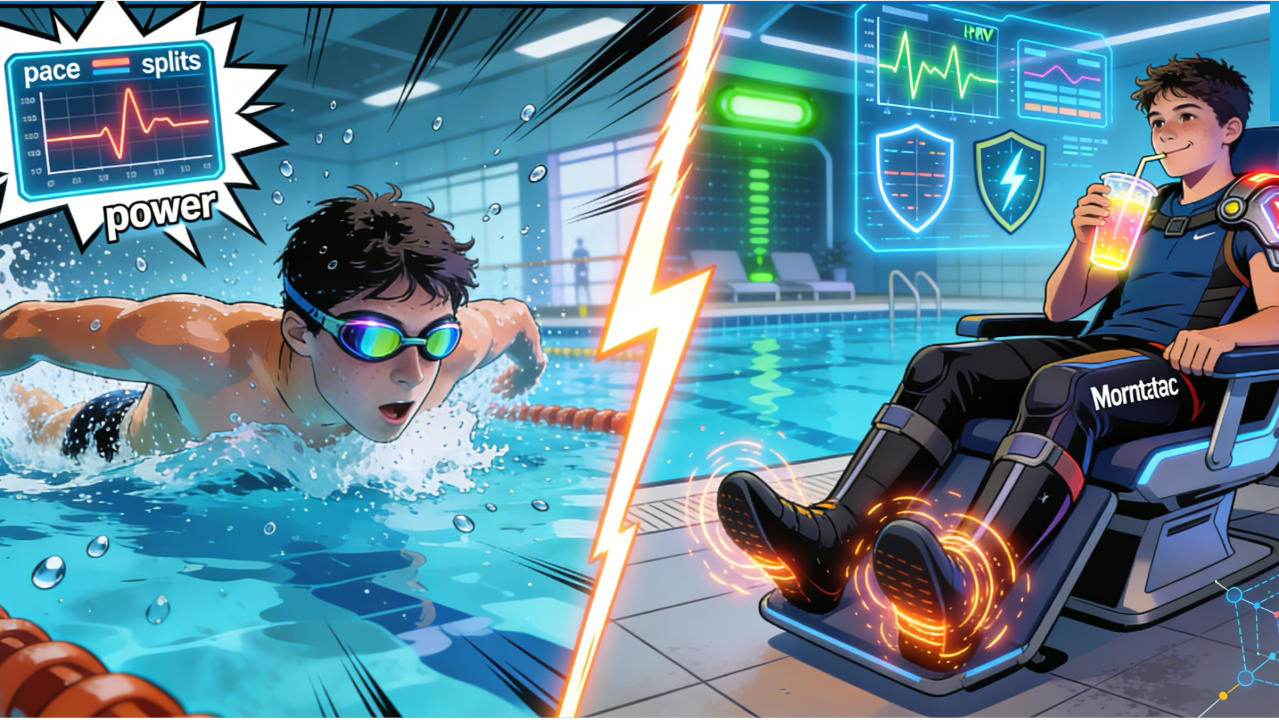
My son is a high school swimmer who suffered a significant shoulder injury heading into what should have been a pivotal season. Anyone who has been around swimming knows how devastating a serious shoulder issue can be, both physically and mentally.
With a great orthopedic doctor, physical therapist, trainers, and coaching staff, we’ve worked methodically to bring him back, carefully balancing load, mechanics, strength, and confidence.
One of the key tools in that journey has been the Hyperice X2 shoulder device, which combines heat, cold, and compression in a programmable wrap that effectively turns your living room (or dorm room in this case) into a mini training room.
It hasn’t been magic. It’s been consistent: daily protocols, check‑ins, and adjustments based on how his shoulder feels, how he’s doing in the water, and how the rest of his body is handling the training load.
The win? He is now back in prime shape, heading into his championship season.
The even bigger win: we both have a deeper appreciation for what “performance” actually means.
Performance is more than watts, pace, and splits
In the endurance and fitness world, we obsess over the metrics that show up on leaderboards:
Pace, power, and heart rate
Splits on the watch
Wins, losses, PRs, rankings
These are the headline numbers, but they’re just the visible tip of the system.
Behind them is an equally important, often more impactful stack of “invisible” variables:
Sleep duration and quality
Recovery status and nervous system readiness
Tissue health and injury risk
Nutrition, hydration, and long‑term biomarkers
Mental state: confidence, stress, burnout
Over the last few years, our household has essentially built a full “performance and recovery tech stack”:
In‑session performance: FORM goggles, power meter, Hammerhead, Garmin, running pods.
Acute recovery tools: ice baths, sauna, Hyperice/Normatec, and, in particular, the Hyperice X2 for targeted contrast + compression on the shoulder.
Sleep and readiness: ŌURA for continuous sleep, HRV, resting heart rate, and temperature signals.
Deep diagnostics: Function Health as a periodic “full lab scan” for underlying trends in metabolic, hormonal, cardiovascular, and nutritional status.
What’s interesting is that this same architecture, live performance data, daily readiness, and periodic deep health checks, is exactly what elite teams and federations are now trying to operationalize at scale. Many of us in the age‑group, youth, and high school worlds are quietly living in the same ecosystem, just without the staff and big budgets.
The fourth discipline has evolved
When I was training for an Ironman triathlon, everyone said the fourth discipline was nutrition.
That’s still true, but I’d argue the fourth discipline has evolved into something broader: integrated recovery.
Not just “did you drink your recovery shake?” but:
Are you sleeping enough, consistently, and at the right times?
Do your recovery markers actually support the workload you’re piling on?
Are you cycling stress, physical and psychological, intelligently over weeks and months?
Are you catching injury and illness risks early, rather than waiting for a breakdown?
Wearables and platforms have finally given us enough fidelity to see how powerful these levers are.
HRV, resting heart rate, sleep staging, and body temperature can offer early warning signs of overreaching, under‑recovery, or impending illness. Longitudinal lab testing can flag deeper issues that a simple “how do you feel?” check will miss.
The problem is no longer a lack of data. It’s the opposite.
Where AI fits: from “more data” to better systems
The next wave of innovation won’t just be “more data.” It will be better systems: integrated, human‑centered frameworks that make this complex ecosystem actionable for real people with real lives.
AI is the thing that makes that shift possible.
Most of us already have more numbers than we can process: splits, watts, HRV, sleep scores, strain, and lab panels. What we’ve been missing is a way to translate all of that into simple, trustworthy decisions:
Should I push or back off today?
Is this ache just soreness, or the start of an injury pattern?
Do my labs and my wearables tell the same story, or are they out of sync?
How do I adjust training when life (work, school, travel, stress) piles on?
Used well, AI can help the “at‑home athlete” in three big ways:
Translation. AI can turn raw streams of HRV, sleep, GPS, and lab values into plain‑language guidance: “Today is a green‑light day for intensity,” or “You need a lighter session and earlier bedtime,” with reasoning that ties back to the underlying data. Instead of you trying to reverse‑engineer every micro‑movement in your Oura or Garmin dashboard, you get a narrative you can act on.
Integration. Right now, every device wants to be its own ecosystem. AI can sit above that, pulling from multiple sources, watch, ring, bike computer, PT notes, lab reports, and building a single picture of your current state. That’s as true for a national team as it is for a teenage swimmer juggling AP classes, finals, and taper.
Collaboration. The best AI systems won’t replace coaches, PTs, or doctors; they’ll make their work more informed. Imagine showing up to a visit with a clear, AI‑generated summary: “Here’s how your load, sleep, and symptoms have interacted for the last six weeks, and here are three questions you should discuss with your provider.” That’s powerful leverage for both sides.
Of course, there’s a shadow side. If we blindly outsource judgment to algorithms, we risk:
- Treating opaque scores as gospel without understanding what’s underneath.

- Ignoring the messy human realities, growth, stress, fear, and motivation that no model fully captures.

- Widening the gap between athletes who can afford all the tech and those who can’t.
The opportunity and the responsibility lie in keeping the “human‑centered” part at the core. AI should be an assistant, not a dictator; a translator, not a gatekeeper.
The real challenge: making sense of it all
For most of us parents, athletes, coaches, and executives, the struggle isn’t collecting data. It’s synthesizing it in a way that:
Fits real life
Informs decisions instead of adding stress
Supports health and performance over the long term
Here’s the simple lens I’ve arrived at for our family, and for any high‑performance environment, whether that’s a national team, a college program, a startup, or a single high‑school athlete:
Define one primary daily readiness signal. Use one main indicator as your “gatekeeper” for load: a combination of sleep, HRV/resting heart rate, and subjective feel. Sport‑specific data (power, pace, intervals) then lives inside the training session, not as the sole judge of whether you should be training that hard in the first place.
Treat performance data as session tools, not identity. Pace, watts, stroke rate, they’re tools to design and evaluate a workout, not verdicts on your worth as an athlete. This matters a lot for kids, who are still forming their athletic identity and confidence.
Make recovery protocols as explicit as training plans. We write swim sets down to the 50. But how often do we write recovery the same way? “Three rounds, 10 minutes contrast with the shoulder device, followed by specific mobility work and a check on pain/ROM” is a session, not a suggestion.
Use labs as periodic “root‑cause reviews.” Lab platforms are a chance to step back quarterly or annually and ask: are there underlying issues (iron, hormones, metabolic markers, cardiovascular risk) that should change how we think about training blocks, nutrition, or sleep hygiene?
Integrate the mental side explicitly. Injuries, setbacks, and near‑misses in sport can quietly erode confidence. A tech‑driven approach that doesn’t account for the athlete’s emotional state can unintentionally increase anxiety. Simple questions like “How confident do you feel in your shoulder today on a scale of 1–10?” belong next to watts and HRV in the log.
Where this goes next
For me, this journey has been both personal and professional.
Personally, it’s about staying healthy and competitive as a lifelong endurance athlete, and helping my son navigate the transition from talented high‑school swimmer to whatever comes next.
Professionally, it’s about the opportunity I see in the sports, health, and performance industry:
We have world‑class tools scattered across devices, apps, clinics, and labs.
We have athletes and parents swimming in numbers but starving for integrated guidance.
We have coaches, PTs, and doctors doing heroic work in their silos with limited connectivity to the rest of the picture.
The next wave of innovation won’t just be more data or smarter devices. It will be AI‑powered, human‑centered systems that integrate wearables, labs, and real life into simple, trustworthy decisions an at‑home athlete can actually use.
In our house, the Hyperice X2 shoulder device wasn’t just a cool piece of gear. It was one node in a larger system that supported the therapy, drawing on medical expertise, training load, wearable signals, and daily reality for a teenager who loves his sport and wanted to get back to racing quickly without sacrificing his long‑term health.
That’s the kind of story, and the kind of system, I’d like to see become the norm, not the exception.
If you’re building in this space, coaching, parenting a young athlete, or navigating your own performance journey, I’d love to compare notes.