

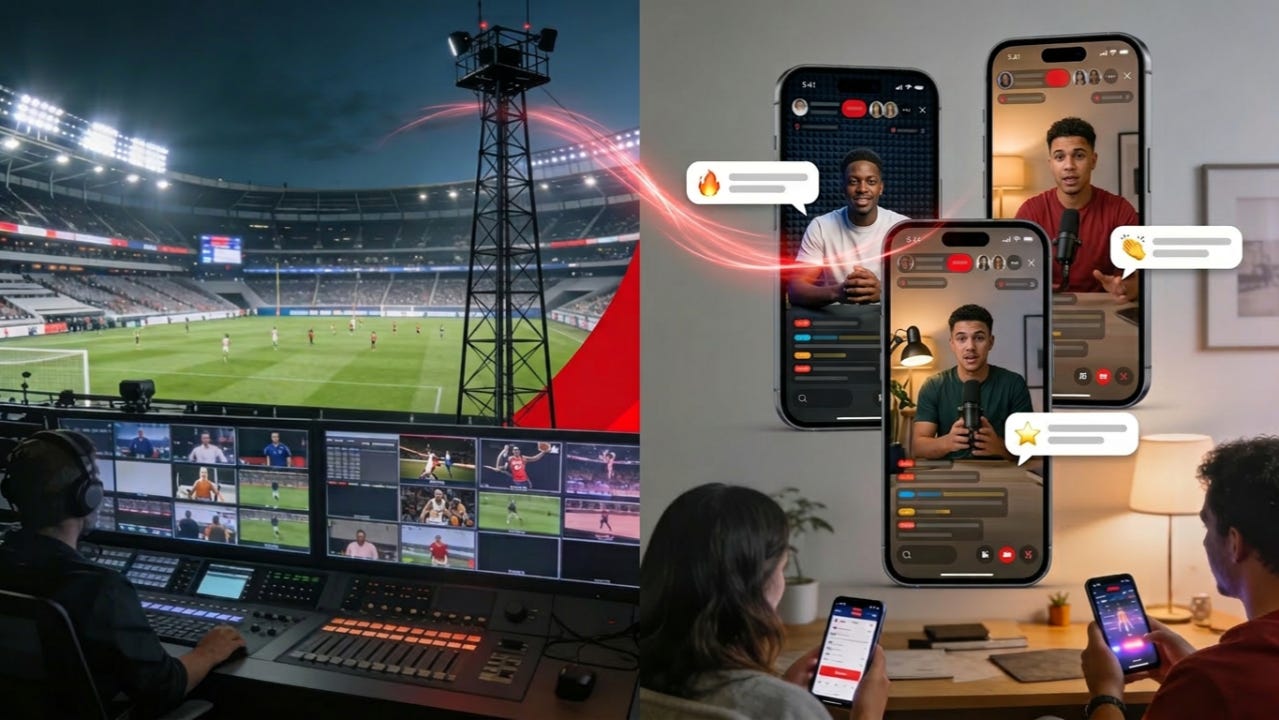
The sports media landscape is shifting in real time.
ESPN quietly absorbed the Playback team on March 17, 2026, no press conference, no fanfare, just a tweet.
For years, I’ve believed that the next frontier of real value in sports media doesn’t live inside a broadcast tower or a polished highlight reel. It lives with individual creators; the athletes, coaches, personalities, and fan innovators who generate the stories, perspectives, and authentic moments that brands then package and distribute as their own. ESPN’s move confirms the industry is finally catching up to that reality.
What Playback Was, and Why It Mattered
Playback wasn’t a traditional sports network. It was a community-first platform that let sports creators host live watch-along experiences alongside their audiences, a sports-native version of what Twitch built for gaming.
It secured official broadcast integrations with the National Basketball Association (NBA) and Major League Baseball (MLB), attracted marquee creator talent such as Gilbert Arenas and Tony Reali, raised $22 million in venture backing, and pioneered what interactive, creator-hosted sports viewing looks like at scale.
The platform ultimately closed in December 2025. But the technology, the approach, and, most importantly, the team that built it? ESPN made sure those didn’t disappear.
The Misconception the Industry Is Finally Unlearning
Here’s something that’s driven me crazy for years: the persistent belief that sports media brands, teams, and league accounts are the true creators of sports content.
They’re not. They never were.
Brands and media houses are aggregators. They curate and package work produced by individual athletes, coaches, reporters, and fan creators. The actual long-term creative value exists at the individual creator level; their stories, their expertise, their unfiltered perspectives. That’s what drives real engagement.
Teams and leagues focus on core, business-aligned content: high-value, widely distributed assets tied to events, tickets, sponsorships, and loyalty programs. What they consistently have left on the table is the “shoulder content”, the behind-the-scenes footage, the training-day moments, the raw commentary, the personal lifestyle content that fans increasingly crave but that doesn’t fit a brand’s polished distribution model.
That’s where the real opportunity has always been. And ESPN just made a $22 million talent bet that says they know it, too.
What ESPN Is Actually Building
To understand why the Playback move matters, you have to zoom out and look at the full picture of what ESPN has assembled over the past 18 months:
A standalone direct-to-consumer streaming platform launched in August 2025, with two tiers, 47,000 live events per year, and all 12 networks in one app.
A $3 billion acquisition of NFL Media assets, including NFL Network and RedZone, was completed in February 2026.
An equity partnership with WWE for exclusive Premium Live Events starting this year.
A TikTok-style vertical video experience (”Verts”) built natively into the ESPN app.
A Creator Network, now in its third class, is generating 9.7 million impressions and reaching 3.5 million fans in 2024, with engagement rates up to 13x higher than social platform benchmarks.
And now: the Playback team is embedded inside product and technology, tasked with building interactive, creator-driven viewing experiences.
This is not a company defending its cable bundle. This is a company deliberately engineering a new category: the all-in-one, creator-powered sports platform that competes with YouTube and TikTok for the next generation of fans, on their terms, in their formats.
The Real Strategic Shift And What It Misses
I want to be honest about something. ESPN entering this space is a validation, but it’s not the endgame.
Here’s the tension: when a brand as large and polished as ESPN builds a “creator layer,” it will inevitably be built for the broadcast experience. Watch parties around live games. Creator co-streams anchored to rights they own. Interactive features layered on top of content they already control.
That’s not wrong, it’s just incomplete.
The most underserved opportunity in sports media is not during the game. It’s everything around it. Sports content consumption is being defined by a shift toward personalized, direct creator engagement outside traditional live events. Fans aren’t just seeking game highlights; they want the training footage, the lifestyle content, the unfiltered athlete perspective, and the deep dives into fan theories. The content that doesn’t fit on a polished platform. The stuff that brands and leagues don’t prioritize because it doesn’t move the needle on their core business metrics.
That content is currently scattered, hard to discover, and massively undervalued.
A persistent misconception is that if you build for live sports, you’ve built for sports fans. You haven’t. You’ve built for the top of the funnel. The creators who generate value at the individual level, the coach who posts a breakdown video at midnight, the athlete who goes behind the curtain of training camp, the superfan analyst with a podcast and 50,000 loyal listeners, they need infrastructure built specifically for them, not repurposed from a broadcast model.
The Harsh Reality for Upstarts
There are, and will absolutely be, more upstart competitors with funding, name-brand athletes, and teams that decide they want a piece of this emerging creator-led sports market. Some of them will launch with glossy decks, celebrity endorsements, and all the right buzzwords.
But they now have a formidable competitor, or they’re just plain late to the party.
Once a player with ESPN’s scale truly recognizes the power of this market, they will stop at nothing to win. They’ve already lit the fuse: DTC at scale, NFL Media, WWE, a Creator Network, a TikTok-style vertical feed, and now the Playback team focused on interactive viewing.
This is not a side bet, it’s a full-stack commitment.
For new entrants, the bar just moved. You can’t simply arrive with money and famous names. You have to be earlier, more focused, and more aligned with creators than a company that now has both the distribution and the conviction to dominate this category.
Why This Is Still a Watershed Moment
None of that diminishes what ESPN’s Playback move signals. Sports Business Journal put it plainly: the future of live sports distribution will be creator-led, personal, and distributed, not one ESPN, but one million.
ESPN heard that and responded with a clear answer: we want to be the platform that hosts all one million.
That ambition is real, and the investment behind it is serious.
The acquisition of Playback’s team is a small transaction with enormous strategic implications. It tells us:
Interactive, creator-hosted sports viewing is no longer experimental; it’s a core product investment for the world’s largest sports media brand.
The “shoulder” around live sports; the commentary, the community, the personalities, is now prime real estate, not an afterthought.
The next battle in sports media isn’t for broadcast rights; it’s for creator relationships, community infrastructure, and the authentic experiences that keep fans staying, engaging, and paying.
The broadcast tower still matters. But the creator layer is where the next decade of sports media will be won.
The question now isn’t whether creator-led sports content is the future. That debate is over. The question is: who builds the infrastructure that actually puts creators first, not as a feature, but as the foundation?