

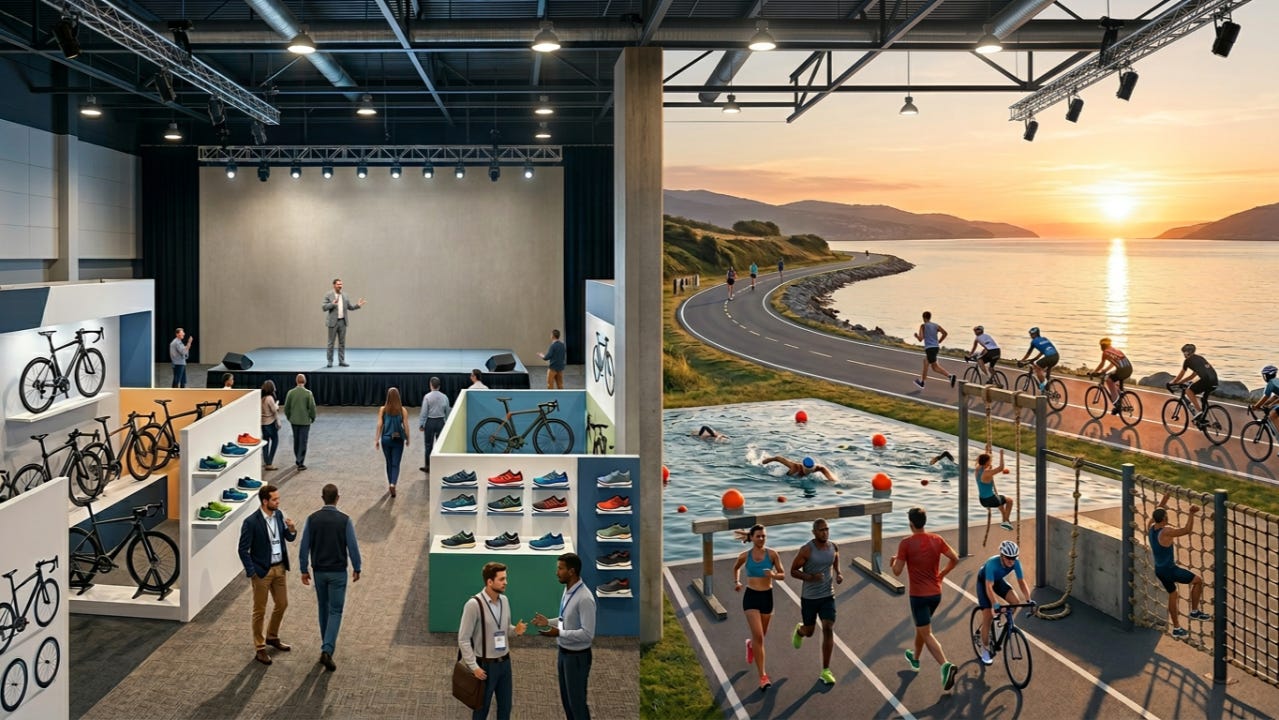
Running, triathlon, cycling, gravel, trail, IMBA‑style MTB, charity events… all drawing from the same participants and communities. All are fighting similar battles on access, economics, and participation.
Very few are actually pulling in the same direction.
The endurance economy is no longer niche.
Destination races and event weekends move real money: travel, hotels, restaurants, retail, and local services. Major marathons and branded events generate hundreds of millions for big cities; mid‑sized races and triathlons deliver multi‑million‑dollar weekends to smaller markets.
This is no longer a cottage industry. It’s an under‑organized economic engine.
And participants already behave that way. The same person might:
Run a 10K in April
Ride a gravel event in July
Volunteer at a charity ride in September
Jump into a sprint triathlon relay next spring
To them, that’s one connected endurance lifestyle. To most institutions, it’s four different markets.
How we ended up with “individual oceans.”
Over time, we’ve built a complex map of organizations, each with a rational mandate:
NGBs: USA Triathlon, USA Cycling, USA Track & Field, and many others
Trade/industry: Running USA, The Running Event, National Bicycle Dealers Association, Bicycle Industry Summit, Running Industry Alliance (RIA), and too many more sport‑specific associations
Advocacy: PeopleForBikes, International Mountain Bicycling Association, League of American Bicyclists, and local chapters, safe‑streets and trail alliances
Event owners: city marathons, tri series, gravel and trail races, obstacle / hybrid events
B2B: registration and timing platforms, data and insights firms, sponsors, agencies
Community: clubs, youth programs, coaches, local nonprofits, volunteers
Civic: CVBs, sports commissions, DOTs, parks and land managers, tourism boards
Each is trying to grow its discipline, serve its members, protect its calendar, and sustain its P&L.
That’s understandable. But at the system level, it means:
Separate advocacy campaigns, often aimed at the same city or agency
Separate studies and surveys, often asking the same questions
Separate conferences and conversations, often with overlapping audiences
Separate views of a consumer who is actually the same person in different gear
We talk like separate oceans, even though the current underneath is shared.
IMBA, PeopleForBikes, Running USA, USAT… same puzzle, different pieces
IMBA focuses on creating and protecting great places to ride. The trails they help build are used by mountain bikers, trail runners, hikers, youth programs, and tourists.
PeopleForBikes pushes for better bike infrastructure, grant programs, and local innovation. Protected lanes and complete streets also help runners, walkers, and communities at large.
Running USA is trying to evolve from “the conference” to a year‑round support and advocacy platform for the running industry.
USA Triathlon is wrestling with long‑term participation and accessibility, trying to reframe tri for new audiences.
None of this work is wrong. The problem is how rarely it’s organized around a shared endurance agenda.
Instead, cities, DOTs, land managers, and sponsors hear multiple, uncoordinated pitches that all point to the same underlying value: safer places to be active, stronger local economies, healthier communities.
The cost of staying fragmented
Staying in our own oceans has a price:
We dilute our advocacy power at the exact moment we should be presenting one compelling, data‑backed story about endurance to cities and agencies.
We duplicate effort across research, events, and tech instead of building shared infrastructure.
We make it harder for participants to move across disciplines with intention, missing opportunities to extend their “endurance lifetime value.”
Triathlon’s participation challenges are a case study. Running’s post‑boom volatility is another. Youth and diversity gaps are a third.
These aren’t just “tri problems” or “running problems.” They’re endurance system problems.
What a real “tide” could look like
A better model doesn’t erase identities. It connects them.
Think about:
Cross‑sport advocacy coalitions: A standing table where running, tri, cycling, IMBA‑style trail orgs, and outdoor / health partners align around safe streets, trail access, permitting, and insurance. One set of numbers. One story per market.
Pooled data and economic insight: A shared layer that tracks how people actually move across running, tri, cycling, gravel, trail, and more. So cities, brands, and investors see the combined endurance footprint, not sport‑by‑sport snapshots.
Coordinated destination strategies: Weekends that intentionally bundle a 5K/10K, a gran fondo, a short‑course tri, and a trail race. Same destination. More nights. Bigger impact.
Unified storytelling: Content and platforms that treat endurance as a lifestyle, not a silo, where a runner can discover tri, a gravel rider can discover trail, and a charity walker can discover their first race.
The opportunity
The endurance economy already behaves like one ecosystem:
One participant moves across sports.
One city benefits from multiple weekends.
One set of roads, trails, and parks carries it all.
One active consumer buys running shoes, bikes, gear, and travel.
The question is whether our institutions are willing to catch up.
If you sit on a board, run an organization, or work with these stakeholders, consider a few questions:
Where are you duplicating effort that could be shared?
Who in an “adjacent ocean” should you be planning with, not just bumping into at conferences?
What would it take to organize your work at the scale of the whole endurance economy, not just your slice?
A rising tide does lift all boats.
In endurance sports, the next step is simple but not easy: stop behaving like separate oceans and start building the tide together.