


Last week I told you Kona was back to a one-day race. Last Saturday, it delivered. Taylor Knibb, an American, won the women’s race in 8:36:28. This one is personal. Her first triathlon win came in May 2011 at TriRock Annapolis, a Competitor Group race we built, and her dad posted the photo to prove it:
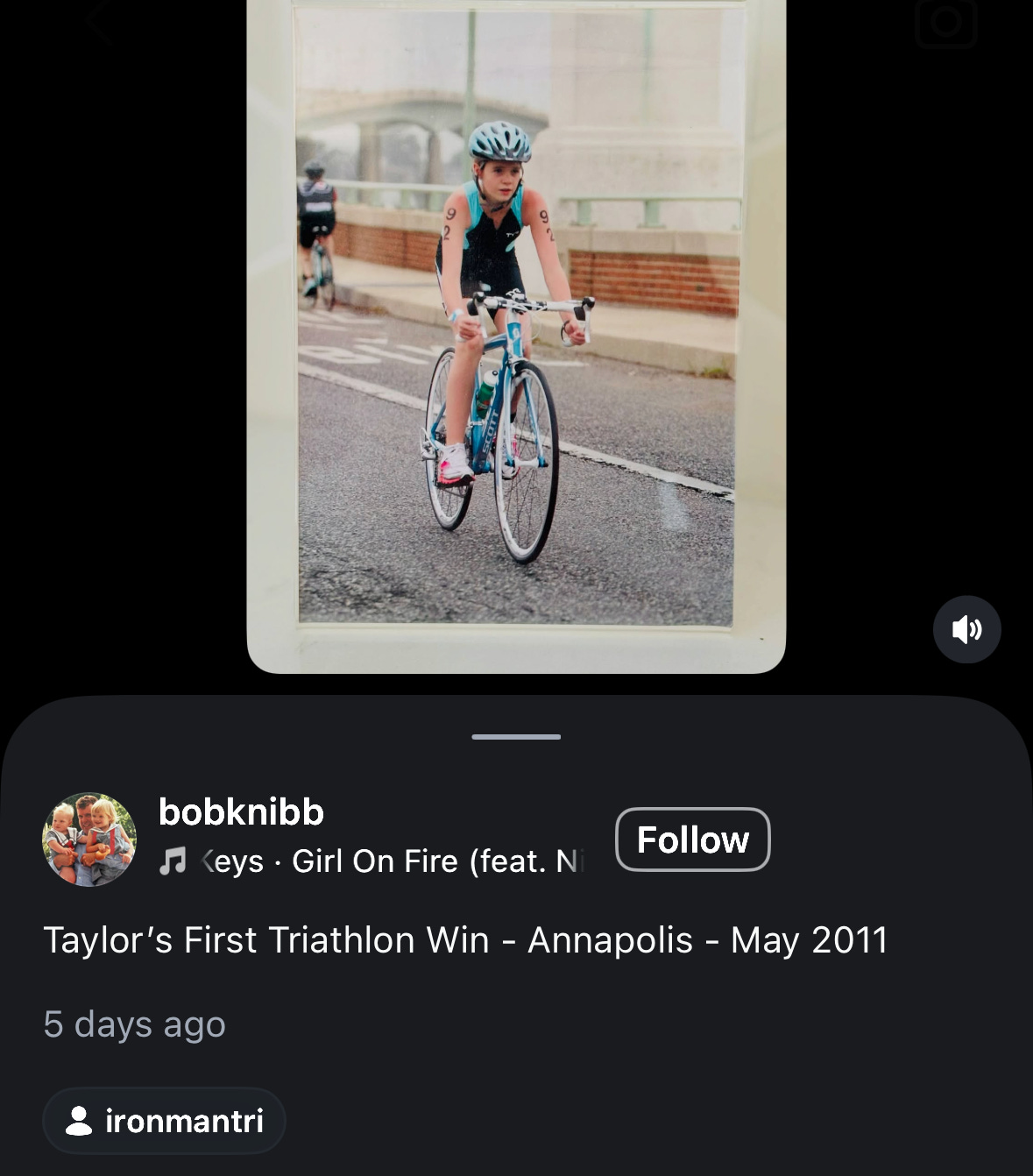
Riding that course like she already knew where this was going.
Fifteen years from a bridge in Annapolis to a world title in Kona. That is what a pipeline looks like when it works.
On the men’s side, Vincent Luis won in his Ironman debut, the first Frenchman ever to take the title. First Ironman, world title, $125,000. Most of us mortals spend our first Ironman negotiating with a cramp at mile 18 and promising ourselves we will never sign up again. Then we sign up again.
Endurance sports finish lines are the best!
Mainstream sports biz spent the week covering ESPN closing in on exclusive rights to a 24-team College Football Playoff, Netflix buying the 2030 World Cup in Spain in the same week it cut 1,000 jobs, and Stephen Ross selling another sliver of the Dolphins at an NFL record price. Meanwhile, a bocce league turned into a national roll-up, one of pickleball's fastest-growing franchisors landed in Chapter 11, a youth baseball company bought a 78-acre campus outside Atlanta, college women got a real flag football league, and the endurance events with the hardest entry are still the ones selling out.
That’s the beat. Welcome to Issue 007.
The Cap Table
1. The bocce league that ate its rivals ·
Adult Rec · M&A
Volo Sports started in Baltimore in 2010 as a single 16-person bocce league (Inc.). Sixteen years later, it has more than 500,000 annual members in 17 U.S. markets and is buying the competition. In June 2025, it bought ZogSports, the country’s second-largest adult social sports platform with more than 120,000 players. On September 30, it added Fray, which runs over 20,000 player registrations a year in Washington, D.C. alone, plus the Miami operations of kickball league CLUBWAKA (PR Newswire).
The fuel: $21 million from Bluestone Equity Partners, raised in November 2024 and earmarked specifically for acquisitions (Bluestone).
Volo’s own pitch is that people crave in-person connection as “loneliness, digital burnout and dating app fatigue” push them to look for it elsewhere (PR Newswire). Sound familiar, running industry? Dating-app fatigue is now a line in a private equity thesis. Somewhere a Hinge product manager just felt a chill. And the data backs Volo up: about 20% of adults played on an adult team in 2025, up from 11% five years earlier (Inc., citing Axios).
Last issue we covered Brodie raising a seed to bring rec basketball to five U.S. markets. This is the other end of the same trend. The upstarts build a brand around the Tuesday night game. The consolidator buys the operators who already own the permits, the field slots, and the bar after. Both can work. The risk with a roll-up is that the thing people pay for, the friend you made on your kickball team, is the one asset you cannot integrate in a spreadsheet. Volo says DC Fray’s “leagues, venues, and #FrayLife community carry over” (DC Fray). That promise is the whole deal. Keep it, and the roll-up is a network. Break it, and you bought a registration database with a nice logo.
And here I am, reminiscing about the beer-league hockey I played back when the only ice time available was 11 p.m. to 1 a.m. on a Tuesday. Nobody needed a private equity thesis to explain why we showed up.
2. Youth baseball buys a campus ·
Youth · Real Estate
Capacity Sports Group, formed in January when Prep Baseball merged with Bullpen Ventures, just took ownership of the 78-acre LakePoint property in Emerson, Georgia, about 40 miles northwest of Atlanta, including eight major league-sized turf fields, plus a lease to run the 170,000-square-foot Champions Center indoor pavilion. Terms were not disclosed. It is Capacity’s fifth announced move this year, after Play9 Sports, two Philadelphia-area multisport facilities, Sideline Soccer Solutions, and Flag Football Life (Youth Sports HQ).
CEO Ken Kocher was refreshingly honest about what families should expect at first: “not much.” He also said, “Families will judge us on whether the event runs well, the facilities are spectacular and we are there to help when they need it.”
I have spent enough weekends at swim meets and destination tournaments to know he is right, and to know the list families actually judge on is longer: parking, the price of a mediocre hotel the night before, and whether you can find a decent cup of coffee before an 8 a.m. warm-up. That last one gets underrated.
The model here is simple. Own the events, then own the venue the events run in, then sell the scouting, profiles, and media on top. It is the Field of Dreams strategy with a better spreadsheet: if you buy it, they will come, because they already have to. That captive audience is the business and the risk. When the same company controls the tournament, the field, and the recruiting showcase, parents have fewer places to go when the price goes up. Kocher says “the fit matters more than the structure.” Parents will decide whether it fits their wallet.
Anyone interested in an endurance sports park?
3. College flag football grows up ·
Women’s · Pipeline
Women’s college flag football has been run by students for years: club presidents booking fields, hunting refs, and selling T-shirts to pay for vans. This spring that changes. NIRSA, the campus recreation association, will run a league for 86 college club women’s teams across Division I, II, and III, in 10 conferences, with about 15 games each from January to April and a national championship in April. The NFL is funding it with a multiyear grant its own league leader would only call “sizable.” The entry fee is $350 per team (Front Office Sports).
UCF’s club president Rylee McDaid summed up what the league is really selling: “Refs, scheduling, fields … it’s going to take all that off my plate.” That is the most honest product pitch of the week. Nobody is building a sport around a logo. They are building it around the admin nobody wants to do.
At the other end of the pyramid, SMAC Entertainment, CAA, and EverWonder Studio are launching the Grand Slam of Flag with the sport’s international federation: six women’s national teams, $500,000 in prizes, in Los Angeles during Super Bowl LXI week in February (SBJ). The NCAA votes early next year on making women’s flag a championship sport, with first title games not until spring 2028.
That gap is the opportunity. The pro event, the club league, and the high school states are getting built before the NCAA shows up. The sport will reach the varsity level with its own infrastructure, its own following, and its own stars, and that gives the athletes leverage most women’s sports never had. Rutgers founder Allison Gandlin put it best: “Look, it’s ready for you. Just press the button.”
And you thought pickleball was going to be the next big thing.
4. The Picklr gets caught in the kitchen ·
Pickleball · Restructuring
The Picklr, one of the largest indoor pickleball franchisors in the country, filed for Chapter 11 last Friday in the Northern District of Texas. Founder and CEO Jorge Barragan says the problem was early growth: the holding company guaranteed leases for about 40 early franchise locations. “We signed, unfortunately, too many corporate guarantees that landed on the holding company, and that’s on us,” he told SBJ. “I own it.” The Picklr was founded in 2021, started franchising two years later, and now has more than 70 U.S. locations. It lost $4.4 million on $10.3 million in revenue in 2025 and carried about $19 million in total liabilities as of March (Entrepreneur). An investor group led by franchisee Tom Neale committed $4.5 million in debtor-in-possession financing and is expected to sponsor the reorganization. The clubs stay open, and the franchisees are not part of the filing (Franchise Times).
Credit to Barragan for saying “I own it” out loud. Most founders reach for “macro headwinds.”
Don’t get me started on how much capital has chased activities you can play in flip-flops with a cocktail in hand. The game is fine. The financing was the problem. When the franchisor signs the leases, the franchise model stops being a capital-light business and turns into a real estate bet with a paddle logo on it. As I tell my son when he heads out the door: have fun, be smart, do what makes you happy, and don't bet the whole allowance on one thing. Pickleball investors could have used the same talk.
5. The hardest entry wins ·
Endurance · Scarcity
SBT GRVL opened its 2027 random-selection lottery on October 14 for 3,000 riders, up from 2,750 after Routt County unanimously approved an expanded permit. It is also adding a 20K trail run and a two-day run-bike challenge, so you can now destroy your legs on Saturday and then ride 108 miles of Colorado gravel on Sunday (Bicycle Retailer). Getting that permit back meant changing start times, cutting congestion, and leaning into “less of a race, and more of a ride” (Steamboat Pilot).
The SBT GRVL folks seem to be taking a page out of the Leadville playbook: a summer of events that drives real economic impact into a small mountain town, including slower shoulder seasons. That formula worked so well that Life Time bought the Leadville Race Series in 2010 for a reported $1 million (Colorado Encyclopedia) and promptly corporatized it. I’m happy I earned my buckles and sweatshirts before Life Time replaced Leadville as the aspirational brand. It is also a formula the people in the Town of Vail still don’t seem to understand, where they have a habit of killing anything good that gets built locally or comes to town.
Saturday in Wilmington, a record 3,500 athletes start IRONMAN 70.3 North Carolina. It sold out in five months, one of the fastest sellouts of any Ironman event in North America this year (Wilmington StarNews). I raced it before it was an IRONMAN, when it was Bill Scott’s Setup Events Beach2Battleship, a race to benefit the local YMCA. Ironman bought it from the YMCA of Wilmington in 2016 (Wilmington StarNews). Another iconic event rolled up into a larger entity. Great course, great town, great people.
Wilmington was our first potential property for TriHabitat!
As someone who has entered more event lotteries than I’d like to admit, I can confirm that losing one makes you want it more. The endurance events that win are not the ones with the biggest marketing budget. They are the ones that treat the town as a partner and the cap as a feature. Last week the Big Apple Triathlon showed what happens when you lose the city. Leadville and SBT GRVL showed what it takes to keep it. Scarcity only works if the host community keeps saying yes.
Fumbles & Vaporware
Odds Couple. On Tuesday, Kalshi filed a rule with the CFTC making athlete harassment an “impermissible activity,” with possible fines, account shutdowns, and police referrals for bettors who go after players. Good. Overdue, but good. Two days later, Chicago-based PredictArena launched a prediction market built for creators, handicappers, and former athletes to point their audiences at markets on the topics they cover. The company says creators can “participate economically” but has not said what that means or whether they get paid. So one company is building a penalty box for bettors who harass athletes, and another is building a platform for athletes to send their followers into the market. It is a bit like hiring lifeguards and selling cannonball lessons at the same pool. Former athletes, read the agreement before you lend your name to it. “Participate economically” can mean a lot of things, and most of them aren’t in your favor.
Signal Lost. SportsGrid, the sports-betting video network, is for sale through Telos Advisers after losing FanDuel and BetMGM as partners. Its revenue was $20 million in 2022 and has declined since, per bankers pitching the deal. The lesson is not that betting content is dead. It is that when two customers are your business, you are not a media company. You are a vendor with a set and a nice logo.
Signal Check
$0: the subscription fee on Garmin’s Cirqa band, a screenless tracker priced at $199.99, against a Whoop membership that starts at $199 a year.
Garmin released Cirqa in July, and it is starting to get the “Whoop killer” headlines. It tracks heart rate, stress, pulse ox, skin temperature, sleep, and HRV, adds Garmin’s Training Readiness and VO2 max, and sends it all into the same Garmin Connect app the rest of your watch data already lives in. BikeRadar’s reviewer said he would pick it over Whoop for that reason alone: one app, one ecosystem, no annual bill. His one complaint is the Velcro strap, which he worries will collect fluff and grime. Fair. Nobody wants a recovery tracker that looks like it lost a fight with a dryer.
Whoop built a great business on a simple idea: give away the hardware, rent the insight. Garmin is testing the opposite: sell the hardware once and treat the insight as a feature. As someone whose wrist, phone, and bike computer are already loyal Garmin subjects, I get the appeal of not paying rent on my own heart rate. The bigger signal is for every wearable charging a subscription. When the incumbent with 80-plus activity profiles makes the data free, your monthly fee has to buy something the device alone cannot: coaching, community, or a reason to open the app that is not guilt.
Full confession: I just canceled my Oura subscription after the ring’s battery started crapping out before the end of the day, and I ordered a Cirqa.
Who’s Building
Chad Mumm (Pro Shop). The company behind Netflix’s Full Swing, co-producer of Happy Gilmore 2, and owner of GolfWRX raised a $24 million Series B led by Arthur M. Blank Sports and Entertainment, with Causeway Media Partners and Ares joining and the PGA Tour returning. Pro Shop says it reaches more than 35 million unique users and doubled revenue year over year (Pulse 2.0). Golf’s best growth story is not on the course. It is in a studio that figured out the sport is also a TV show, a podcast, a shop, and a social club. Happy Gilmore would approve, but he would still want to see the deck before swinging away.
FloSports (FloLacrosse). Flo signed a multiyear deal to become the exclusive global streaming home of the National Lacrosse League, moving it off ESPN in the U.S., and launches FloLacrosse on November 5 as its first new channel since 2024 (SBJ). A Saturday game of the week and the Finals also run free on the FloSports Channel on Prime Video, YouTube, and LG. The full ride costs $39.99 a month (NLL). Flo’s model has always been to own the niche and own the superfan. At that price, it had better be the most dedicated superfans in sports. Lacrosse parents, I see you reaching for your wallet. I moved USA Cycling’s streaming off Facebook and onto FloSports in 2021 (SBJ), and the debate then was the same one every emerging property has now: build exposure by giving it away for free, or drive revenue to a struggling NGB and pay for production quality is worth watching. My older USA TODAY Sports Media Group colleaague, Phil Wendler, led Flo’s side of the NLL deal, and I’d bet Ryan Fenton had a hand in it too. Well done, FloSports team.
Taylor Hoekstra (Popfly). The outdoor creator marketplace, with a vetted network of more than 20,000 creators, banned AI-generated influencers after one tried to join, wrote the ban into its terms, and launched a petition asking brands to keep real people behind creator content (Outdoor Industry Association). Hoekstra calls mass-produced AI content “digital litter.” In a category that sells authenticity, that is not a culture-war stance. It is quality control. Nobody buys a tent because a synthetic person pretended to sleep in it.
Overheard
“I think if you’re a business that defines yourself as innovative and forward-thinking, you’re going to find yourself in situations that don’t always go the way you want them to do, and that’s in service of growth.”
NWSL commissioner Jessica Berman, on the league’s failed streaming deal with Victory+, which she called “definitely not ideal” (Front Office Sports).
That is a classy way of saying the check bounced. The Athletic reported the deal fell through over nonpayment, and Victory+ collapsed by early September. The league moved games to its own NWSL+ and then to The Roku Sports Channel, and Berman says re-shopping the rights was “a competitive process.”
The Texas Rangers hit the same wall this summer but never had to re-shop anything, and they weren’t as transparent about it. They moved their games midseason to BZZR, a platform where minority team owner Neil Leibman served as a director and investor, giving them a crash landing pad. The team’s announcement didn’t mention Leibman’s BZZR role, and fans were less than happy with how it went down (Sportico). (Disclosure: I previously served as BZZR’s Chief Strategy Officer.)
I give Jessica credit. She has leveled up into one of the most underrated commissioners in sports (hear that, WNBA?). Most commissioners would have buried this. She owned it. But the lesson for every emerging property is not “be innovative.” It is to underwrite your distribution partner like you would underwrite a sponsor. Volo is promising that the community survives the roll-up. Capacity is promising families will not notice the new owner. FloSports is promising lacrosse fans their league is in good hands. Every one of those is a counterparty bet.
Innovation is fine. Make sure the other side of the deal can pay.
Build Accordingly.
Bouker Pool · Managing Partner, Weck Enterprises · Reply to this email or DM me on LinkedIn.
Got a tip, a fumble, or a build worth covering? Send it. Overheard exists for you.
Full disclosure: I advise and invest across sports-tech, media, youth sports, endurance, and wearables. When B&P covers a company I’m involved with, I’ll do my best to note it in the item.