

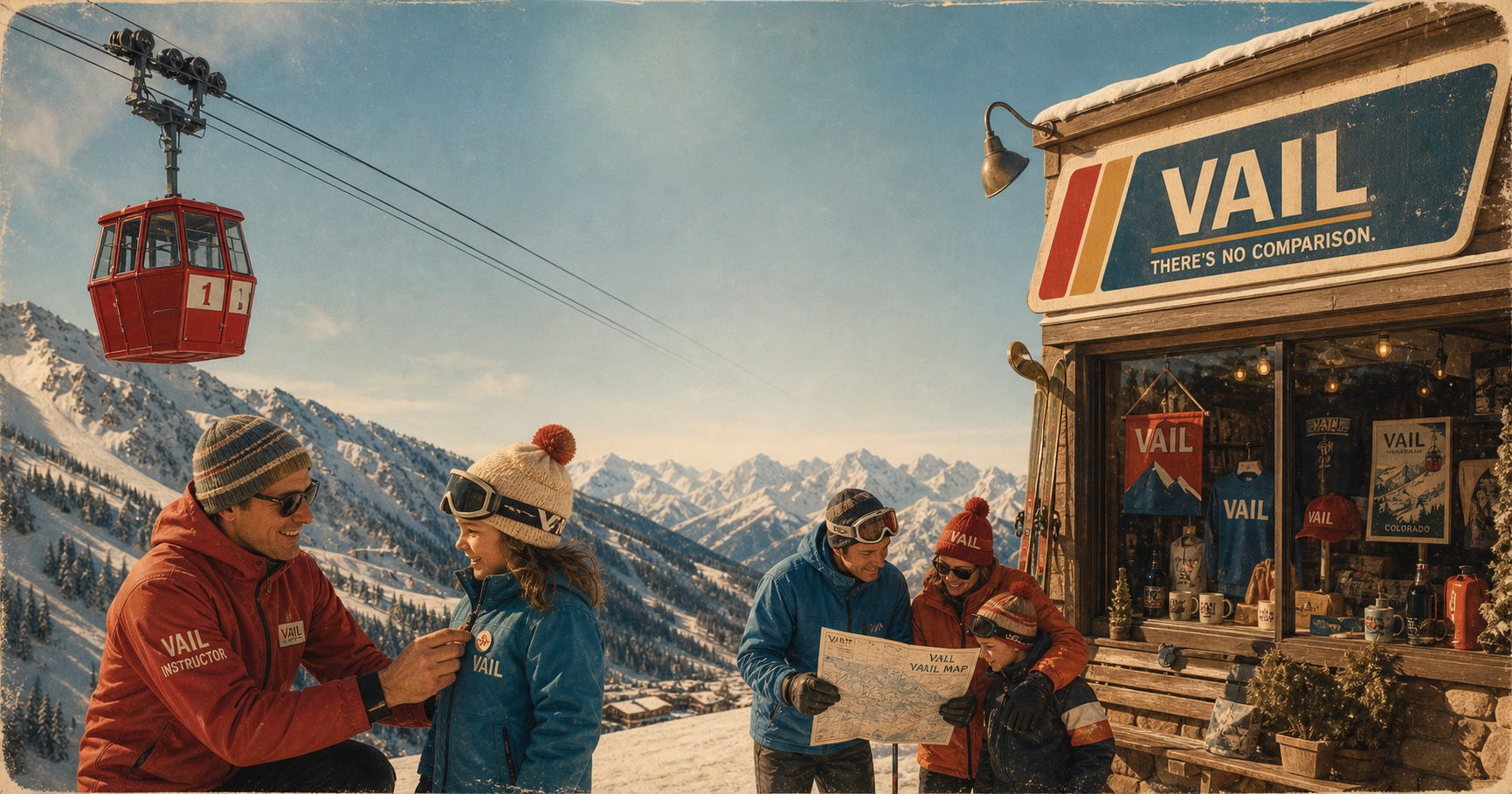
There are places that shape you, and then there are places that become part of your internal map. Vail has long been that kind of place for me. Not just a mountain I skied, not just a resort where I once worked as an instructor, but a place that helped teach me what a great experience feels like when it is built by people, not just by systems.
That is why I have been thinking about Rob Katz’s return and Vail Resorts’ new “Beyond Epic” language. On one level, the strategy makes perfect sense. Vail built one of the smartest business models in modern sports by turning a weather-exposed, seasonal business into a recurring revenue machine through the Epic Pass. But once a company masters access, scale, and yield, the next question is harder: can it still create wonder?
That is the question hanging over Vail now.
Because for all the talk about experience, experience can be a slippery corporate word. Sometimes it means removing friction. Sometimes it means better data, better apps, better wayfinding, better service recovery. All of that matters, and Vail has invested heavily in it through the My Epic app, mobile passes, AI support, and other tools designed to make the day easier and more seamless. But a seamless day is not always a memorable one.
And memory is where premium brands either become beloved or become interchangeable.
The Vail I remember had texture. It had quirks. It had little flashes of humanity that made the mountain feel alive. When I was teaching in the early 90s, instructors had pockets full of candy, ribbons, and pins to hand out to kids. Lift operators brought personality to their stations with music, snow sculptures, trivia, and occasional costumes. The mountain did not feel over-managed. It felt inhabited. That may sound like nostalgia, but it is actually a serious point about brand design. Personality is not fluff. It is part of the product.
Later, I watched my son grow up on that same mountain. In the absence of what Vail delivered to me in my day, he collected pins and stickers from Charlie’s T-shirt shop. He held onto paper trail maps. He brought those things back to school and used them to tell the story of where he had been and what he had done. Those objects were small, but they carried weight. They turned a ski day into an identity marker. They extended Vail into the rest of his life.
That is what the best experience businesses understand. The product is never just the product. The real product is the story a customer gets to tell afterward.
Which is why one of Vail’s more revealing misses, at least to me, was the introduction of digital badges without a meaningful physical counterpart. The logic behind the badges is obvious enough. Track engagement. Reward participation. Build habits. But if a child earns something in the app and there is no simple way to redeem it for a patch, a sticker, a photo, or some small physical token at the base area, then the loop is incomplete. The system recognized the behavior, but it failed to create the memory.
That kind of miss matters more than it looks.
For years, Vail has been optimized brilliantly as a machine. That is not criticism. It is a fact. The company’s operating model, its pass strategy, and its scale have set the standard for the category. Even now, the company is framing its next phase as an “Epic Experience” strategy, with Rob Katz back in the CEO role and a clear acknowledgment that growth cannot come from pass sales and acquisitions alone. The problem is that optimization has a way of sanding down personality if no one is actively protecting it.
And that, more than pricing, lines, or app functionality, is what many longtime skiers feel.
The mountain has been cleaned up, standardized, and corporatized to the point that too much of it now feels emotionally neutral. It works, but it rarely surprises. It delivers, but it does not always delight. For a premium brand, that is dangerous territory. The more polished and professional the system becomes, the more deliberate the company has to be about preserving the soul.
Investors should care about that, too.
Not because the soul is sentimental, but because the soul has economic value. It shows up in return intent, in family tradition, in advocacy, in the emotional switching costs that keep people tied to one mountain over another. It is what turns a customer into an ambassador without a media budget. It is what keeps a place from becoming just another well-run asset.
That is why I find this moment so interesting. Rob Katz is not inheriting someone else’s strategy from the outside. He is returning to a position in the company he helped define at a moment when the model's logic is no longer enough on its own. The next phase is not about proving Vail can operate at scale. It already did that. The next phase is about proving that scale and soul need not be opposing forces.
I want that to be true, probably more than most. As a lifelong skier at Vail and a former instructor, I have a soft spot for the place. I want this change to be real. I want Vail to remember that what made it special was never just the acreage, the lifts, or the pass economics. It was the feeling that the mountain had a personality, and that the people who worked there were allowed to give it one.
The 1980’s slogan “VAIL: There’s No Comparison” is what I hope comes back.
Not nostalgia for nostalgia’s sake. Not a performative nod to heritage. Something more concrete than that. A real return to the small gestures, physical artifacts, employee discretion, and unexpected moments that make guests feel that they are somewhere with character, not just somewhere with capacity.
Because once a place loses its personality, it is very hard to get it back.
And to be fair, Vail is not the only thing that has changed. The Town of Vail itself, the village, and the broader resort environment have undergone a kind of sanitizing that warrants its own conversation. That story is bigger, more complicated, and worth telling on its own terms. For now, it is enough to say that when a place known for being singular starts to feel homogenized, people notice. They always do.
If “Vail. There’s no comparison” once meant something real, then the challenge now is not to recreate the past. It is to recover the qualities that made the past unforgettable in the first place.
That is the work.
And it is work worth doing.