

AI in Sports Media: The Difference Between Table Stakes and Real Value Creation
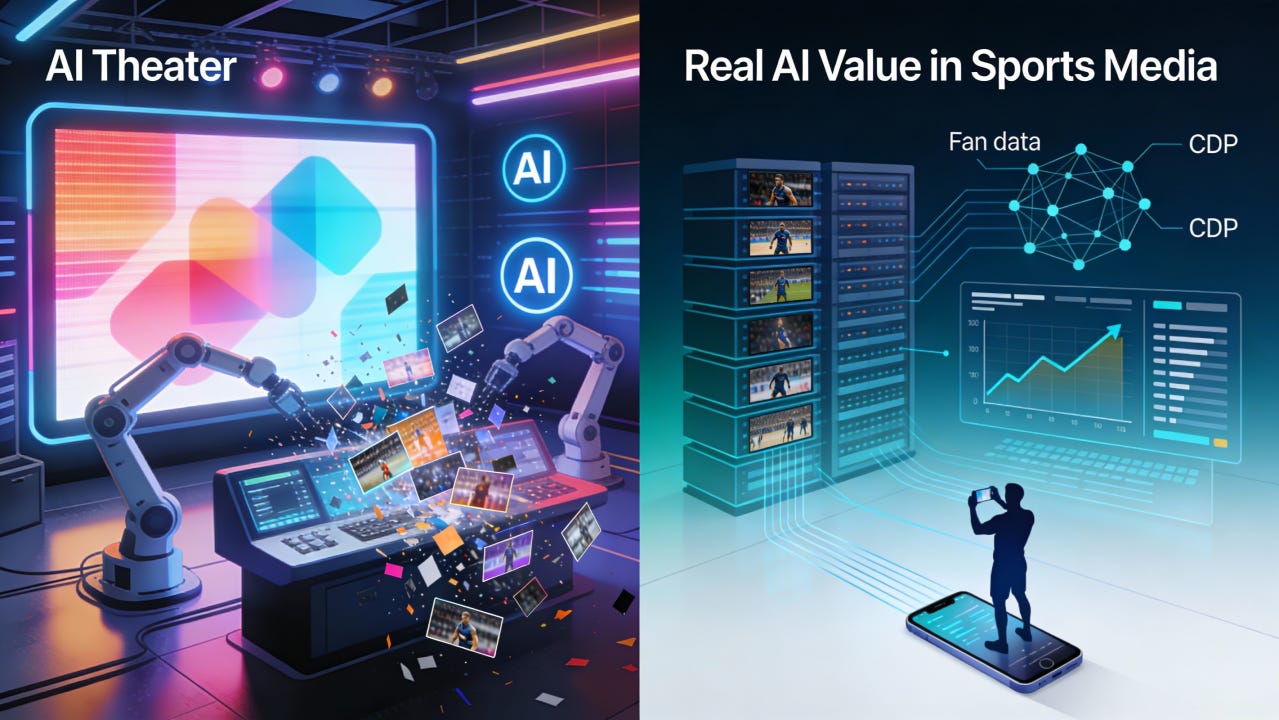
The AI gold rush has arrived in sports. Every platform races to add “AI-powered personalization,” every analytics company claims AI superiority, and every startup pitches “AI-driven engagement,” all promising a data-driven utopia that will unlock unprecedented value and automate away complexity. Yet almost no one is acknowledging the real divide: the difference between merely meeting the new baseline of being “AI-enabled” and building proprietary AI infrastructure that turns hidden assets into enterprise value.
AI is no longer a feature; it is infrastructure. Being “AI-enabled” is now table stakes, a minimum requirement that gets you into the game but no longer wins it, just as having a website did in 2002 or adopting mobile and cloud did a decade later. The organizations that actually outperform will not be the ones that bolt ChatGPT-style tools onto existing systems, but the ones that redesign their businesses around how AI can change behavior, sharpen diagnostics, and improve outcomes at scale.
In this environment, saying “we use AI” carries about as much strategic weight as saying “we’re online”: everyone is. What separates contenders from pretenders is whether AI functions as a core operating system, powering fan intelligence, archive activation, sponsorship proof, and athlete empowerment, or is merely sprinkled on as a marketing label. One is technological theater. The other is a durable competitive advantage.
The CES Overload of Tech!
At CES 2026 , the message was unmistakable: AI has moved beyond demos into physical systems that perform real work. The event spotlighted what industry leaders now call “Physical AI” - artificial intelligence that doesn’t just generate text or images, but powers robots, autonomous vehicles, manufacturing systems, and sports operations at scale. NVIDIA CEO Jensen Huang described this shift as a “ChatGPT moment for physical AI,” signaling the transition from chatbots to systems that understand and act in the real world.
Yet CES also exposed the growing divide between AI implementations that deliver genuine value and those that simply create noise. As Meta announced it was delaying the global rollout of its Ray-Ban Display smart glasses due to “unprecedented demand” in the United States, with waitlists extending well into 2026, the event demonstrated how practical AI wearables can succeed when they solve real problems. Meanwhile, deepfake technology continues to erode trust across digital platforms, with researchers warning that 2026 will be the year most people get fooled by synthetic media as deepfake volume surges from 500,000 instances in 2023 to an estimated 8 million in 2025.
The sports industry dominated CES headlines with concrete, operational AI deployments. At Lenovo’s Tech World event held in the spectacular Sphere venue, Lenovo and FIFA unveiled comprehensive AI systems for the FIFA World Cup 2026™ - Canada, Mexico and U.S.A, including Football AI Pro, a customized enterprise knowledge assistant that orchestrates multiple intelligent agents across petabytes of FIFA data to provide coaches, players, and analysts with real-time tactical insights. The system provides 3D context for live game stats and can instantly answer plain-language questions about performance.
Additional innovations showcased include AI-powered 3D digital avatars that replicate each player’s individual physical dimensions for more accurate offside decisions, referee body cameras with Lenovo’s AI-driven stabilization overlay providing unprecedented broadcast perspectives, intelligent command centers using digital twins for real-time tournament operations monitoring, and smart wayfinding systems connecting cities, fan zones, venues, and landmarks through AI-guided navigation.
Ken Wong, Lenovo‘s EVP and President of Solutions and Services Group, explained the scale of the challenge: “Their football data spans team rosters, tracking data, player performance, team statistics, match highlights, tactical analysis, and historic trends, encompassing petabytes of data in total. Mining and making sense of it all is a huge challenge. Football AI Pro addresses that need.”
Beyond FIFA, CES showcased how AI is reshaping sports performance itself. Lumistar showed off very cool autonomous mobile robot (AMR) technology for athletic training in tennis and basketball, using precision movement, AI-driven repetition, and real-time performance data to help athletes refine technique and reaction speed at scale. Canon Americas Lab had the AI-powered markerless motion capture for sports analytics, and Trickshot’s technology for converting live sports footage into immersive 3D content for AR and VR. Amazfit showed off the V1TAL Food Camera for analyzing nutrition as a measurable performance input and Helio Glasses with heads-up displays for runners, integrating real-time metrics into the field of vision.
FPT Software and Chelsea FC discussed their AI-first partnership, demonstrating how hackathon-style innovation cycles deliver fan engagement tools like Mega Store Express (click-and-collect merchandise) and AI-powered personalization at scale.
These implementations represent proprietary AI infrastructure built to solve specific operational challenges, not generic tools hastily deployed for marketing purposes. This is the fork in the road for sports media: invest in real AI infrastructure that creates competitive moats, or settle for AI theater that generates temporary buzz but no lasting advantage.
What AI Actually Is (And What It Isn’t)
Artificial intelligence, in the context of sports media, is not magic. It is not a thinking entity. It is not a substitute for strategy.
AI is a set of tools: machine learning models, natural language processing, predictive analytics, and computer vision that identify patterns in data and automate decisions based on those patterns. It works brilliantly when you have high-quality data, a specific problem to solve, the infrastructure to act on AI’s output at scale, and a clear understanding of what the AI is optimizing for.
But AI fails catastrophically when treated as a magic wand: when you assume that bolting ChatGPT onto your CMS will transform your content strategy, when you think adding “AI-powered” to your product description will unlock new revenue streams, or when you use AI to automate processes that were never well-designed in the first place.
At CES, practical AI tools like Claude Opus 4.5 emerged as a counterpoint to hype. This advanced coding assistant achieved 80.9% accuracy on real-world software engineering benchmarks while using 50-75% fewer tokens than competing models. The distinction matters: Claude Opus 4.5 succeeds because it was purpose-built for specific tasks requiring sustained reasoning and multi-step execution, not because it was marketed as a general-purpose miracle solution. Organizations increasingly separate useful AI from “AI slop,” implementations that add friction rather than value.
The Dangerous Versus The Valuable
The most dangerous AI deployments in sports media are the ones that look most impressive: real-time highlight generation, automated commentary, and AI-generated thumbnails. They capture attention. They look like the future. And they deliver almost no real value because they are solving the wrong problem.
The most valuable AI deployments are the quiet ones: identifying which fans are most likely to churn and why; matching archived content to current audience interests; optimizing sponsorship placement based on actual engagement patterns; predicting which stories will resonate with which segments; and delivering content at the right time through the right channel.
These are not flashy. They do not make for impressive product demos. But they drive revenue, reduce churn, prove sponsor ROI, and build competitive moats.
The Misinformation Challenge
In 2026, AI-powered misinformation represents a growing threat that sports organizations cannot ignore. Deepfakes and synthetic media are scaling at an explosive rate, with cybersecurity firms estimating annual growth of 900%. AI-generated faces, voices, and full-body performances now fool ordinary viewers in low-resolution contexts like video calls and social media. Sports leagues face particular vulnerability: fabricated locker-room confrontations, fake injury reports, doctored game footage, and synthetic athlete statements can spread virally before verification systems catch up.
Any AI system touching content distribution must now be designed for authenticity, auditability, and traceability, or it becomes part of the misinformation problem rather than the solution. This reality makes proprietary AI infrastructure even more valuable; systems built with domain-specific understanding can implement verification protocols that generic tools cannot.
***A critical prerequisite: IP rights and the licensing landscape must be solved before AI can unlock archive value at scale. Organizations first need clarity on what content can be activated, how, and where, or every AI roadmap will eventually run into a legal wall. This intersection of AI infrastructure and IP rights management is a critical, and still underdeveloped, layer of the value chain. A deeper dive into how rights frameworks shape AI deployment in sports media is coming soon.The Real Value Creation: Proprietary AI Infrastructure
This distinction becomes crystal clear when you examine what forward-thinking organizations have built. The most valuable asset in sports media is not the content you create today. It is the archive of content you created yesterday.
The Archive Problem
Most sports organizations treat archives like digital graveyards. Thousands of hours of footage, thousands of stories, thousands of moments, locked away, unsearchable, inaccessible, generating zero value. Teams and leagues invest millions in production. The content sits in a tape vault or a server farm. It generates nothing.
Eon Media has understood something fundamental: proprietary AI infrastructure could solve this specific problem by creating systems that:
Understand content semantically. Not just “this is a video of a football game,” but “this is a video of a player’s third-quarter performance in a specific matchup, featuring particular tactical patterns, with specific emotional intensity.”
Match content to moments. Connect archived footage to current events. When a player gets injured, surface the injury archive. When a player breaks a record, surface the progression of their career. When a team faces a similar opponent, surface the tactical archive.
Activate content at scale. Automatically surface content to relevant audiences through relevant channels at relevant times.
Measure content value. Understand which archived content drives engagement, which drives conversion, and which proves sponsor ROI.
This is proprietary AI infrastructure. Built to solve a specific business problem: how do you turn a massive, underutilized archive into a revenue-generating asset?
The answer is not “plug in a large language model.” The answer is: build a system that understands the domain deeply, that integrates with existing workflows, and that can be trained on the specific content and context of your organization.
Eon Media’s work with U.S. Ski & Snowboard Team during the Beijing Olympics demonstrated this approach in action. Using Eon Extract, the organization provided real-time brand recognition data that captured sponsor logo appearances with unprecedented granularity, including clarity (partial vs. full view) and contextual placement.
From Hidden Assets to Enterprise Value: Case Studies
This proprietary approach to AI creates a multiplier effect when applied to organizations sitting on underutilized content and audience assets.
United States Olympic & Paralympic Committee / Team USA
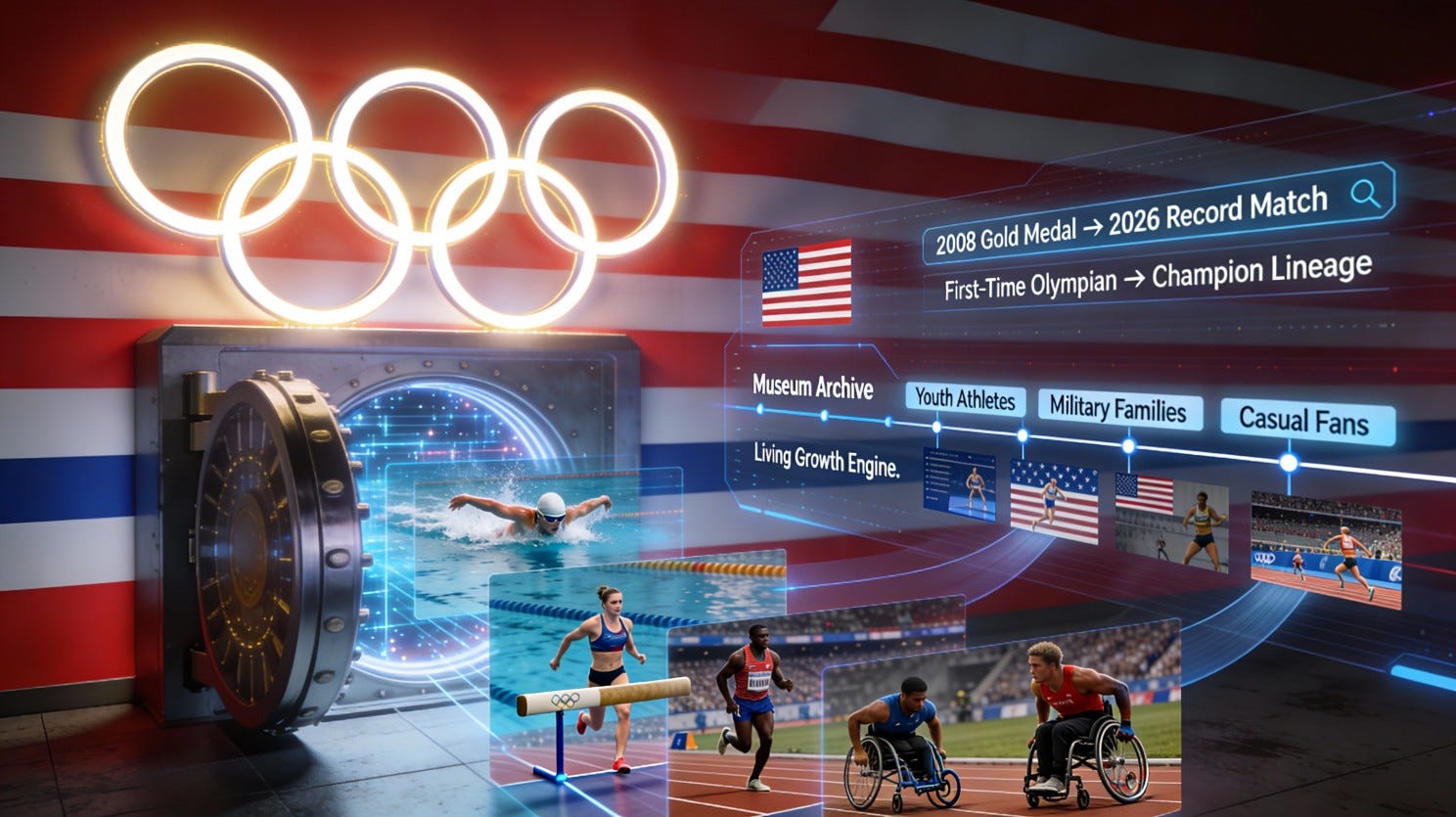
Team USA sits on one of the most powerful archives in global sport: decades of Olympic and Paralympic footage, athlete interviews, trials, training environments, human-interest stories, and behind-the-scenes moments across every discipline. Yet for years, large parts of this archive have functioned more like a historical museum than a living engagement engine. The U.S. Olympic & Paralympic Museum in Colorado Springs has begun collecting oral histories and making historical materials accessible, but the full potential for digital activation remains significantly under-realized.
Fans know the rings. They know the moments. But the full power of the archive, the ability to connect past Games to current quad stories, to introduce new fans to legacy athletes, to bring Olympic values into daily digital habits, remains significantly under-activated.
An Eon Media–style approach asks: What if you built AI infrastructure that understood the Team USA archive at a semantic level? What if a gold-medal performance from 2008 could be programmatically surfaced any time a current star broke a similar record in 2026? What if you could automatically connect a first-time Olympian’s breakthrough to a lineage of past champions in that event? What if you could predict which Olympic stories will resonate with which segments, youth athletes, military families, casual viewers, and deliver them through the right channels?
Suddenly, the archive becomes a growth engine, not a museum, fuel for year-round engagement, education, and commercial partnerships, rather than content that only surfaces every four years.
Warren Miller Entertainment / Outside
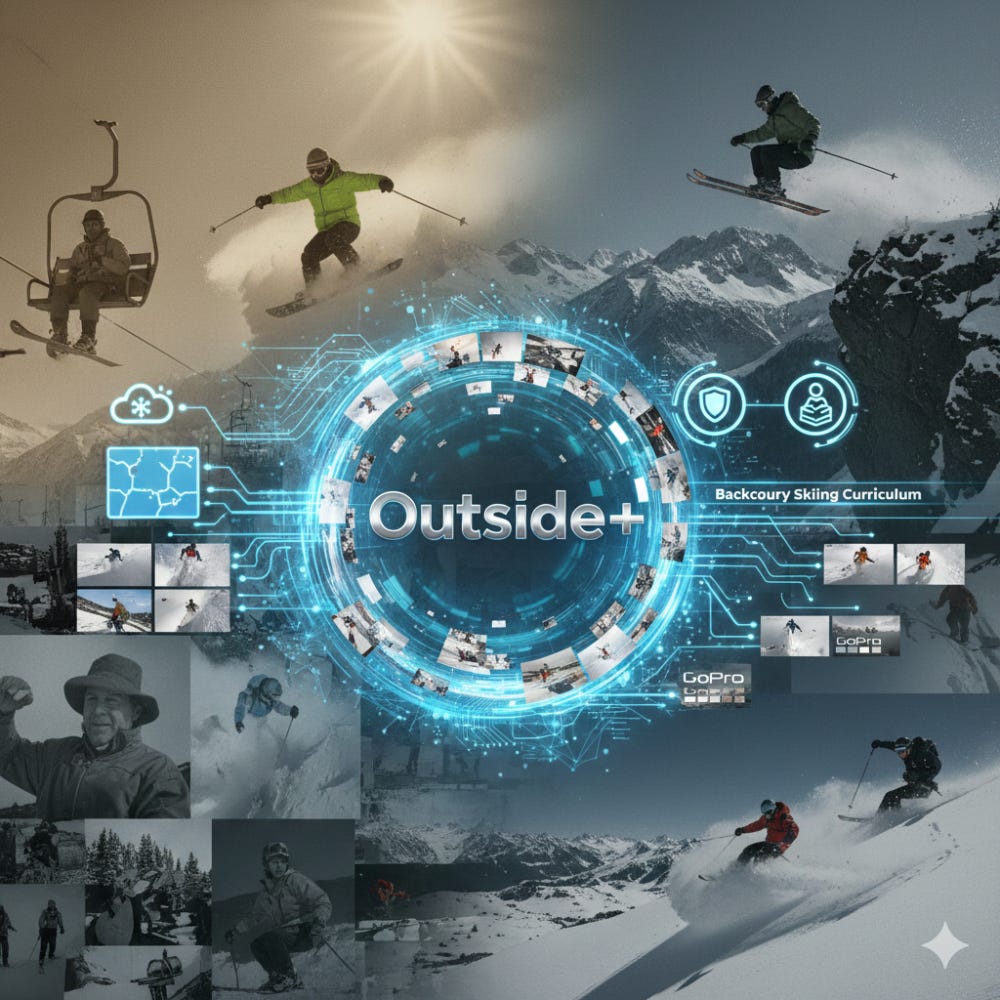
Warren Miller’s films and the broader Outside ecosystem are the foundation of modern outdoor and mountain culture storytelling, a multi-decade archive of skiing, riding, adventure travel, and mountain-town life. Historically, that content has lived mostly in long-form films, magazines, and seasonal releases. The deeper archive, hundreds of hours of raw footage, B-roll, and legacy stories, remains underutilized between marquee projects.
Outside Inc. acquired Warren Miller Entertainment in 2020 alongside SKI, Climbing, Backpacker, and other adventure media brands, creating a consolidated archive spanning 70+ years. The company has made the Warren Miller film library, 47 films dating back to 1961, available through its Outside+ subscription platform. Yet the strategic question remains: how do you transform this from a passive library into an active engagement engine?
AI infrastructure could transform this:
What if the Warren Miller + Outside archive was deeply indexed and understood by AI?
What if a new storm cycle in Park City automatically triggered a curated stream of classic powder segments from the same region?
What if a new generation of backcountry skiers could be served a progressive “curriculum” of technical segments, safety explainers, and athlete diaries drawn from 30+ years of footage?
What if sponsors could align to specific themes, “first descents,” “family trips,” “women’s big mountain lines” with demonstrable engagement data behind each?
In that model, the archive stops acting like a library and starts behaving like a platform: a dynamic, personalized feed of legacy content that deepens affinity, drives subscriptions, and anchors an always-on community.
Premier Lacrosse League: A New Property Setting the Foundation
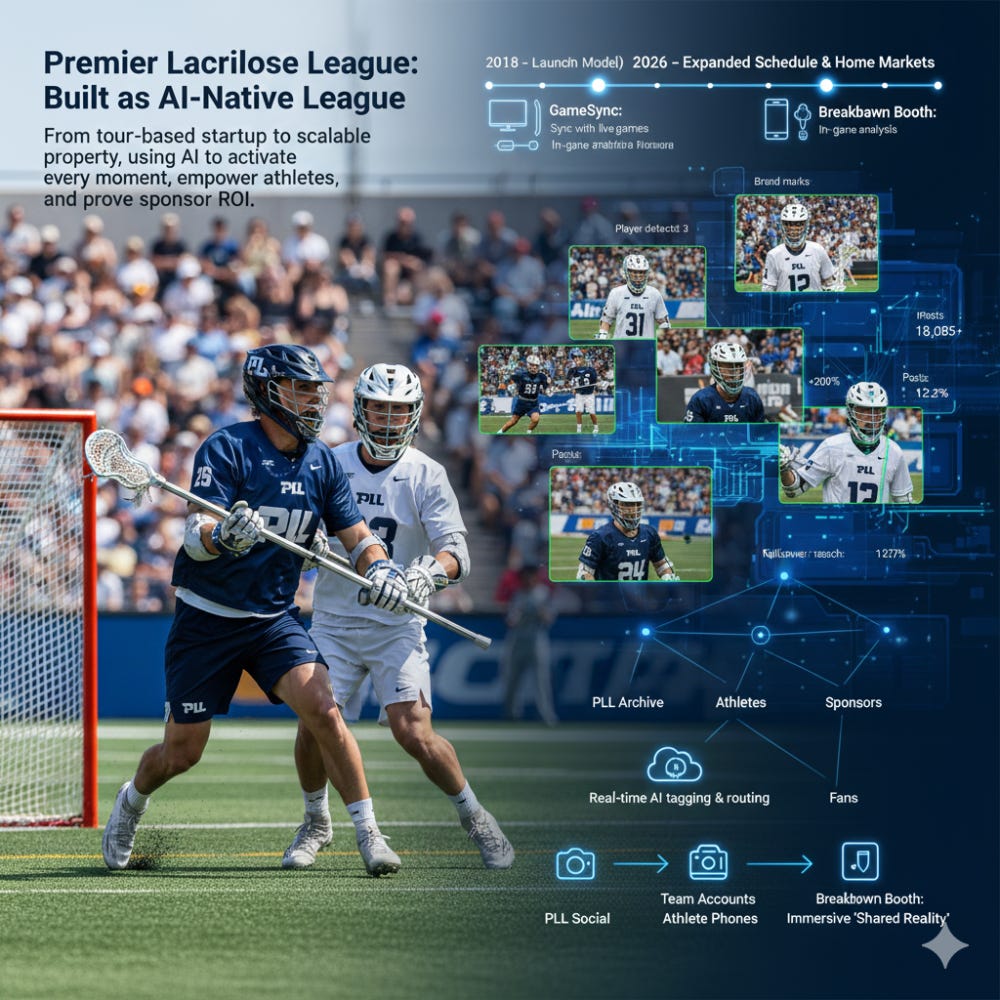
The Premier Lacrosse League represents a fundamentally different case study, not a legacy organization with decades of underutilized content, but a new and emerging property intentionally building AI-powered infrastructure from inception to set the foundation for sustainable growth.
Founded in 2018 by Paul Rabil and Michael Rabil, the PLL launched as a digital-first, player- and fan-focused league designed explicitly for the social media age. The league faced a unique challenge: introducing a sport unfamiliar to most Americans while competing for attention in a saturated sports media landscape. Rather than replicating traditional league models, the PLL embraced technological infrastructure as a core competitive advantage.
The league’s touring model, moving as one unit to different cities each weekend, created operational complexity and also generated massive content-production demands. To manage this, the PLL became the first sports organization to deploy PhotoShelter‘s AI-powered digital asset management system in real-time during competition. During the 2024 Championship Series, PhotoShelter AI tagged 20,000+ images, recognized more than 40,000 players, and identified more than 18,000 brand marks automatically. This automated workflow enabled the league to distribute approximately 12,000 visual asset requests per month without manual intervention.
“The AI recognition of our photos will help us save hundreds of hours tagging and organizing photos, enabling us to share content with our partners, players, and fans faster than ever before.” The system uses facial recognition combined with jersey data to identify players even when helmets obscure their faces, and custom models trained on league-specific attributes to automatically route content to athletes, sponsors, and media partners.
The results have been tangible. The league saw a 200% increase in athlete posting week over week during the Championship Series, with players averaging 12.2% engagement on Instagram, significantly above typical sports benchmarks. More importantly, the PLL achieved a 187% increase in social media follower reach through PhotoShelter’s content distribution platform. By partnering with Greenfly for last-mile social workflows, the league saw 15% growth in the social following of PLL athletes in the first two weeks of implementation.
Beyond content distribution, the PLL has built a comprehensive digital infrastructure across multiple dimensions. The league implemented GameSync, a feature in the PLL app that transforms how viewers connect with games both in-stadium and through broadcasts. It deployed a Breakdown Booth during the 2025 season, using low-latency technology to bring players and broadcasters into in-game analysis, creating windows into the league while educating fans about tactical nuances. The league also partnered with Cosm to deliver lacrosse in “Shared Reality” for immersive viewing experiences.
This infrastructure investment has coincided with remarkable growth across key metrics. In June 2025, ESPN renewed its media rights agreement with the PLL for five years and took a minority equity investment in the league, recognizing “significant growth potential in the PLL’s forward-thinking approach and commitment to innovation.” The deal encompasses all Premier Lacrosse League games plus the newly launched Maybelline Women’s Lacrosse League, with games streaming on ESPN+ and select matchups on ABC, ESPN, and ESPN2.
Paul Rabil, PLL Co-Founder and President, described the partnership as “building a model for how modern sports leagues can grow, with equity, innovation, and access at the center.” The league has expanded its 2026 schedule, with a May 9 opening and increased player compensation of approximately 15% year over year. Looking ahead to 2026 and beyond, the PLL plans to transition from its touring model to assigned home markets while maintaining neutral-site events, a data-informed decision based on years of ticketing, streaming, and engagement analytics.
The PLL’s strategic approach demonstrates how emerging properties can build AI infrastructure not as a luxury or marketing gimmick, but as foundational operational capacity. By investing early in proprietary systems that understand their specific content, activate their growing archive in real-time, prove sponsor ROI through automated brand recognition, and empower athletes to amplify the league brand through frictionless content distribution, the PLL has created a scalable model for growth that traditional leagues struggle to replicate.
Most importantly, the league has positioned itself to avoid the archive problem entirely. Every piece of content produced gets automatically tagged, categorized, and made searchable from day one. As the archive grows, it becomes increasingly valuable, not locked away in digital vaults, but continuously activated to onboard new fans, deepen existing relationships, and prove commercial value to sponsors and media partners.
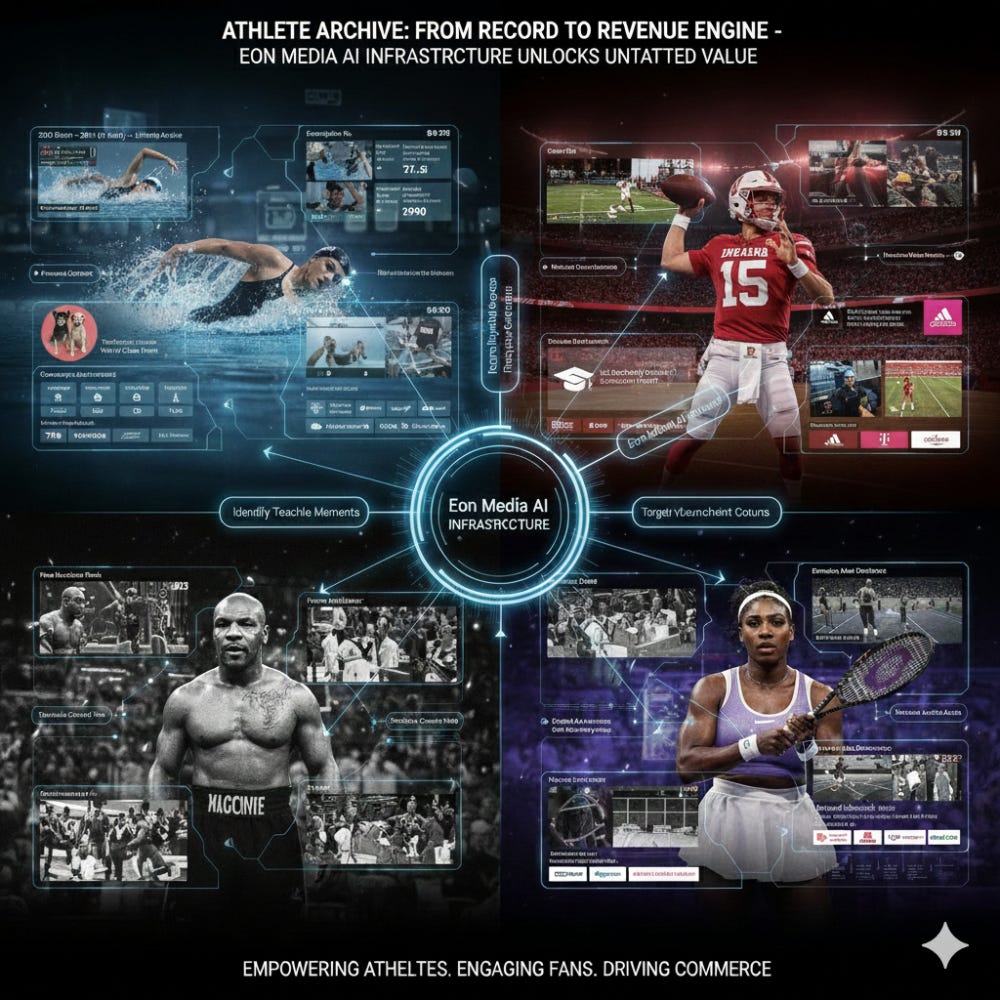
Athlete Personal Brands and Estates
Consider athletes like Katie Ledecky and Fernando Mendoza, as well as legacy figures like Mike Tyson and Serena Williams. Their archives contain thousands of hours of footage, training sessions, competitions, interviews, personal moments, and technique demonstrations. This archive has massive value: nostalgia, education, entertainment, inspiration, and coaching content. But most athletes have no infrastructure to activate it systematically.
Katie Ledecky is the most dominant distance swimmer in history. During Paris 2024, her digital footprint exploded:
X (Twitter) Engagement: Likes grew 3,431%; Reposts increased 2,527%.
Partnerships: Simultaneous activations with Ralph Lauren, Athleta, LaCroix, and more.
Commercial Value: A reported $7M deal with TYR Sport.
But here is the billion-dollar question: What happens to the “content” between the Olympic cycles?
The “Locked” Archive
Right now, Ledecky’s greatest assets are gathering digital dust. Behind the gold medals sits a “treasure trove” of untapped value:
The “Hardest Winter” Tapes: Raw footage of the training blocks that led to world records.
The “Finke” Sets: Practice sessions where she outpaces male Olympic medalists in 800m repeats.
The Technical Edge: 6,000-meter sets and technique drills that every swim coach on earth would pay to access.
The AI Solution: From Post to Platform
An AI-native infrastructure doesn’t just “post to Instagram,” it builds a business. By training AI on the Ledecky archive, we move from momentary hype to evergreen revenue:
Automated Curriculum: AI identifies “teachable moments” in raw practice footage to create subscription-based coaching tiers.
Semantic Search: Instantly matching a current world-record attempt in 2026 with the exact training drill Ledecky used to master that pace years prior.
Audience Segmentation: Programmatically delivering “Elite Technique” to coaches, “Inspiration” to casual fans, and “Authenticity” (featuring her dogs, Jane and Rems) to lifestyle brands.
B2B Licensing: Packaging high-performance data and visuals for global swim federations and youth development programs.
The Big Takeaway
Katie Ledecky is already a commercial powerhouse. But by treating her archive as Infrastructure rather than History, she moves from being an “Endorser” to being a “Platform.”
Fernando Mendoza isn’t just Indiana’s first Heisman winner; he’s a masterclass in modern athlete branding. In a single season, he’s transformed from a transfer student to a projected top-5 NFL pick with a $2.6M NIL valuation.
Here is why his “Infrastructure-First” approach is the new standard for athletes:
1. The On-Field “Product”
Mendoza led the Hoosiers to an undefeated 13-0 season and their first Big Ten title since 1945.
Stats: 71.5% completion, 33 TDs (nation-leading), and only 6 INTs.
Outcome: He proved he is a high-performing asset under pressure.
2. Diversified Partnership Portfolio
He didn’t just take the first check. He built a roster of blue-chip partners:
The Anchor: A landmark deal with Adidas, joining the likes of Patrick Mahomes.
The Reach: Dr Pepper, T-Mobile, Keurig, and Epic Games.
The Differentiation: A UC Berkeley business grad who finished his degree in just 3 years.
3. Mission-Driven Monetization
Through “Mendoza Mania,” he partnered with his brother to launch exclusive merch. Crucially, a portion of sales supports the National MS Society in honor of his mother.
The Lesson: Authentic philanthropy transforms a commercial brand into a movement.
The “Hidden” Opportunity: The Archive
Despite this success, Mendoza (and most athletes) sits on a “static” archive. Thousands of hours of training, game film, and family moments are currently “locked” in digital storage.
With AI-Native Infrastructure, that archive becomes a growth engine:
Automated Content: AI identifies “teachable moments” for youth QB coaching subscriptions.
Segmented Narrative: Programmatically delivering draft-prep footage to scouts while sharing family stories with MS awareness communities.
Evergreen ROI: Ensuring his brand generates revenue and influence long after his final snap.
The Bottom Line: Fernando Mendoza’s next NFL contract might be worth $40M+, but his content archive is the asset that will pay dividends for a lifetime.
For legends like Serena Williams and Mike Tyson, decades of footage, training tapes, and raw interviews represent a gold mine that is currently “locked” in storage.
The Problem: The Museum Trap
Most legacy content is treated as a historical record. It surfaces once a year for an anniversary or a “Throwback Thursday,” then goes back into the vault. It is a static cost, not a dynamic asset.
The Solution: AI-Powered Infrastructure
By applying Eon Media-style AI, these archives transform from “history” into a continuously refreshing content engine:
Mindset & Curriculum: AI extracts thousands of hours of training footage to build “The Serena Method” or “Tyson’s Peak Performance” coaching platforms.
Hyper-Contextual Licensing: When a new star breaks a record in 2026, the archive programmatically surfaces the “Mirror Moment” from 1996 for immediate media licensing.
Nostalgia-as-a-Service: AI identifies specific emotional beats to create personalized content streams for different generations of fans.
Authentic Brand Integration: Sponsors no longer just buy a “logo placement”—they buy into specific, semantically tagged moments of grit, victory, or comeback that align with their brand values.
The Shift: Knowledge over Footage
In the AI era, a legacy archive becomes more than just “video.” It becomes a Body of Knowledge.
It’s an educational platform, a documentary generator, and a predictable revenue stream that ensures an athlete’s influence and income extend indefinitely beyond their final competition.
Democratizing Content Creation: Freeing Athletes to Be Athletes
Here is where AI infrastructure delivers its most transformative value: enabling athletes and creators to build their own brands without sacrificing the time and energy they need to be the best at their sport.
The Current Trade-Off Problem
The current system forces a brutal trade-off. An athlete who wants to build a personal brand, own their NIL, build direct fan relationships, and generate direct revenue must become a content producer. They must hunt down highlight clips, edit and format them for different platforms, write captions, post consistently, engage with comments, negotiate sponsorships, and track metrics.
This takes hours. For a professional athlete, it is hours stolen from training, recovery, family, and sleep. For a college athlete, it is hours stolen from academics and athletic development.
The result: most athletes do not build personal brands at scale. They lack the bandwidth, the skills, the infrastructure. So they remain dependent on leagues, teams, media companies, and platforms to tell their story and monetize their image.
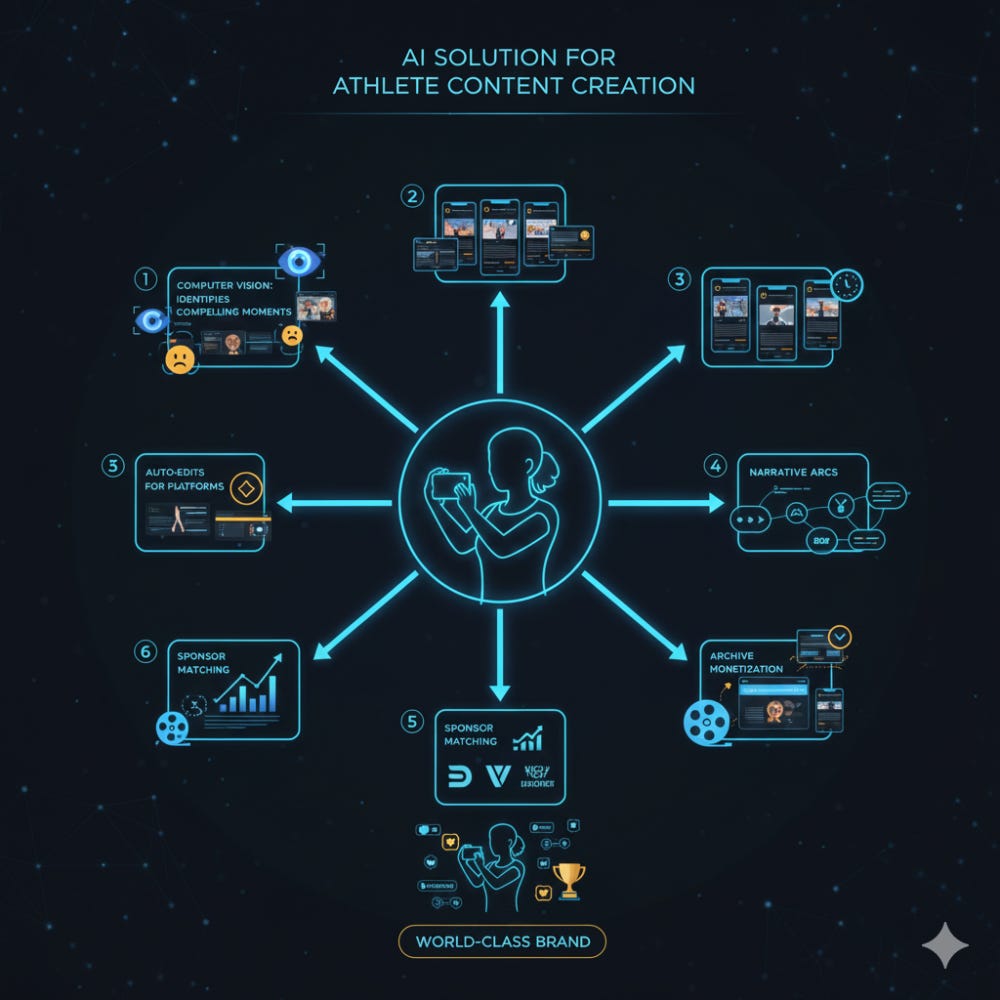
The AI Solution
Proprietary AI infrastructure changes this equation entirely. What if an athlete could record their life, training, competition, commentary, personal moments, and AI infrastructure automatically:
Identifies the most compelling moments using computer vision to spot great performances, emotional reactions, milestones, and teachable moments.
Creates ready-to-post content automatically trimmed and formatted for different platforms with auto-generated captions.
Optimizes distribution timing based on when the athlete’s audience is most active.
Builds narrative arcs connecting individual moments into larger stories.
Matches sponsorships to content identifying which moments feature sponsors’ products and proving value.
Monetizes the archive by repackaging historical footage into new content series.
Suddenly, an athlete can build a world-class personal brand without becoming a full-time content producer.
This is not hypothetical. Companies like INFLCR (now a Teamworks company) are building AI-powered tools that help athletes create, distribute, and monetize personal content with minimal time investment. INFLCR provides athletes with automated access to professionally captured photos and videos from their competitions, handles distribution through a mobile app, and connects athletes to NIL opportunities through the INFLCR Global Exchange, a marketplace linking student-athletes with national brands.
Jim Cavale, INFLCR’s founder and CEO, articulated the vision: athletes should be on the platform 4-5 times per week, grabbing content for free storytelling that engages audiences, with monetization opportunities as a complementary feature rather than the primary driver. The platform serves more than 100,000 athletes at the collegiate and professional levels, including more than 500 NBA and NFL players who graduated from college programs that used INFLCR.
The implication is massive: AI infrastructure democratizes personal brand building. It allows athletes to own their NIL without sacrificing performance. It allows emerging athletes without huge social followings to build direct fan relationships. It allows athletes from underrepresented sports to punch above their weight in content production and reach.
The NIL Transformation: From Dependency to Independence
The NIL landscape has evolved rapidly, but it still faces a fundamental structural problem: most athletes are not equipped to monetize their images effectively. They depend on agents (who take 15-30% cuts), influencer managers (who push lucrative but inauthentic partnerships), and platforms (which own the audience relationship).
AI infrastructure inverts this. It enables creator independence through five models:
Self-Directed Content Creation. The athlete records daily. AI handles identification, editing, captioning, and distribution timing. Result: 365 days of content with minimal time investment.
Direct Fan Monetization. AI identifies which moments resonate with which segments. The athlete sells exclusive content directly to fans. Result: Additional revenue stream independent of traditional sponsorships.
Authentic Sponsorship Matching. AI analyzes content, identifies naturally appearing products, and matches athletes to sponsors who genuinely fit their lifestyle. Result: Higher-quality sponsorships, more authentic endorsements, better audience trust.
Archive Monetization. AI continuously repackages the athlete’s archive into new content optimized for different audiences, technique breakdowns, race strategy analysis, and training philosophy. Result: Passive income from archive content with no additional recording required.
Community Building at Scale. AI manages community features—answering frequently asked questions, flagging meaningful fan engagement, recommending fan-to-fan interactions—so the athlete can focus on authentic connection with their core community rather than drowning in administrative work. Result: Community feels personal even at scale. Athlete maintains an authentic connection without burnout.
The INFLCR Global Exchange exemplifies this model in action. The platform has connected student-athletes with NIL opportunities from WWE’s Next in Line wrestling program, MoneyLion’s financial platform, Vantage Sports’ coaching marketplace, and NOCAP Sports’ brand campaigns for Coke Zero, Ritz, Powerade, and other national sponsors. By automating disclosure and compliance reporting, the system also helps schools meet NCAA NIL regulations while athletes maintain eligibility.
In swimming, NIL opportunities have grown significantly since 2021, though they remain modest compared to revenue sports like football and basketball. Most swimmers secure deals with swim-specific brands or local businesses that provide meaningful support, covering groceries, travel expenses, and training costs, rather than life-changing income. The top earners leverage Olympic status or a strong social media presence to secure deals with major brands. Claire Curzan signed with Crocs in 2023 and New Era in 2025. Emma Weyant partnered with Sporti to launch a co-branded swimwear collection. Success in the water increasingly correlates with NIL success, but social media presence often matters as much as athletic achievement.
Athletes can use platforms like Opendorse to systematically market themselves. Indiana University diver Isabella Smith, with more than 230,000 TikTok followers, lists rates on Opendorse starting at $627 for a social media post, $142 for a shoutout, and $45 for an autograph. While these numbers pale compared to revenue-sport athletes, they represent genuine opportunities for Olympic sport athletes to monetize their brands.
The Competitive Economics of AI-Powered Athlete Branding
This shifts the entire economics of an athlete’s personal branding in fundamental ways:
Time Commitment: Before AI infrastructure, building a personal brand demanded 10-20 hours per week. After AI infrastructure, that drops to just 1-2 hours per week, only the time needed to record authentic moments. The AI handles everything else.
Skill Requirement: Before, you needed to be a skilled editor, writer, and marketer to build a credible brand. After that, you just need to be authentic on camera. The technical production work is automated.
Cost Structure: Previously, athletes hired managers, agents, and content teams at $50K – $500K per year. After that, they subscribe to an AI platform infrastructure for $100 - 1,000 per month. The cost drops by 90%.
Control and Ownership: Before, athletes remained dependent on intermediaries, agents, managers, and platforms to tell their story. After that, the athlete owns the content, owns the audience relationship, and controls the monetization directly.
Revenue Potential: Before, you could only build a significant personal brand if you already had a massive social following. After, AI-powered authenticity and community building unlock revenue at any following size. A college athlete or a niche sport athlete can generate meaningful income through direct fan relationships and archive monetization.
Athletes who adopt this infrastructure first gain massive advantages. They can start building personal brands earlier, and college athletes no longer sacrifice academic and athletic development for content production. They achieve higher profitability by keeping 85-90% of revenue instead of giving 30% to agents. They tell authentic narratives instead of being forced into generic sponsorship deals. They build long-term assets; their archive grows more valuable over time, unlike social media followers, which fade. And they gain leverage in negotiations with leagues, teams, and sponsors by proving direct fan relationships and genuine engagement.
This is not a marginal improvement. This is a structural transformation in how athletes can monetize their image and build personal brands that they actually own.
From Content Creation to Content Leadership
This goes beyond production. It enables athletes to become content leaders in their sport.
Consider a world-class swimmer like Katie Ledecky. She records training, competitions, commentary, and personal moments. AI automatically extracts technique breakdowns from her “hardest winter training ever” sessions, race strategy analysis from her Olympic performances, mental training insights from her return-to-competition journey, nutrition protocols from her fueling routines, and training philosophy from her practice footage with elite training partners. This content is packaged and distributed to young swimmers (online coaching revenue), parents (community building), coaches (education and certification curriculum), casual fans (entertainment and inspiration), and sponsors (proof of influence and authentic integration).
The athlete is no longer just an athlete. They are an educator, thought leader, and content creator. Their archive becomes a body of knowledge. Their personal brand becomes an educational platform.
Result: Multiple revenue streams, influence beyond direct performance, and a personal brand that outlasts their athletic career.
The Organizational Opportunity
For sports organizations, leagues, and platforms: build or acquire AI infrastructure that enables athletes to be both elite performers and content creators.
Organizations that do this become essential infrastructure for athletes’ personal branding. They become the platform athletes choose because it solves their real problem: how to build a personal brand without sacrificing their sport.
An athlete-first platform minimizes time and skill requirements, maximizes athlete control and revenue, and focuses on authenticity over vanity metrics.
Organizations that build this will own the future of athlete personal branding.
The Gap: Why Most AI Deployments Fail
Here is where most sports organizations go wrong.
They see the hype. They see competitors deploying AI. They panic. So they do what looks fastest: buy a ChatGPT subscription, bolt it into their CMS, and call it “AI-powered content generation.”
The result: lower-quality content, faster production, temporary illusion of productivity, and no real competitive advantage.
ChatGPT is a general-purpose tool. It does not understand your sport’s domain. It does not know your audience. It does not know your archives. It does not know what has worked before.
Even worse, they automate the wrong things: highlight generation without understanding what matters to which audiences, commentary without voice or personality, thumbnails without visual psychology.
All of these feel like progress. All deliver almost zero value.
The gap between these approaches and what Eon Media built is the gap between theater and competitive advantage. Eon built systems that deeply understand a specific problem, integrated with workflows, could be trained on specific content, measured impact, and iterated continuously.
Where Real AI Value Lives: Five Critical Problems
If you want to deploy AI effectively in sports media, stop looking for flashy automations. Start looking for specific, measurable problems AI can solve better than humans at scale.
Problem 1: Content Activation at Scale
The constraint is not production; it is activation. Knowing which content to surface to which audiences at which times.
How AI solves it: Machine learning predicts resonance, NLP tags content semantically, and computer vision identifies key moments automatically.
Value: Transforms archives from cost centers into revenue generators.
Problem 2: Sponsorship ROI Proof
Sponsors want proof that their activation drove measurable engagement and conversion.
How AI solves it: Track exposure, measure subsequent behavior, attribute revenue to specific placements, optimize future campaigns.
Value: Millions in sponsor renewals and rate increases. Eon Extract demonstrated this capability during the Beijing Olympics, providing US Ski & Snowboard with granular brand recognition data that transformed sponsorship pricing conversations from estimates to data-driven negotiations.
Problem 3: Audience Intelligence at Scale
Your data is fragmented across ticketing, social, email, merchandise, and in-venue systems.
How AI solves it: CDP-powered machine learning identifies patterns, predicts churn and conversion, and segments by behavior, not demographics.
Value: Drives revenue and reduces churn through targeted interventions.
Problem 4: Content Recommendations and Discovery
Most sports organizations still use crude collaborative filtering.
How AI solves it: Deep learning understands content semantics, user preferences, and contextual factors to increase engagement and conversion.
Value: Higher engagement rates, longer session times, and increased subscription renewals. One Premier League team implementing AI-powered personalization saw 64% increase in app engagement and 42% rise in content sharing among users under 25.
Problem 5: Athlete Content Production and Brand Building
Athletes want to build brands but lack time and infrastructure.
How AI solves it: Computer vision identifies moments, NLP generates captions, and algorithms optimize timing. The athlete records. AI produces. The athlete owns and monetizes.
Value: Democratizes personal branding, increases athlete earning potential, and strengthens league/team brand amplification through authentic athlete voices.
The Architecture: Building Real AI Value
Real AI infrastructure for sports media requires five components:
1. Data Foundation
Real data. Not synthetic. Actual engagement history, conversion history, and audience behavior. Organizations without rich data should invest in data collection and CDP infrastructure first.
Critical: In an era where deepfakes and synthetic content erode trust, authentic data becomes even more valuable as the foundation for verified, auditable AI outputs.
2. Proprietary Models Trained on Your Domain - Not generic models. Models trained on your specific content, audiences, and business outcomes.
Harder than plugging in ChatGPT. Vastly more valuable.
PhotoShelter’s custom models for the Premier Lacrosse League demonstrate this principle; trained specifically to recognize PLL players with helmets, identify league-specific brand placements, and route content according to the unique workflows of a touring professional lacrosse league.
3. Integration with Workflows
The best AI is useless if it sits in a research project. Real AI integrates with CMS, email, social, ticketing, sponsorship management, and athlete platforms. It augments humans.
The PLL’s integration of PhotoShelter AI with Greenfly’s distribution platform and team/athlete social accounts creates a seamless workflow in which content flows from capture to athlete phones to fan engagement within minutes of creation.
4. Measurement and Iteration
Set specific KPIs. Deploy. Measure impact. Iterate.
Most organizations skip this and waste money on AI theater. Eon Media’s approach with US Ski & Snowboard included clear metrics: number of logo appearances, clarity of view, contextual placement, data that directly informed pricing negotiations, and sponsorship renewals.
5. Human Judgment at the Boundaries
AI optimizes. Humans set strategy. Let AI recommend. Have humans review, set goals, and make brand-critical decisions.
The PLL’s Breakdown Booth exemplifies this balance; AI-powered replay technology enables the feature, but human broadcasters and players provide the analysis, personality, and storytelling that creates authentic fan connection.
The Context: AI in 2026
AI in sports media now sits inside a broader reality where the hype cycle collides with three hard truths: misinformation is scaling fast, consumers are separating useful AI from pointless “AI slop,” and AI is quietly embedding itself into everyday products.
The Risk: Deepfakes and Misinformation
Deepfakes and synthetic media are eroding basic trust. AI-generated video and audio already influence elections, news cycles, and reputations. Sports is not immune: AI-fabricated locker-room rants, fake trade “leaks,” or doctored clips could spread faster than truth.
Researchers warn that 2026 will be the year most people get fooled by deepfakes, as generation quality crosses the “indistinguishable threshold” where synthetic voices, faces, and performances fool nonexpert viewers reliably. Deepfake volume has exploded from roughly 500,000 instances online in 2023 to about 8 million in 2025, with annual growth nearing 900%.
The technologies driving this surge include video generation models with temporal consistency that eliminate flicker and warping, voice cloning requiring only seconds of audio to produce convincing replicas, and consumer tools like OpenAI’s Sora 2 and Google’s Veo 3 that enable anyone to create polished synthetic media in minutes. Even more concerning, the frontier is shifting toward real-time synthesis, AI systems that can generate live video-call participants whose faces, voices, and mannerisms adapt instantly.
In this environment, any AI system touching content distribution must be designed for authenticity, auditability, and traceability, or it becomes part of the misinformation problem. Sports organizations deploying AI must implement cryptographic content provenance, Coalition for Content Provenance and Authenticity (C2PA) specifications, and multimodal forensic tools. Simply looking at pixels is no longer adequate; infrastructure-level protections become the meaningful line of defense.
The Opportunity: Practical AI That Actually Works
2026 is the year consumers give AI a reality check. People are turning off chatbots that cannot resolve issues and ignoring “AI features” that add friction, while gravitating toward tools that genuinely enhance workflows.
Advanced coding assistants like Claude Opus 4.5 exemplify this trend, achieving 80.9% accuracy on real-world software engineering benchmarks while using 50-75% fewer tokens. These tools behave like reliable senior engineers rather than unpredictable parlor tricks. The model excels at agentic workflows, reaching peak performance in 4 iterations, whereas other models require 10+ attempts. This represents AI that works: purpose-built, domain-specific, measurably effective.
In parallel, AI is moving into physical products. Meta’s Ray-Ban Display glasses are seeing such strong U.S. demand that global rollout has been paused, signaling how quickly AI-infused devices become mainstream when they fit real-world use cases. At CES 2026, Lenovo showcased comprehensive FIFA World Cup infrastructure, including Football AI Pro (orchestrating multiple agents across millions of data points for tactical insights), AI-enabled 3D avatars replicating individual player dimensions for officiating accuracy, and intelligent command centers using digital twins for real-time operations monitoring.
For sports, the lesson is clear: The winning AI plays will look less like shiny demos and more like boring, deeply embedded infrastructure that quietly activates archives, proves sponsor ROI, personalizes fan journeys, and frees athletes to build brands without sacrificing performance.
Everything else is noise.
The Takeaway: Hype Versus Reality
AI in sports media will follow the classic technology adoption curve. Early adopters will capture disproportionate value. The hype will peak. Reality will set in. Most AI deployments will fail to deliver promised value. A few will deliver massive competitive advantages.
The Organizations That Succeed
Organizations that succeed will:
Define a specific problem. Not “deploy AI,” but “use AI to activate our archive,” or “reduce churn,” or “prove sponsor ROI,” or “democratize athlete content creation.”
Build or acquire proprietary infrastructure. Not ChatGPT, but domain-specific models trained on your data. The Premier Lacrosse League’s investment in PhotoShelter’s custom-trained AI models demonstrates this approach—systems that understand the specific context of touring professional lacrosse and integrate with the league’s unique operational workflows.
Integrate deeply into operations. Not a research project, but core to how you operate. Eon Media’s archive systems, INFLCR’s athlete content platforms, and the PLL’s real-time tagging infrastructure all share this characteristic—they are operational tools, not experimental features.
Measure relentlessly. Not assumptions, but actual impact on KPIs that matter. Eon Extract’s sponsorship ROI reporting provides granular metrics that transform abstract “exposure” into quantified business value.
Iterate constantly. Not one deployment, but continuous improvement. The PLL’s evolution from basic content distribution to AI-powered real-time tagging to integrated athlete/sponsor workflows demonstrates this iterative approach.
The Organizations That Fail
Organizations that fail will treat AI as a cost-cutting tool or marketing feature. They will deploy generic AI, see short-term savings or impressions, then watch as the novelty wears off, back where they started with higher costs and no competitive advantage.
They will fall victim to algorithmic echo chambers that narrow content diversity and reinforce existing biases rather than expanding reach. They will automate the wrong processes, creating “AI slop” that adds friction to fan experiences rather than value. They will fail to address misinformation risks, leaving their AI systems vulnerable to deepfakes and synthetic content that erode trust.
Most dangerously, they will mistake activity for progress, generating impressive-looking demos and metrics that measure outputs rather than outcomes, investment rather than returns, features rather than competitive advantages.

The Future
The future of AI in sports media is not ChatGPT. It is proprietary infrastructure that understands your specific domain, activates your specific assets, democratizes content creation for your athletes, and drives your specific business outcomes.
The technology exists. The playbook exists. Organizations like Eon Media have proven the model through archive monetization and sponsorship ROI systems. The Premier Lacrosse League demonstrated this through real-time content distribution and athlete-amplification platforms built from the ground up. FIFA and Lenovo are deploying it for the 2026 World Cup, featuring AI-powered officiating, tactical analysis, and operational intelligence. INFLCR and Teamworks are scaling it across 100,000+ athletes with NIL management and content automation tools.
The examples span legacy organizations activating decades of dormant archives, emerging properties building AI-first operational infrastructure, global mega-events leveraging AI for unprecedented scale and precision, and platforms democratizing personal branding for athletes across all levels.
The only remaining question: will you invest in real AI infrastructure, or will you settle for AI theater?
Because in 2026, the gap between the two is impossible to ignore.
And for athletes: the only remaining question is whether you will own your personal brand, or let platforms and intermediaries own it for you.